
Google integrates Gemini 3.5 Flash and agents across Search, Gmail, YouTube
Serge Bulaev
Google has added Gemini 3.5 Flash and agent features to Search, Gmail, and YouTube, so users may get faster and smarter help in these apps. The new AI Mode in Search now uses Gemini 3.5 Flash by default and has reached over 1 billion monthly users. Universal Cart lets people add products to a single shopping cart while browsing, and agents might watch for things like price drops or restocks. Industry experts suggest these features could make online shopping more connected across different companies. Analysts say Google appears to be focusing on practical use and trust, not just getting the highest test scores for its AI models.

Google announced Gemini 3.5 Flash and expanded agent-oriented features across products and platforms, with Search and Gemini/Antigravity clearly covered in the sources. This new framework prioritizes widespread, real-world utility over synthetic benchmarks. Google said AI Mode in Search surpassed 1 billion monthly active users globally at I/O 2026 (Google Blog). The key takeaway is the embedding of agentic features - like persistent context and seamless commerce - into everyday tools, making the underlying AI nearly invisible to the user.
Agents and Gemini 3.5 Flash Take the Spotlight
Google is integrating its faster, more efficient Gemini 3.5 Flash model and new AI agents across its products. This initiative aims to deliver practical, background assistance in Search, Gmail, and YouTube, focusing on seamless user experience and task automation rather than just achieving the highest performance on AI benchmarks.
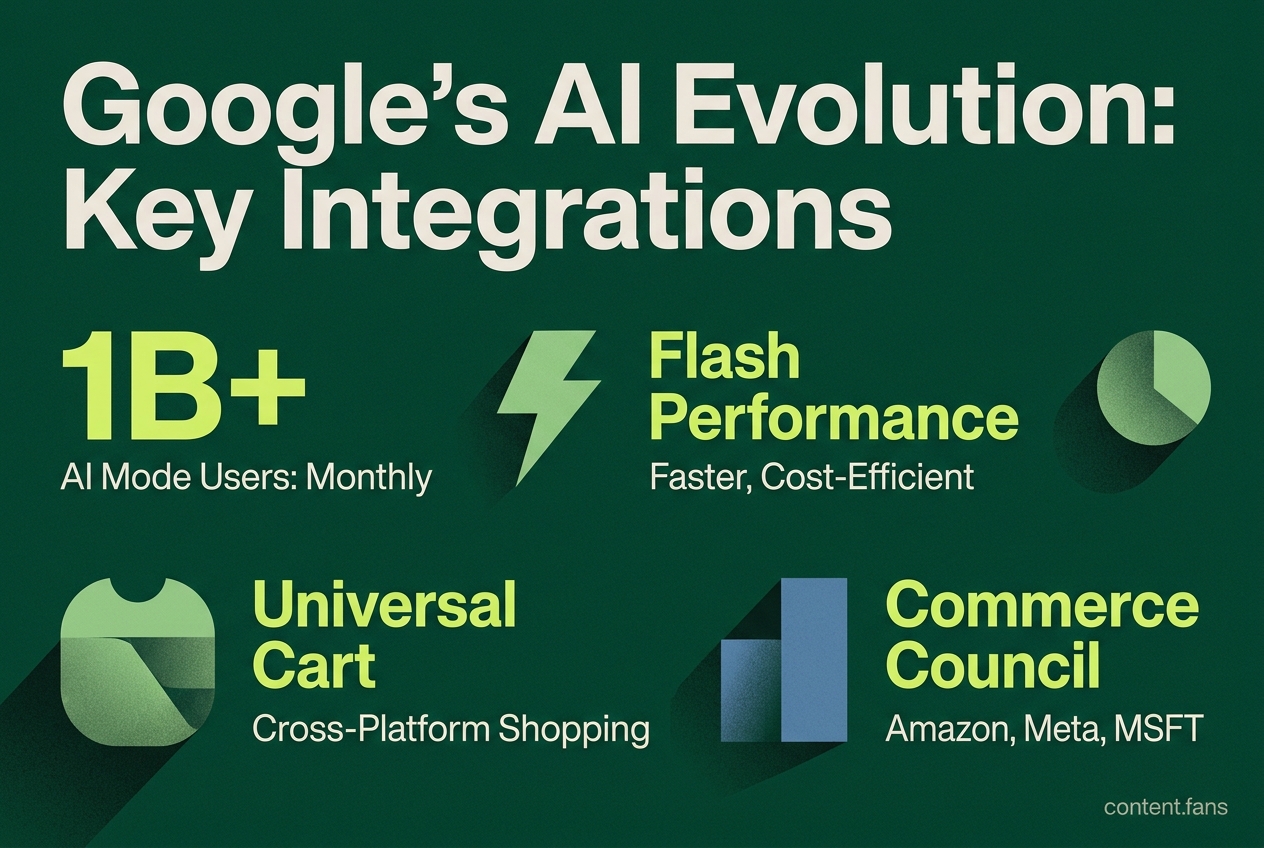
According to industry reports, the redesigned AI Mode in Search now functions as a multimodal input system, capable of ingesting and reasoning across text, images, files, and even active Chrome tabs simultaneously (AdvertisingBusiness.org). Google claims Gemini 3.5 Flash delivers significant performance improvements in speed and cost efficiency compared to competing models, though these figures are vendor-provided. According to industry reports, Flash shows strong performance on tool-use tests, while Opus 4.7 leads in complex coding tasks on SWE-Bench Pro coding benchmark.
Universal Cart Signals a Shift in E-Commerce Protocols
A key commercial feature, Universal Cart, functions as an intelligent, cross-platform shopping basket. It allows users to add items from Search, Gemini, YouTube, or Gmail. After an item is added, background AI agents can monitor for price drops, restocks, and better alternatives. The feature is rolling out first in Search and the Gemini app, with YouTube and Gmail slots to follow.
- Surfaces covered at launch: Search, Gemini app
- Upcoming integrations: YouTube, Gmail (timeframe not specified)
- Safeguards: brand preferences, spending limits, and explicit user approvals for high-risk actions
The feature's significance is amplified by major industry adoption. Competitors and partners including Amazon, Meta, Microsoft, Salesforce, and Stripe have joined the Universal Commerce Protocol council, signaling a potential market-wide shift toward interoperable, agent-driven commerce (Newsfile). This model moves away from individual site checkouts to a protocol-based system where platforms manage the shopping journey.
Gemini Spark Brings Agentic AI to the Enterprise
For the workplace, Google introduced Gemini Spark, a 24-hour personal agent available within the Gemini Enterprise tier on Google Cloud. Gemini Spark is engineered for security and reliability; it executes tasks in isolated VMs, manages recurring workflows via Workspace and custom connectors, and requires user approval for sensitive actions like sending emails or processing transactions (Google Cloud Blog). Enterprise analysts believe this focus on approval-gated autonomy effectively balances delegation with compliance.
Benchmarks: Practical Performance Over Leaderboard Wins
Google's presentation framed its benchmark data as a guide to practical application rather than a claim to absolute superiority. This strategy emphasizes shipping functional agent behaviors over chasing leaderboard rankings. The supported benchmark figures are: SWE-bench Pro 64.3%, OSWorld-Verified 78.0%, and MCP-Atlas 77.3% for Opus 4.7; the sources do not support comprehensive comparison data for Gemini 3.5 Flash across all benchmarks.
While industry reports suggest Gemini 3.5 Flash shows strong performance in multi-step tool use, Claude Opus 4.7 leads in complex coding tasks. Analysts interpret this as a deliberate choice by Google, reinforcing the message that for always-on agents, speed and seamless integration are paramount.
What exactly is AI Mode, and how is it different from regular Google Search?
AI Mode is Google's new default search experience powered by Gemini 3.5 Flash. It now serves a significant number of users globally, representing a substantial portion of people who see these AI-generated answers at the top of their results [3].
Instead of showing ten blue links, AI Mode accepts text, images, files, videos, and even entire Chrome tabs in one query and returns a single synthesized answer. Early tests show this cuts the average time to find information by a significant percentage, according to Google's internal metrics [3].
How does Gemini Spark work in Gmail, YouTube, and Search?
Gemini Spark is described as a 24/7 personal agent that runs quietly in the background. In Gmail it can summarise long threads, draft replies, and surface reminders; in YouTube it can extract product links from videos and drop them straight into your cart; in Search it silently keeps track of price drops or restock alerts for anything you have previously asked about [2].
Each Spark task launches inside its own fresh, isolated virtual machine, and any action that sends email or spends money pauses for explicit user approval, adding a safety gate that reviewers praise as "hands-off yet safe" [2].
What is Universal Cart, and which partners are involved?
Universal Cart is a persistent, cross-platform shopping basket co-developed with Amazon, Meta, Microsoft, Salesforce, and Stripe under the new Universal Commerce Protocol (UCP) council [5].
You can add products from Search results, Gemini chats, YouTube descriptions, or Gmail receipts; the cart then checks for compatibility, price history, and available coupons before final checkout. Google says merchants that opt-in see significant improvements in conversion rates during early trials [3].
How fast and cost-efficient is Gemini 3.5 Flash compared to Claude Opus 4.7?
According to industry reports, Gemini 3.5 Flash shows significant improvements in speed and cost efficiency compared to Claude Opus 4.7 [7].
On multi-step agent tasks, Flash shows strong performance versus Opus 4.7, confirming Google's claim that the model excels at tool-using workflows. However, Opus 4.7 still leads on complex coding benchmarks, so the trade-off is speed and cost versus raw coding depth [7].
What are the privacy implications of sharing data across Search, Gmail, and YouTube for agents and Universal Cart?
Google's new Agent Payments Protocol (AP2) encrypts shopping intent and payment data end-to-end, stores tamper-proof audit records, and lets users set brand preferences and spending limits [2].
Nevertheless, because the Universal Cart aggregates signals from Search queries, YouTube watches, and Gmail receipts, privacy reviewers note that Google gains a much richer behavioural graph unless users opt out of cross-service personalisation [2]. According to industry reports, regulators are seeking increased transparency measures in the coming period.