
Google integrates Gemini 3.5 Flash across Search, Workspace, Android
Serge Bulaev
Google is adding Gemini 3.5 Flash, a new AI tool, to products like Search, Workspace, Gmail, Android, and developer tools. The AI may help users complete tasks and get information in tools they already use every day. Search now lets users send text, images, and tabs, and get custom answers, and there are new ways to check if images are AI-generated. For businesses, Google Cloud has shown a way to use safe, managed AI agents, which may help with security and tracking. Some experts suggest this shows Google wants to put AI everywhere, but there might be challenges in places with strict data rules.

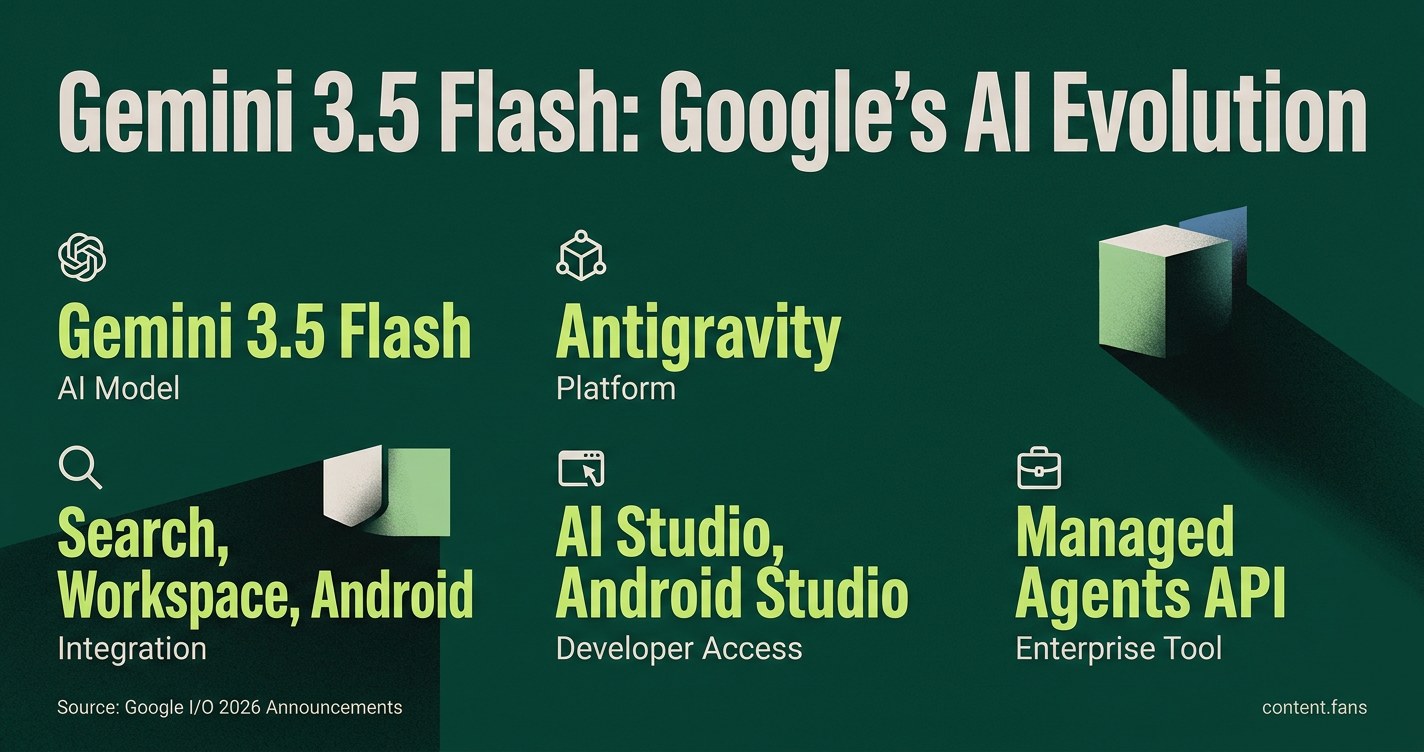
Google is integrating Gemini 3.5 Flash across its entire product ecosystem, including Search, Workspace, Android, and developer tools. This strategic pivot, announced at I/O 2026, transforms Gemini from a standalone chatbot into an ambient AI layer designed to execute tasks within the apps users rely on daily. This move signals a shift from a chatbot destination to an agentic fabric woven throughout Google's consumer and enterprise offerings, all powered by the Gemini 3.5 Flash model via the new Antigravity platform.
Search becomes an agentic interface
Google is embedding its Gemini 3.5 Flash AI model family as an agentic layer across its core products. This initiative aims to shift user interaction from simple question-and-answer exchanges to delegating complex, multi-step tasks that the AI completes proactively within Search, Workspace, and Android.
Search has AI Mode powered by Gemini 3.5 Flash, and Google is adding more multimodal/agentic capabilities, but the specific claim about combining text, image, and Chrome tab inputs to generate dynamic, custom-assembled results is not confirmed by the sources provided. A Google Blog roundup confirms that background agents will monitor the web for subscribers, while new C2PA content-credential tools help verify AI-generated images.
Workspace and Gmail gain Spark
Android and developer tooling tighten the loop
For developers, Gemini 3.5 Flash is accessible via Google AI Studio, Android Studio, and the Antigravity platform. This allows them to integrate the same model powering Search and Workspace into their applications, with new tools for previewing native voice interactions and generating code or visual prototypes from on-device prompts.
Managed Agents for enterprise builders
Google Cloud introduced a preview of its Managed Agents API, providing enterprise builders with a secure, hosted runtime for AI agents. With a single API call, developers can deploy agents capable of reasoning, tool use, and code execution. According to industry reports, key features include capabilities for tool calling, persistent memory, access controls, content verification, and usage analytics.
Early signals and open questions
Industry analysis frames Google's strategy as creating a "distributed agent runtime" across its entire stack - a long-term bet on deep integration over standalone AI products. While this leverages Google's vast user base, analysts note potential adoption challenges related to data security and third-party SaaS restrictions. By mid-2026, the key components are rolling out in public preview or general availability, with access varying by region.
What exactly is Google doing with Gemini 3.5 Flash inside Search, Gmail, Docs, Android, et al.?
Google is turning every major surface into an AI agent layer built on Gemini 3.5 Flash.
- Search includes AI Mode, background information agents for subscribers, and generative UI/custom dashboards, while C2PA-style content credentials are a separate trust-and-safety feature rather than a Search-only image-verification capability.
- Workspace (Docs, Sheets, Drive) gets Gemini Spark, a 24/7 personal agent that drafts content, schedules follow-ups and works after your laptop is closed.
- Gmail shows new live conversational panels that read the thread, context from Calendar and Docs, then propose or even send replies under supervision.
- Android receives native voice support, Gemini 3.5 Flash in Android Studio, plus new APIs for camera, microphone and on-device reasoning.
Bottom line: Gemini stops being a separate chatbot and becomes an always-on operating substrate inside the tools people already use.
Why is Google calling this a pivot from "chatbot to operating layer"?
Because the user experience flips from ask → answer to delegate → monitor.
In early 2025 most AI sat in a browser tab; in 2026 it proactively drafts, schedules, researches and takes action across apps.
According to industry reports, agentic workflows are among the key ways AI will transform work, with many organizations still citing security as a primary concern.
The shift is strategic - embedding agents boosts daily stickiness because users never have to leave Search or Gmail to get AI help.
What are the most concrete workflow changes users will notice?
- Search evolves from a query box into a multi-modal canvas: paste a video, upload a PDF, or drop a spreadsheet and instantly receive auto-generated charts, source links and next-step suggestions.
- Gmail conversations now surface buttons like "Spark draft → Sheets report → Calendar invite in one thread.
- Docs Live lets you speak an idea and watch Gemini convert it into a structured brief while you continue the meeting.
- Background agents track web pages or drive folders and alert you only when thresholds you set are crossed (new competitor pricing, document edits, etc.).
Early testers in Google's Croud case study cut research + strategy tasks from multi-day handoffs to one click (Google Cloud).
What are the biggest barriers and criticisms?
| Barrier | What analysts say |
|---|---|
| Entity harmonization | Resolving customer data across CRM, ERP, and support systems remains a significant technical challenge |
| Security perimeter | If sensitive data must leave a SaaS vendor's boundary to reach Gemini, enterprises may reject it on procurement grounds |
| Hallucination risk | With agents now acting, confidence doesn't equal accuracy; Google still warns users to verify critical information |
| Vendor lock-in | The richest experience requires multiple Google services - a friction point for multi-cloud organizations |
How are Microsoft, OpenAI and others expected to respond?
Industry observers expect competitive responses across the market:
Microsoft is likely to deepen Copilot integration across Teams, Outlook, and Azure while emphasizing enterprise trust and hybrid cloud capabilities to offset Google's vertical stack advantage.
OpenAI may focus on expanding their custom GPT marketplace and improving code interpreter quality, while pushing platform-agnostic APIs so agents work inside any SaaS platform.
Anthropic and others are expected to emphasize safety features, audit capabilities, and compliance-ready agents to attract regulated industries.
Overall, the market appears to be splitting into platform agents that live inside existing suites versus specialized agents focused on specific verticals like legal, sales, or finance.