
Google DeepMind CTO Unveils AI Strategy for Gemini 3.5, Agentic Software
Serge Bulaev
Koray Kavukcuoglu, Google DeepMind's CTO, will talk about AI model development and product integration at an event in San Francisco in September 2026. He may discuss topics like agentic AI, instruction following, multimodal media, and safety-first engineering, which he has mentioned before. The event appears to focus on new AI research and how it is used in products, including comparisons between big labs like DeepMind and smaller startups. Kavukcuoglu's team is updating the Gemini AI models every six months, guided by user feedback from billions of interactions. There may also be discussion about how talent and ideas are flowing between large tech companies and startups, and about the challenges both face with scaling, cost, and safety.

Google DeepMind CTO Koray Kavukcuoglu is set to unveil a new AI strategy centered on Gemini 3.5 and agentic software at an upcoming AI conference. The chief technology officer's presentation will detail generative AI development and product integration, providing a crucial look at Google's frontier research roadmap.
The gathering positions Kavukcuoglu alongside startup leaders. This unique format offers a direct comparison between the full-stack research approach of a major lab like DeepMind and the specialized strategies of emerging "neolabs."
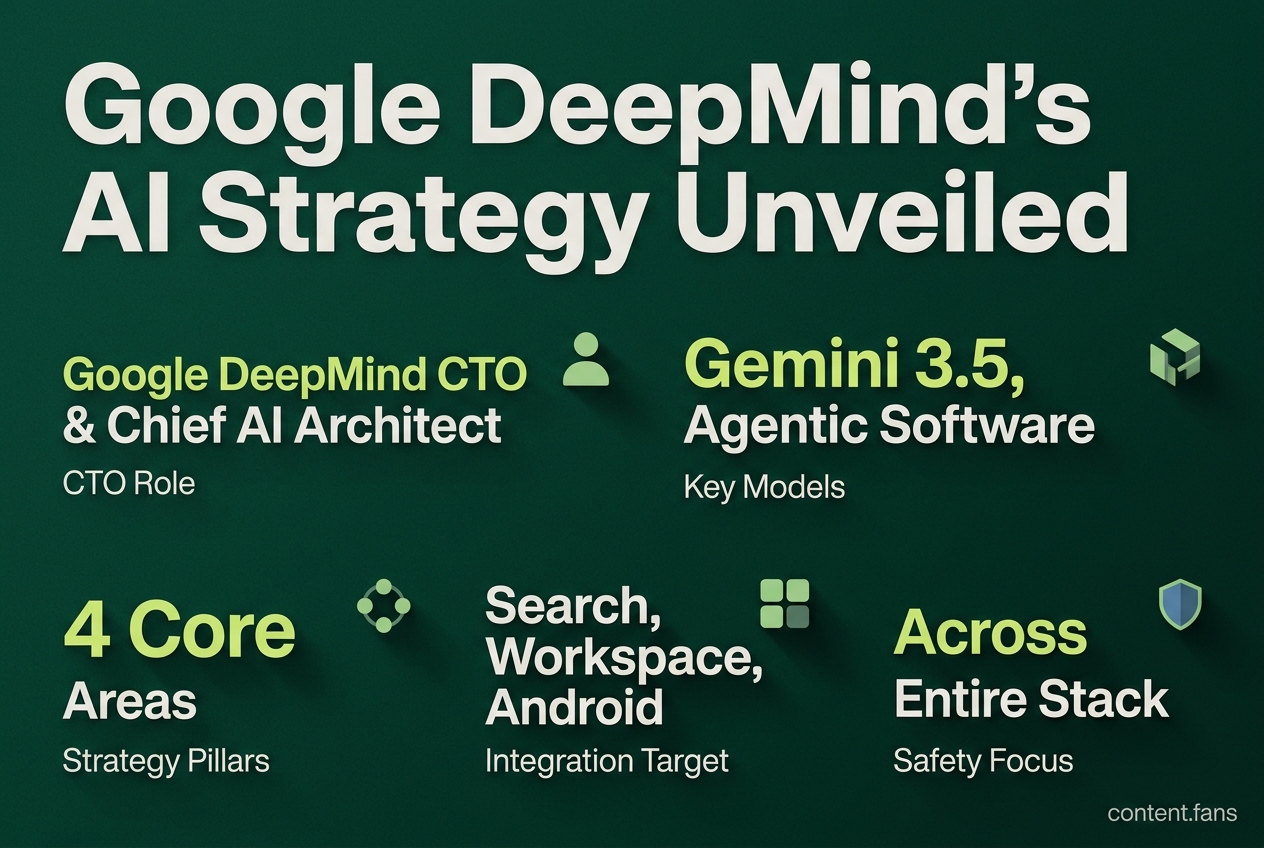
Koray Kavukcuoglu's dual mandate at Google
As Google DeepMind's CTO and Google's Chief AI Architect, Koray Kavukcuoglu oversees both frontier AI research and its practical application. According to industry reports, his expanded role focuses on accelerating the integration of advanced models like Gemini into products such as Search, Workspace, and Android for billions of users.
Kavukcuoglu holds the dual positions of CTO at Google DeepMind and Chief AI Architect for Google. Industry reports suggest his mandate involves accelerating the pipeline from frontier models to key products. According to industry sources, he has outlined upgrade cycles for the Gemini models, driven by feedback from user interactions.
Strategy pillars he has highlighted
According to industry reports, Kavukcuoglu's strategy revolves around key pillars he is expected to detail further:
- Agentic AI: Developing models that can plan, utilize tools, and automate complex, multi-step workflows.
- Instruction Following & Internationalization: Fine-tuning models to understand nuanced user prompts and adapt to regional norms.
- Multimodal Generative Media: Creating unified models that can process and generate text, images, video, and code seamlessly.
- Safety-First Engineering: Implementing robust safety controls across the entire stack, from custom TPUs and data centers to user-facing products.
Industry reports suggest he has positioned Gemini 3.5 Flash as focused on "coding capability and agentic workflows." Panel summaries also indicate that generative media is a core pillar of the strategy, not a peripheral experiment.
What he is expected to share
The event agenda highlights key discussion themes, all of which align with Kavukcuoglu's recent work and Google's strategic initiatives:
- Frontier Architectures: According to industry reports, Gemini models have achieved new benchmarks and introduced reasoning capabilities for researchers.
- Enterprise Adoption: Google is integrating Gemini into core products like Search and NotebookLM to analyze real-world usage patterns and gather feedback.
- Open vs. Proprietary Systems: Industry sources suggest the release of APIs for models enables startups to build on Google's foundation.
- Agentic Software: Recent internal demonstrations have showcased Gemini creating interactive educational widgets directly within Workspace documents.
Big labs and neolabs on one stage
The conference will also feature speakers like former OpenAI research VP Jerry Tworek and humans& co-founder Eric Zelikman. Their companies represent the "neolab" model - specializing in niche problems while leveraging APIs from major labs. This speaker lineup suggests the event aims to foster a direct comparison between DeepMind's integrated approach and the modular strategies of agile startups.
The discussion is expected to be substantive, moving beyond a simple "big vs. small" debate. A recent CNBC report on the two-way flow of talent between Google and smaller labs highlights that both face common challenges in model scaling, inference costs, and safety protocols.
What role does Koray Kavukcuoglu play inside Google DeepMind and across Google products?
Koray Kavukcuoglu serves as both the CTO of Google DeepMind and Chief AI Architect at Google. As CTO, he leads generative AI research; as Chief Architect, he guides the integration of these models into products like Search, Workspace, and Android. According to industry reports, he is responsible for shipping Gemini 3.5 and its subsequent updates.
What is the generative-AI strategy that Kavukcuoglu has outlined?
According to industry sources, Kavukcuoglu's generative AI strategy is built on core pillars:
- Agentic AI: Models capable of planning, using tools, and reasoning across various services.
- Instruction following & internationalization: Ensuring Gemini 3.5 can process nuanced, multilingual prompts and adhere to local safety standards.
- Multimodal generative media: Treating image, video, and audio generation as core functionalities, not afterthoughts.
- Safety-first, full-stack integration: Embedding security measures from the silicon level (TPUs) up to the end-user interface.
This strategy is implemented through rapid iteration, where each Gemini release addresses needs identified from user interactions in Google products.
How is Gemini 3.5 Flash different from earlier releases?
Gemini 3.5 Flash, the first model in the 3.5 series, is reportedly optimized for key areas:
- Coding and agentic workflows: Enabling interactive widgets, live simulations, and automated multi-step processes.
- Ultra-low latency: Designed for real-time applications like NotebookLM and the new Search generative experience.
- API-first pricing: Offered at lower token costs than previous models to encourage adoption by startups and the "neolab" ecosystem.
How does Google plan to reach AGI according to Kavukcuoglu's roadmap?
Kavukcuoglu emphasizes that Google DeepMind does not yet have a clear path to AGI. Instead, the strategy focuses on a continuous Research × Engineering × Product feedback loop:
- Real-world signals: User interactions within Search, Gmail, and Chrome directly inform which capabilities to prioritize.
- Rapid release cycles: This allows the lab to quickly translate user signals into model improvements.
- Generalized learning: The system is designed to learn across different domains (e.g., from protein folding to coding) without needing task-specific retraining.
He stresses that the ultimate measure of success for AGI is being "useful for the users," rather than simply outperforming benchmarks.
Where and when will Kavukcuoglu share deeper technical details in public?
According to industry reports, Kavukcuoglu is expected to share more technical details at upcoming AI conferences. He is expected to speak on tracks including frontier architectures, enterprise AI adoption, and open versus proprietary AI systems.