
Google Cloud Hires Hundreds of Engineers to Boost Enterprise AI Adoption
Serge Bulaev
Google Cloud is hiring hundreds of engineers to help more businesses use AI, especially with its Gemini models and other tools. The company says demand for hands-on help is growing quickly, and it appears that helping customers with integration issues may be more important than improving the AI models themselves. Google is also making deals with large private equity firms so that many companies in their portfolios can access these AI tools under one contract. Job descriptions suggest these engineers will help solve problems, share lessons, and support customers directly. The hiring effort is ongoing and may help Google show that close support, not just new features, is key to getting businesses to use AI.

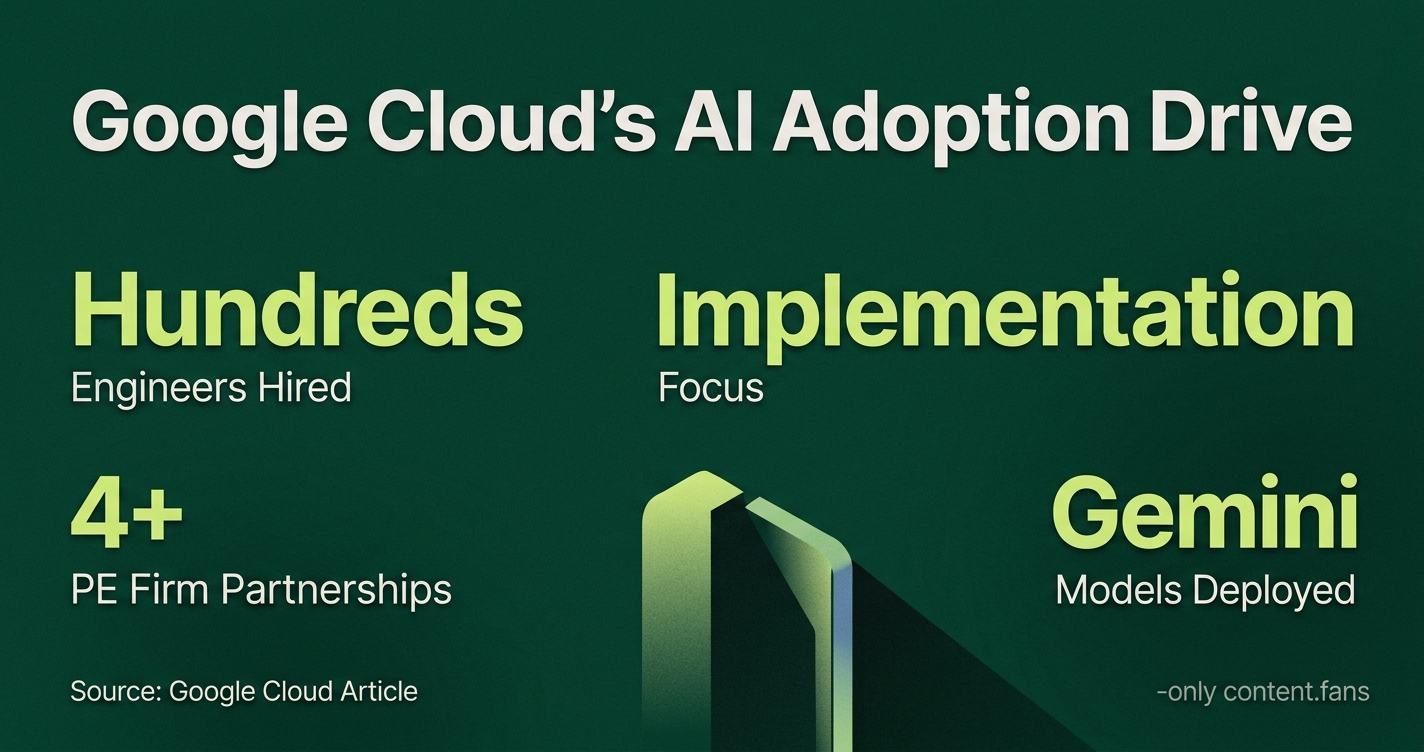
In a significant move to accelerate enterprise AI adoption, Google Cloud is hiring hundreds of specialized engineers to help businesses deploy its Gemini models and platform tools. This strategic hiring sprint signals a pivot toward hands-on implementation support, addressing the growing demand from customers who face complex integration challenges. Google's focus suggests that overcoming deployment roadblocks is now a higher priority than simply advancing the AI models themselves.
Why Google is Expanding Its Forward Deployed Engineer Roster
Google is hiring hundreds of Forward Deployed Engineers (FDEs) to embed directly with customers and bridge the gap between AI pilots and production systems. These technical specialists solve complex integration issues, address data readiness, and overcome legacy system hurdles that commonly stall enterprise AI initiatives.
According to industry reports, demand for hands-on support is growing rapidly. Job postings for a "Forward Deployed Engineer II, GenAI" call for an "embedded builder" to connect cutting-edge AI products with customer infrastructure (Google Careers). The goal is to tackle common production roadblocks, including:
- Integrating with legacy systems that lack clean data streams.
- Navigating security reviews for regulated industries.
- Managing workflow changes and staff retraining.
- Orchestrating AI agents across multiple tools.
- Establishing monitoring and cost governance for live models.
This strategy of deploying on-site engineers, while on a much larger scale, mirrors similar initiatives by competitors like OpenAI and Anthropic, highlighting an industry-wide shift toward implementation services.
Scaling Distribution Through Private Equity Partnerships
Alongside the engineering expansion, Google Cloud is pursuing an aggressive distribution strategy by partnering with major private equity firms. These "omnibus licensing agreements" provide entire portfolios of companies with access to Google's AI stack under a single contract, bypassing individual sales cycles.
Key partnerships include:
- Vista Equity Partners: A multiyear deal provides Vista-owned companies with streamlined access to Gemini models, Gemini Enterprise, and dedicated FDE support.
- CVC Capital Partners: A similar agreement extends Google's AI tools to CVC's portfolio of retail, healthcare, and industrial companies.
- Blackstone and KKR: Both firms are reportedly in talks for portfolio-wide deals to grant their companies access to Google's AI models.
This approach allows Google to quickly seed its technology across entire business ecosystems.
Fueling Adoption with Significant Partner Investment
To support these large-scale rollouts, Google Cloud has established a substantial AI adoption fund. The capital is designated to subsidize the costs of consulting and systems integration partners who help customers move from pilot projects to full-scale production. The fund will cover essential implementation work, such as data engineering, security framework construction, MLOps pipeline development, and change management.
Shifting from Sales Pitches to Engineering Execution
This strategic pivot emphasizes a clear shift in Google Cloud's go-to-market priorities. According to industry reports, leadership has indicated a greater need for deep technical capacity than for traditional sales roles. The focus is now on engineering execution to drive revenue.
FDE job descriptions reinforce this, stating that engineers will "identify repeatable patterns" and serve as a "critical feedback loop" for product teams (Google Careers). By embedding engineers on-site, Google aims to use field learnings to refine its Gemini models for specific industries like healthcare and finance, proving that hands-on support is the key to unlocking enterprise AI.