
Google Antigravity 2.0 expands enterprise AI agents with 1M-token windows
Serge Bulaev
Google announced Antigravity 2.0, a tool that helps companies use AI agents without building their own control systems. Analysts say this is Google's answer to Anthropic Managed Agents, with Google focused on bigger context size and connections to its cloud, while Anthropic aims for more safety. Antigravity 2.0 may allow agents to handle much larger tasks and data, but costs and control issues are not guaranteed to be easy. Experts suggest companies might need to pick between bigger, more flexible tools and safer, more careful ones, and warn about getting locked in to one platform. No official numbers show how many businesses are using these tools so far.

Google Antigravity 2.0 is reshaping the enterprise AI agent landscape by hiding complex orchestration code, allowing teams to launch production-ready agents without building a control plane. The platform is introduced in Google's own blog materials and codelabs, positioning it as a direct competitor to Anthropic's Managed Agents, creating a clear choice for businesses between massive scale and cautious safety.
Antigravity 2.0 vs. Anthropic: A New Race for AI Supremacy
Google Antigravity 2.0 is a managed service that provides the infrastructure for building and deploying AI agents. It focuses on large-scale data processing with massive context windows and deep integration into the Google Cloud ecosystem, removing the need for teams to write their own orchestration code.
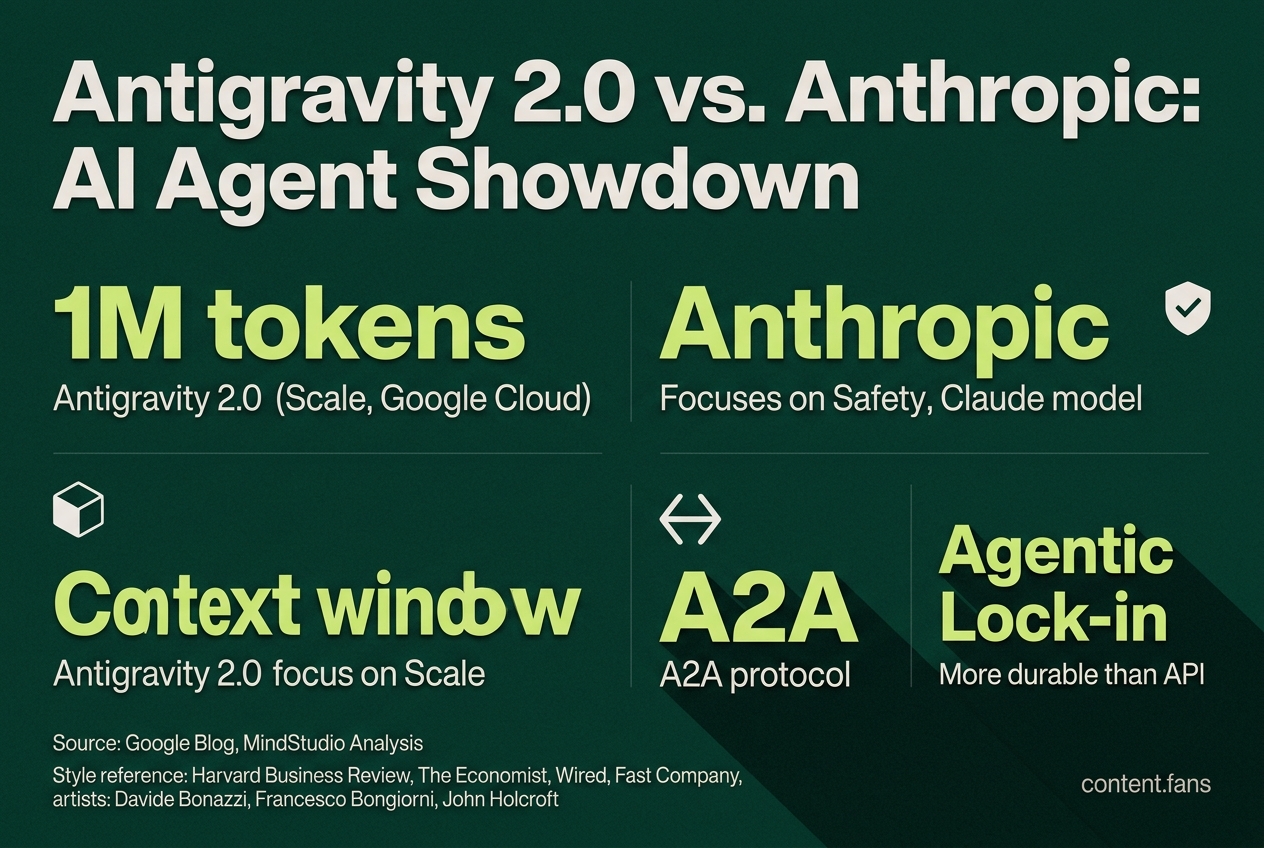
Analysts frame the platform race as a strategic split. A MindStudio analysis highlights that Google is optimizing for large context windows and tight Google Cloud integration, while Anthropic centers its offering on the safety and conservative tool use of its Claude model. This creates a distinct tradeoff for enterprises. Antigravity 2.0's A2A protocol supports one-million-token context windows, ideal for processing large document sets, video, or audio. In contrast, Anthropic's MCP protocol offers substantial context capabilities, though with different optimization priorities.
The Hidden Costs and Tradeoffs of Enterprise AI Agents
While managed platforms promise to accelerate production, the financial benefits are not guaranteed. Industry reports suggest that teams can achieve significant project compression and cost reductions using repeatable patterns, though other data reveals hidden expenses. According to industry analysis, a significant portion of infrastructure spending on agent projects comes from orchestration and observability, pushing the total cost of ownership (TCO) to multiple times the initial API estimates. This explains why some pilots launch quickly while others face extended delays.
Navigating Governance and Vendor Lock-In
Governance has emerged as a critical concern. When a single platform controls an agent's identity, memory, and policy enforcement, switching vendors later can become prohibitively expensive. Experts warn that agentic lock-in is "more durable than API lock-in" because it spans multiple layers of the tech stack. To mitigate this risk, analysts advise using framework-agnostic designs or ensuring platforms support standards-based protocols like MCP or A2A for long-term portability.
Expert guidance consistently includes a core checklist for enterprises:
- Verify complete audit trails for all non-human identities.
- Map data proximity rules before committing to a workload.
- Demand policy enforcement at the connector level, not just model guardrails.
- Test clear migration paths between different models and cloud regions.
Following these steps has been shown to reduce delays during critical security and compliance reviews.
Key Market Signals and Future Outlook
Currently, Anthropic's MCP shows broader protocol adoption, while Google's A2A is positioned for future multi-vendor interoperability. The market is becoming intensely competitive, with platforms like Vertex AI Agent Builder, Microsoft Copilot Studio, and IBM watsonx Orchestrate entering the same managed agent category. While observers are closely tracking market share, comprehensive adoption numbers for either platform remain limited in public reporting. The evidence suggests a rapidly evolving field where platform decisions are increasingly shaped by engineering costs, governance needs, and long-term flexibility.
What exactly did Google announce and why are enterprises paying attention?
Google has introduced Antigravity 2.0, a managed service that turns Gemini's 1-million-token context window into ready-to-run enterprise agents. Instead of asking IT teams to stitch together orchestration, memory and connectors, Google now hosts the entire lifecycle inside Vertex and Workspace, letting a single agent ingest entire code repos, policy manuals or quarterly filings in one shot. Industry reports suggest significantly reduced pilot-to-production cycles compared to previous deployment timelines. The immediate draw is engineering-hours saved: no standing up frameworks like LangGraph or CrewAI; developers wire Google-hosted tools and the platform handles parallel execution, retry logic and audit trails.
How does this differ from Anthropic's Managed Agents approach?
Both suites promise "zero-to-production" agents, but they optimize for opposite pain points.
- Anthropic keeps the Claude model at the center: substantial context capabilities, conservative tool-use and built-in constitutional AI guardrails. That makes it popular among health-care, legal and finance teams that need traceable reasoning.
- Google bets on breadth: the 1M-token Gemini window, native multimodal support (slides, video, SQL dumps), and connectors to BigQuery, Gmail, Drive and Chrome Enterprise. If your stack already lives in Google Cloud, agents inherit IAM roles and VPC-Service-Perimeter rules, cutting integration cost.
In short, pick Anthropic when regulatory proof outweighs speed; pick Antigravity when data gravity is inside Google Cloud and you need scale.
What are the lock-in and governance realities buyers raise in enterprise evaluations?
Because Antigravity owns runtime, memory, tool routing and policy, buyers worry that deeper adoption now equals higher switching cost later. Expert consensus from industry analysis:
- Agent-level lock-in is stickier than classic API lock-in - model, orchestration and dev patterns accumulate in one stack.
- Governance gaps live at the connector layer: many early deployments trust agent tool calls by default and ship audit logs only to Google's Cloud Audit, not to external SIEMs.
Enterprise security teams are therefore pressing for model-agnostic control planes (CrewAI, LangGraph) or at minimum MCP-compatible gateways so agent actions can be enforced by a third-party policy engine.
Where are teams seeing measurable cost or cycle-time wins?
Industry reports from field deployments:
- Enterprise case studies: show significant project compression and substantial cost reductions in AI build processes.
- Industry benchmarks: observability and orchestration now represent a significant portion of total TCO, dwarfing raw model API fees. Platforms that bake observability in (Google, Microsoft, Salesforce) therefore compress multi-vendor line items into one subscription.
- Analysis frameworks show integration and talent buckets remain heavy; platforms only save money when workflow volume is high enough to amortize license uplift.
In practice, document-heavy, high-volume workflows (claims, support tickets, policy updates) show clearest ROI, while low-volume, high-custom logic apps still favor framework-agnostic builds.
How should procurement score Antigravity 2.0 on an RFP?
Enterprise scorecards typically evaluate multiple key vectors:
-
Governance & audit
Does the platform stream agent action logs to customer SIEM and support fine-grained RBAC beyond Google's IAM? -
Connectors & ecosystem
Out-of-box connectors to SAP, Salesforce, Workday, ServiceNow; is the vendor willing to co-develop new ones under SOW? -
Observability & DevOps fit
Are traces, latency heat-maps and tool-failure retry surfaced in Cloud Monitoring and third-party Grafana? -
Pricing portability
Is runtime sold per-seat, per-agent-hour or per-consumed-token? Can licenses be reparked if agents are retired? -
Exit & port
Does the vendor guarantee MCP or A2A export of agent graphs, memory and policy? Is there a documented off-boarding runbook?
Antigravity scores high on ecosystem fit and metered token pricing, but neutral on exit guarantees until A2A standard is GA. Leading enterprises are therefore piloting inside non-critical workflows and writing portability clauses into master services agreements rather than defaulting to vendor paper.