
GitHub sees 17M agent PRs in March 2026, commits surge
Serge Bulaev
GitHub saw a big rise in code changes made by autonomous agents, with about 17 million pull requests in March 2026. The number of commits may reach 14 billion this year if the current growth continues, but experts warn this might not last. This surge is making GitHub's systems work much harder, causing more incidents and a need for greater capacity. GitHub is adjusting its plans to handle the growth, focusing on new tools and better controls. Reports suggest that while code is being delivered faster, it may come with more warnings and duplicate code.

A surge in AI agent-generated code is testing GitHub's limits, with the platform handling a significant increase in pull requests from autonomous agents. This explosion in automated commits is reshaping software development, creating both unprecedented velocity and significant infrastructure strain.
The Scale of the Surge: A Look at the Numbers
GitHub is experiencing exponential growth in AI-driven activity. According to industry reports, autonomous agents are generating substantially more pull requests than in previous periods. Concurrently, weekly commits have surged significantly, with projections suggesting massive annual growth compared to previous years.
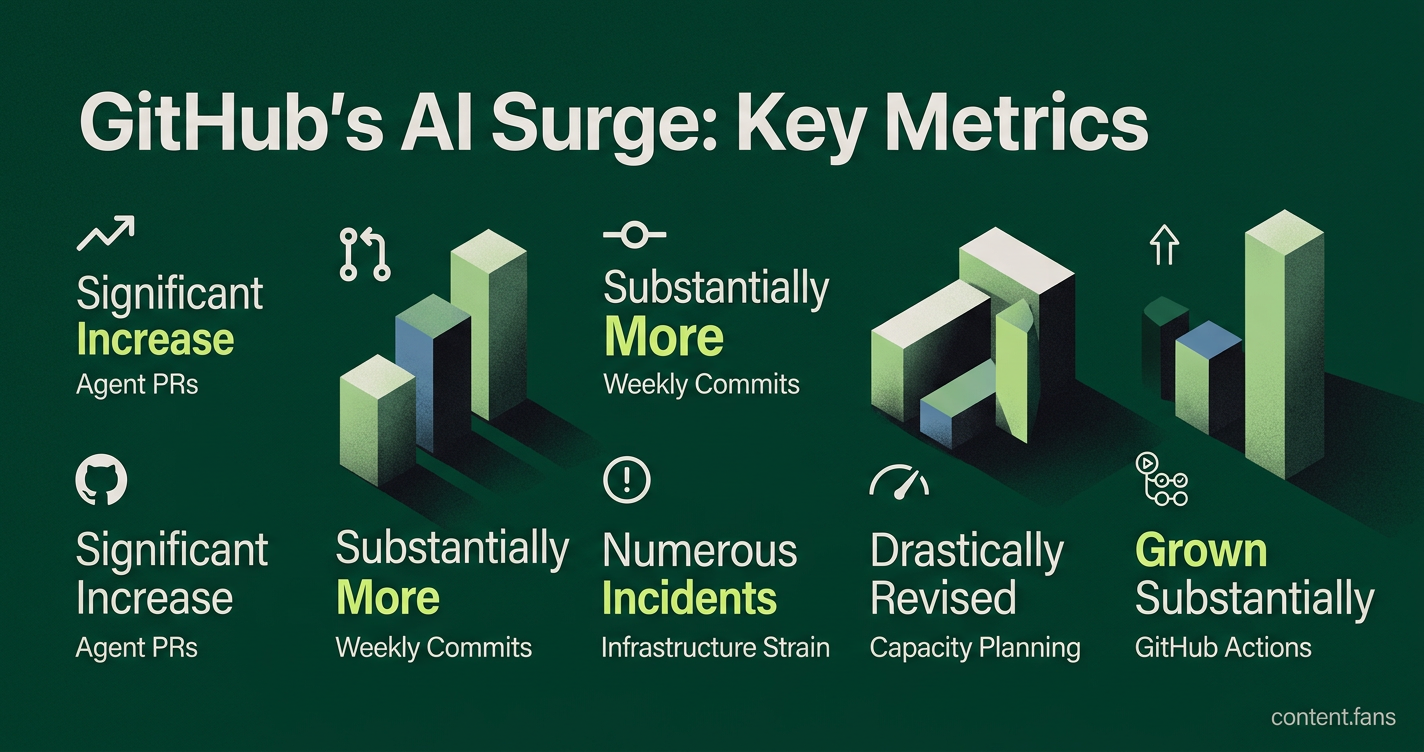
According to GitHub COO Kyle Daigle, the platform is processing substantially more commits per week, a massive increase from previous totals. Daigle cautioned that while this pace could theoretically lead to enormous commit volumes this year, such linear growth is unlikely to hold, a point highlighted on Simon Willison's weblog. Agent-initiated pull requests have climbed sharply as well. Meanwhile, GitHub Actions workloads have grown substantially, according to industry reports including the Times of India tech desk.
Infrastructure Under Strain
The massive increase in activity has visibly strained the platform. GitHub's internal teams are responding to a system where usage continues to set new records. This stress has manifested in significant operational challenges:
- The platform has experienced numerous incidents in recent months.
- Capacity planning has been drastically revised, with requirements growing far beyond initial projections.
Balancing Velocity, Quality, and Governance
In response, GitHub's roadmap prioritizes new tools and controls to manage the influx of AI-generated code. Near-term priorities include the Copilot CLI, dedicated agentic workflows, and enhanced enterprise governance to balance development velocity with code quality. This is critical, as industry reports note that while agent-driven development accelerates tasks, it can also lead to more static-analysis warnings and duplicate code. The current trend points toward a future of human-supervised code generation, with developers managing more reviews as GitHub races to stay ahead of its increasingly autonomous users.
How much has agent activity grown on GitHub?
According to industry reports, a significant number of pull requests are now being opened by autonomous AI agents on GitHub, representing substantial growth from previous periods. This leap mirrors an even broader explosion in total commits: weekly volume has climbed significantly, putting the platform on track for massive annual commit volumes if growth patterns continue (GitHub's COO Kyle Daigle stresses linear growth will not hold). For context, GitHub has reported substantial year-over-year growth in total commits.
What is driving this surge in AI-driven commits?
The driver is a shift from code suggestions to delegated execution. GitHub's investment in Copilot coding agent, Copilot CLI, and Agentic Workflows now lets agents open PRs, run CI, and merge approved changes without constant human oversight. As Daigle summarized, "agentic development becomes real," moving GitHub from a repository platform to the control plane for AI agents inside enterprises.
Is the infrastructure keeping up?
Not yet. Daigle admits the platform is "visibly strained", experiencing numerous incidents in recent months. GitHub has had to significantly revise capacity planning, with requirements growing far beyond initial projections. Concurrently, GitHub Actions compute time has grown substantially, underscoring the load automated agents add to every build and test cycle.
How is code quality affected?
Quality is mixed. Industry reports show significant improvements in completion of routine coding tasks and a substantial portion of boilerplate commits now handled by agents, but also higher bug density and more security vulnerabilities per line when reviews slip. The pattern: agents excel on well-scoped, modular work with strong test coverage, yet can amplify defects on complex or ambiguous tasks that lack rigorous human review.
What is GitHub doing next?
GitHub's roadmap focuses on velocity, quality, and governance:
- Deeper agentic integrations across every DevOps surface
- Expanded model choice with intelligent routing to keep latency low
- Enterprise-grade governance so organizations can adopt AI agents "confidently at scale"
The company continues to position itself as a leader in enterprise AI coding solutions, underscoring its intent to own the agentic software lifecycle rather than just host the code.