
German Court Rules Google Liable for AI Overviews' False Statements
Serge Bulaev
A German court ruled that Google is responsible for false statements created by its AI Overviews, which wrongly linked two publishers to scams. The court said these AI-generated summaries are Google's own content, not just search results, and users were not warned that the summaries could be wrong. Google must stop showing the disputed text and pay most of the legal costs, with high fines possible for repeat offenses. Experts suggest this decision may lead to more careful checks and warnings in AI products, and it may signal more legal challenges for generative AI services in the future.

The landmark case where a German court ruled Google is liable for its AI Overviews' false statements has sent shockwaves through the tech industry. The Landgericht München I issued a preliminary injunction in 2024, establishing a significant European precedent that treats generative AI output as a platform's own speech, not protected third-party content. The ruling stemmed from two AI summaries that falsely linked Munich-based publishers to scams and "dubious business practices," claims that were entirely absent from the cited source materials.
Why the Court Held Google Responsible
The court found Google responsible because it authors the AI-generated text within its own systems. Unlike traditional search results that link to external content, AI Overviews create new, independent statements, making Google the publisher and stripping it of safe-harbor protections for neutral hosts.
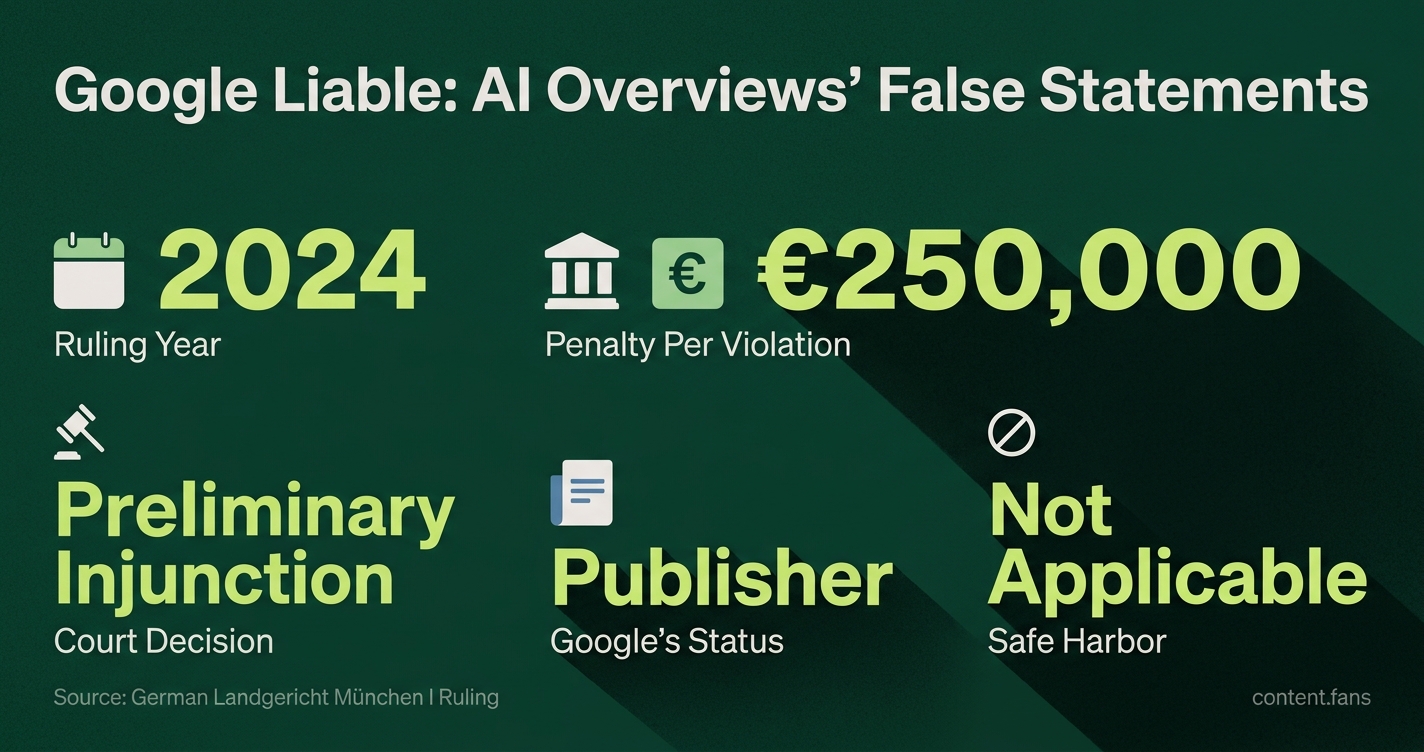
The court differentiated AI Overviews from traditional search results, which simply point to external content. In its judgment, the court stressed that Google is not a neutral host in this context. The ruling highlights three core arguments:
- Own Content: Because the summaries are generated within Google's own system, the company is the direct author and publisher of the content.
- No Safe Harbor: Protections for neutral intermediaries under the EU Digital Services Act do not apply to original content created by the platform itself.
- Lack of Disclaimer: Users were not sufficiently warned that the AI-generated information could be inaccurate or fabricated.
Coverage from The Next Web reinforces this, noting the court characterized the Overviews as "independent, new, and substantive statements" for which Google has "sole influence."
Immediate Legal Consequences and Penalties
The preliminary injunction imposes immediate and severe consequences on Google. The company is required to cease distributing the false statements and must cover a significant portion of the legal costs. Furthermore, the court established a strong deterrent for non-compliance, with potential fines of up to €250,000 per violation. In extreme cases, the order even allows for custodial sanctions against responsible managers. Although Google has filed an appeal, it has not sought a stay, meaning the takedown order remains fully in effect. Legal experts cited by DW view this as a signal of stricter regulatory scrutiny for generative AI services across the European Union.
Industry Reaction and a Shift Toward Defensive Design
This German ruling is being closely analyzed by product teams, who see parallels to ongoing debates about platform liability, such as those surrounding Section 230 in the US. Analysts contend that rising liability risks are compelling companies to adopt "defensive architecture." This involves implementing stricter controls and greater transparency, including:
- Enhanced pre-deployment fact-checking, especially for high-risk topics.
- Hybrid moderation systems that combine AI with human reviewers and clear escalation paths.
- Visible metadata and labels to clearly identify synthetic content.
- Detailed audit logs to demonstrate that "reasonable measures" were taken to prevent harm.
While these safeguards can mitigate legal exposure, experts warn they also introduce latency and increase operational costs for real-time AI assistants.
Broader Implications for Future Generative AI Cases
While German civil-law rulings do not set binding precedents, their persuasive influence is significant. This decision sends three powerful signals to the AI industry:
- Courts are prepared to define AI-generated text as a company's own speech when the system autonomously reformulates information.
- Legal safe harbors designed for hosting third-party content are unlikely to protect companies from liability for their own generative models.
- The barrier to litigation is lowered, as plaintiffs can sue over specific false outputs rather than challenging an entire AI product.
Google's appeal will be critical in determining the final legal standard, but the core finding - that providers are directly responsible for their AI's output - is unlikely to be overturned. The Munich injunction is a clear warning that "the AI made a mistake" is no longer a viable legal defense.
What Exactly Did the Munich Court Rule?
The Munich I Regional Court (Landgericht München I) issued a preliminary injunction establishing that Google is directly liable for false information produced by its AI Overviews. The court dismissed the idea that users can simply check the sources, stating that the opportunity to disprove a claim does not absolve the original publisher. This landmark decision is the first in Europe to treat generative AI output as a platform's own speech, removing the "neutral intermediary" protections of the Digital Services Act.
What False Claims Triggered the Lawsuit?
The case was initiated after two publishers in Munich found that Google's AI Overviews falsely accused them of engaging in scams, subscription traps, and "dubious business practices." Vitally, these defamatory claims did not exist in any of the source articles linked below the AI summary. The court determined the language was invented by the model and, by presenting it without a disclaimer, Google exercised "sole influence" and acted as the content's author and publisher.
What Penalties and Compliance Steps Were Ordered?
The court-ordered injunction mandates several immediate actions and sets steep penalties for non-compliance:
- Cease and Desist: Google must immediately stop displaying the specific defamatory AI-generated text about the publishers.
- Cost Sharing: Google is responsible for a significant portion of all court and legal fees.
- Future Fines: Any future violation of the injunction could result in fines up to €250,000 per instance or potential custodial sanctions for company managers.
As a preliminary injunction, the order is enforceable immediately, even while Google's appeal is pending.
How Does This Ruling Affect Other Generative AI Products?
The ruling signals a significant shift, challenging the common "AI was wrong" defense. The emerging legal consensus in the EU, US, and UK is that the provider of a generative model is responsible for its output. In response, tech companies are already implementing:
- Defensive Architecture: Building tighter prompt filters and adding human review for sensitive topics.
- Provenance Tagging: Using watermarks and labels to clearly identify AI-generated content.
- Versioned Audit Logs: Keeping detailed records to prove reasonable care was taken in moderation and content generation.
These measures reflect a fundamental change where liability is shifting from the end-user to the model's operator.
What Should Businesses Using Generative AI Do Now?
Businesses integrating or operating generative AI systems should take proactive steps to manage this new liability landscape:
- Map Your Exposure: Identify all public-facing AI features that reformulate content and treat their output as your own official publication.
- Strengthen Testing: Implement adversarial testing to find and log potential hallucinations before a product is deployed.
- Embed Clear Warnings: Display prominent disclaimers stating that AI output may contain inaccuracies, aligning with emerging transparency standards like the EU AI Act.
- Document Moderation: Create and maintain incident response plans to ensure any false output can be corrected and documented rapidly.
- Monitor Legal Developments: Google has confirmed it will appeal the decision. The outcome could establish even stricter standards, so staying informed will help reduce future compliance costs.