
Gensyn Launches Delphi Mainnet, AI-Powered Info Market Moves On-Chain
Serge Bulaev
Gensyn has launched Delphi, an AI-powered information market, to the mainnet as of April 22, 2026. The platform lets people create and trade on prediction markets where AI, not humans, decides outcomes, which may help reduce the chance of manipulation. Market creators get paid a share of trading fees, while Gensyn collects a small fee that will be used with a future AI token. It appears that early testing saw strong use, but the full system is not complete until the token launches. Some traders may be waiting for more proof of how well settlements work before using the platform more widely.

Delphi, a novel AI-powered information market, launched on mainnet with invite-only creator access and trading open; full permissionless access expanding soon. This marks a significant development for on-chain prediction markets. The decentralized platform enables users to create and trade on markets where outcomes are settled exclusively by verifiable AI, not human arbiters. This design aims to minimize manipulation risk and empower creators to directly monetize their insights without centralized gatekeepers.
How Delphi Works on Chain
Gensyn's Delphi is a decentralized information marketplace where users trade on the outcomes of future events. Unlike traditional prediction markets, Delphi uses verifiable smart oracles for settlement with AI models determining market outcomes, eliminating human arbitration. The platform runs on an Ethereum Layer 2 for low-cost, transparent transactions.
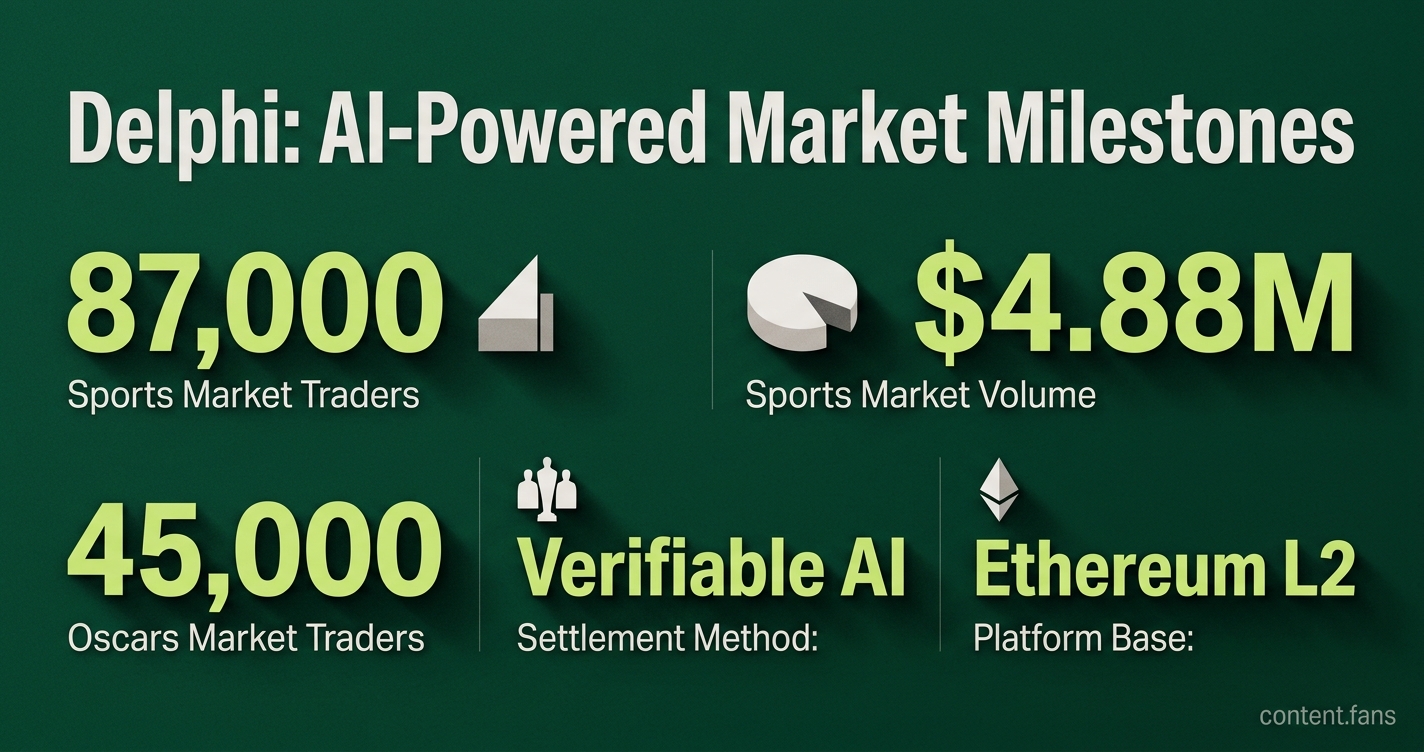
Delphi is built on Gensyn's Ethereum Layer 2 network. Each prediction market is a distinct smart contract employing an on-chain LMSR automated market maker to ensure constant liquidity. Upon a market's conclusion, Gensyn's AI oracle autonomously analyzes public data, generates a cryptographically verifiable result, and initiates the on-chain settlement.
- Market creators earn a portion of trading volume upon successful market settlement.
- Protocol burns a significant portion of revenue and routes the remainder to treasury, impacting AI token supply.
The platform demonstrated significant early interest, with substantial trading volume recorded during its testnet phase leading up to its launch.
Positioning Against Emerging AI Markets
Delphi's use of AI-verified predictions aligns with a growing trend to apply cryptographic proofs to AI systems. While projects like Bittensor and SingularityNET concentrate on decentralized AI training and services, Delphi carves a niche in tradable information. Its core differentiator from conventional prediction markets is its dependence on verifiable oracles, which replaces the need for human-based governance and dispute resolution.
According to analysts, the strategy of using protocol fees for a token buy-and-burn mechanism effectively links platform activity with value accrual for the token holder. However, the economic model remains partially theoretical, as the Gensyn team has yet to announce a launch date for its AI token.
Early Metrics and Next Steps
The public testnet saw strong engagement, including a sports market with 87,000 traders and $4.88M volume, and an Oscars market with 45,000 traders. The platform expanded from AI benchmarks to 'any resolvable question.' A key feature is the platform's full transparency: all transactions, order books, and oracle interactions are permanently recorded on-chain, offering a real-time data source for market analysis.
Gensyn has secured significant funding from prominent investors, including a16z crypto. This capital is dedicated to advancing the AI oracle's capabilities and scaling the Layer 2 infrastructure to maintain low gas fees as the platform grows.
Discussions within the trading community indicate that many are cautiously observing Delphi's initial performance, particularly the accuracy of its AI-driven settlements, before deploying significant capital. The platform's future competitiveness in the expanding sector of verifiable information markets will likely depend on the successful launch of its AI token and continued transparent performance reporting.
When did Delphi officially graduate from testnet to mainnet?
Launched on mainnet with invite-only creators; full rollout expanding. The upgrade kept every metric on-chain and introduced the permanent fee schedule that now rewards creators.
How do market creators earn revenue on Delphi today?
Creators collect a portion of trading volume in each market they launch, paid automatically on settlement. Protocol burns a significant portion of revenue and routes the remainder to treasury, impacting AI token supply, tying platform growth directly to token scarcity.
What prevents human bias from corrupting market outcomes?
Verifiable AI models - not people - act as the final oracle. Each model runs inside Gensyn's decentralized AI network, settles on the OP-Stack Layer 2, and publishes cryptographic proofs so anyone can audit the decision trail without exposing the underlying data.
Which blockchain layer hosts Delphi's trading and settlement logic?
Markets, trades, price curves, and AI resolutions all occur on Ethereum via an OP-Stack Layer 2 deployment. This design keeps gas costs low while inheriting Ethereum security, giving builders and traders fully on-chain symmetrical LMSR liquidity from minute one.
How did Delphi perform during its testnet run?
During its testnet phase, Delphi recorded substantial test volume, functioning as a real-time signal for model intelligence. All model evaluations, trade executions, and price changes were on-chain and auditable, delivering the transparency that drew creators to the platform.