
Adobe expands GenStudio with AI for brand intelligence, content agents
Serge Bulaev
Adobe is adding new AI features to GenStudio, making it a single place where marketers can create and manage content. The new Brand Intelligence uses a company's designs and history to check if new content matches brand rules and helps pick the best images and words for each platform. Early testers get a score showing if their materials fit the brand. Agents in GenStudio may help teams quickly turn ideas into ready-to-use content, and some reports suggest these tools could make work much faster. Big brands like Coca-Cola and PepsiCo are trying these new features, and experts think this might change how teams create marketing materials, though other companies and new AI tools are also competing in this space.

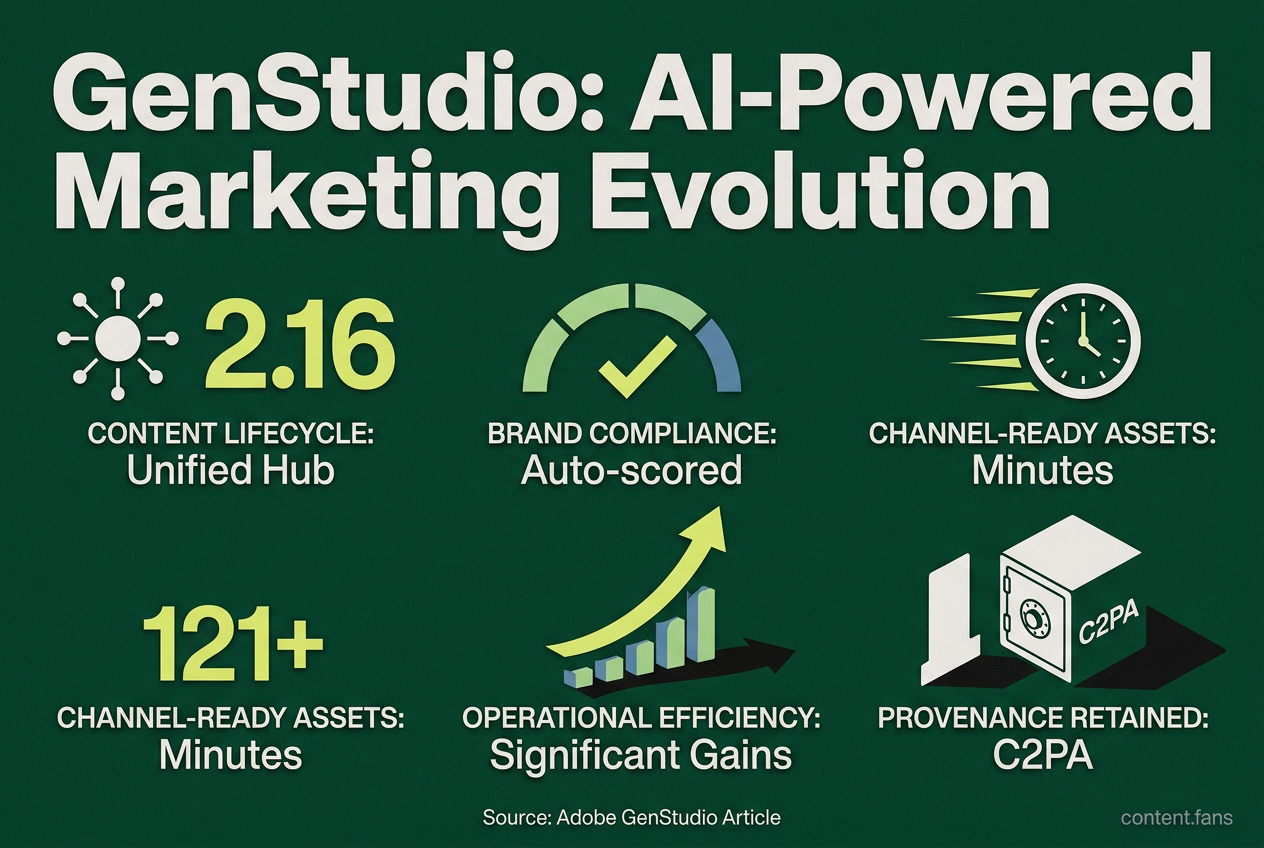
Adobe is enhancing its GenStudio platform with powerful AI for brand intelligence and content agents, creating a unified hub for marketers. This positions GenStudio for Performance Marketing as a central solution where teams can manage the entire content lifecycle - from initial brief and generation to review and activation - without switching between disparate systems.
What Brand Intelligence adds
Adobe's Brand Intelligence feature uses AI to analyze a company's design systems, campaign history, and user feedback. It builds a dynamic brand model that automatically scores new content for compliance, ensuring every asset aligns with established voice, color, and typography rules before publication.
By ingesting design systems, campaign history, and feedback, Adobe Brand Intelligence builds a continuously learning brand ontology. According to the Adobe Business Blog, this service powers two core "skills" within GenStudio: Validate, which scores new assets against typography, voice, and color rules, and Assemble, which ranks compliant copy and visuals for each channel. Early testers receive a numerical brand score that flags off-brand fonts or mismatched imagery. The same blog notes that Firefly Design Intelligence can now train "StyleIDs" from a brand's visuals, letting designers auto-apply layout and tone across Creative Cloud apps.
Key Brand Intelligence skills recalled by Adobe HelpX:
- Validate brand compliance in real time
- Assemble approved copy and imagery across ads, email, and social
Agents reshape daily workflows
A conversational Content Production Agent, now in beta inside GenStudio for Performance Marketing, interprets a marketing brief and fetches approved assets from Adobe Experience Manager. An internal demo cited by the company shows the agent moving from intent to channel-ready variations in minutes. Adobe's blog on "The next era of performance marketing" says these agents also trigger Firefly Services APIs for image reframing and object compositing, while maintaining Content Authenticity credentials on export.
This architecture differs from earlier automation. Industry reports suggest that agentic systems manage end-to-end loops, potentially offering significant operational efficiency improvements when compared with traditional linear workflows. These gains, while still under review, may signal a shift where human teams work more like editors than creators.
Market signals and early outcomes
Brands such as Coca-Cola and PepsiCo reportedly use GenStudio's new AI layers to compress global campaign launches. Adobe says C2PA provenance is retained on every imported asset, and brand credentials attach on export in a current beta.
Competitive tracking from the Markets Chronicle Journal places Canva, LocaliQ, and HubSpot Marketing Hub among the most mentioned alternatives. Analysts suggest Adobe's edge lies in commercial indemnification and its link with Creative Cloud, though foundational model providers like OpenAI Sora and Google Veo present technological pressure.
According to industry reports, a significant portion of surveyed CX leaders expect generative and agentic AI to drive short-term wins. This suggests a growing appetite for systems that couple compliance with scaled personalization, the exact space Brand Intelligence aims to occupy.
What is Adobe GenStudio's new Brand Intelligence layer?
Brand Intelligence is an AI-driven ontology that turns static brand guidelines into a living map of logos, colors, typography, voice, and past campaign decisions. It continuously learns from every approval, rejection, and edit, then auto-scores each new asset for brand fit before anything goes live. Early adopters are already seeing double-digit drops in off-brand exports, and the system now supports up to 20 GB of proprietary training assets per brand workspace.
How do the new AI agents speed up content production?
Instead of clicking through templates, marketers can type a brief in plain English; the Content Production Agent interprets goals, persona, and channel, then selects or generates text, images, and layouts that already pass Brand Intelligence validation. The workflow is fully parallel: while one agent writes copy, another reframes video for TikTok, and a third assembles email HTML - all inside the same GenStudio project. Brands like Coca-Cola report campaign-to-live cycles cut from weeks to minutes.
What role does Firefly Creative Production play?
Firefly Creative Production packages the best-performing steps (prompts, StyleIDs, reframing rules, approval gates) into reusable "recipes" that any team member can clone. Once a recipe is proven, it can be triggered by a calendar event, a product-feed update, or even a spike in ad-fatigue detected by the optimization agent - no human reopening of After Effects or Photoshop required.
How does GenStudio protect brand safety and authenticity?
Every asset created or imported retains C2PA provenance metadata, and GenStudio can auto-apply a brand credential on export (beta). Because Firefly models are trained only on licensed content and customer-provided assets, enterprises get legal indemnification - a safeguard most open-model competitors cannot match.
Who are GenStudio's main competitors in 2025-2026?
Canva is a competitor focused on template-driven design; LocaliQ and HubSpot compete in SMB marketing spaces. Raw generation models like OpenAI's Sora or Google's Veo can out-spend Adobe on pure novelty, but none offer an end-to-end, brand-compliant supply chain that connects creative, DAM, activation, and performance data in one security-audited stack.