
CIOs Report: 4 Pillars Drive Digital Transformation in 2026
Serge Bulaev
The report suggests that digital transformation in 2026 needs more than just technology. Success may depend on four main areas: executive alignment, organizational readiness, strong data systems, and updated AI governance. Studies show that when leaders work together and focus on customers, results improve. However, some companies may still struggle with gaps in skills and data management. Experts believe that treating data governance as a decision tool, not just a rule, may make organizations more resilient.

Recent CIO leadership surveys reveal that successful digital transformation in 2026 depends on more than just technology. Lasting breakthroughs are driven by four strategic pillars that complement tech spending: executive alignment, organizational readiness, robust data foundations, and evolving AI governance. These pillars ensure that senior executives unite behind a customer-centric vision, fund the necessary work, and share accountability for turning isolated pilots into enterprise-wide value.
Pillar 1: Executive Alignment Elevates the CIO's Strategic Role
A unified executive team is critical for success. Industry reports confirm the CIO's rising influence, with 65% now reporting directly to the CEO per Deloitte. A significant portion of CIOs co-drive business strategy, and many organizations plan larger IT budgets, prioritizing AI and automation. However, high-performing organizations also emphasize clear decision rights to prevent "decision breakdowns" - the unresolved trade-offs and fragmented ownership that derail transformations. They establish clear escalation paths and measure value based on adaptability and risk reduction, not just project completion.
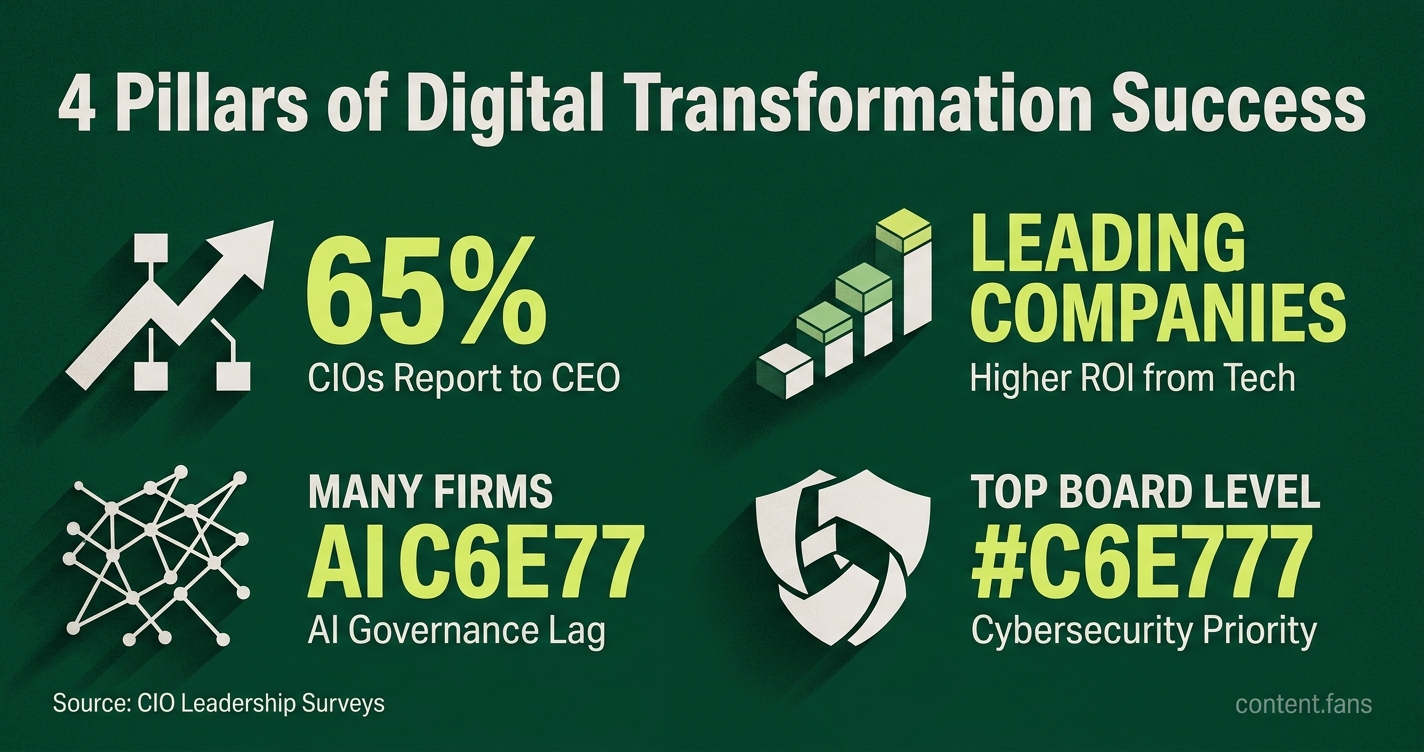
Success in digital transformation relies on four foundational pillars. These include achieving strategic alignment among executives, ensuring the organization is ready for change, building robust data foundations for reliable insights, and implementing an evolving governance framework for AI and data to manage risks and ensure compliance.
Pillar 2: Organizational Readiness Unlocks Higher ROI
Technology alone does not guarantee returns; organizational capabilities do. Industry reports show leading companies achieve significantly higher ROI from their tech stacks because they focus on readiness. Their advantage comes from agile operations, documented AI governance, sustained upskilling investments, and cross-functional teams that break down silos. A structured readiness model - auditing data quality, aligning teams, and executing on unified architectures - prevents shortcuts that lead to later compliance and integration problems.
Pillar 3: Evolving AI and Data Governance Mitigates Risk
Modern governance is shifting from manual oversight to automated, AI-assisted controls. Platforms can now automate data discovery, classification, and policy enforcement, improving reliability while reducing overhead. Organizations that extend existing data governance to cover AI pipelines see higher adoption rates than those creating separate programs. Despite this, significant gaps remain, with many firms reporting that their governance frameworks lag behind the rapid pace of AI deployment, especially in areas like real-time consent and bias monitoring.
Pillar 4: Robust Data Foundations Power Strategic Initiatives
While cybersecurity remains the top board-level priority, operationalizing AI for measurable value is now a close second. This momentum carries significant risk, as AI models built on weak data foundations will inherit the same silos and quality issues that plagued earlier business intelligence projects. The most resilient organizations avoid this by treating data governance as a strategic decision system, not just a compliance checkbox. They embed it directly into change management to ensure adoption and drive reliable outcomes.
How should executive alignment be structured so that digital programs actually deliver measurable value?
Begin with a shared vision that the board, CEO and line-of-business heads can articulate in one sentence. Industry reports show CIOs who report directly to the CEO are significantly more likely to co-drive enterprise strategy and hit ROI targets within 18 months. Formalize this in a quarterly "value-realization review" where IT and business owners jointly sign off on three value KPIs per initiative - cost-to-serve delta, revenue lift or risk-reduction percentage - and keep the same metrics for at least four quarters to allow compounding gains.
What practical steps lift an organization from "technology-ready" to "transformation-ready"?
Move through a three-phase readiness sprint rather than a multi-year study.
1. Foundation (weeks 1-4): audit data quality, map skills gaps, appoint a cross-functional governance council.
2. Alignment (weeks 5-8): redesign two core workflows that mix human and AI tasks, lock in agile decision rights, fund a sustained upskill track.
3. Execution (weeks 9-12): scale one AI pilot that already shows a significant uplift in a key process, embed risk guardrails and publish a monthly dashboard of adoption, bias checks and value delivered. Enterprises that follow this cadence record significantly higher ROI than peers fixated on platform selection alone.
Which governance upgrades are non-negotiable when AI moves from lab to production?
Extend existing data-governance charters to cover model lineage, training-data consent and real-time drift monitoring. Leading organizations are implementing automated policy enforcement inside CI/CD pipelines - every new model release triggers an instant check for bias, data sovereignty and explainability before it reaches customers. Companies that integrate AI controls into legacy data programs outperform those running separate AI-governance offices on compliance speed and stakeholder trust scores.
How can CIOs keep skills development from stalling once the initial excitement fades?
Shift from one-off training to "evergreen upskilling contracts": allocate a visible budget line that employees can draw on every quarter for micro-certifications, hack-days or vendor academies. Tie renewal of the budget to verified application - at least one new skill must be used in a live project within 60 days of completion. Organizations using this rule report significantly fewer open critical roles and a measurable lift in internal promotion rates.
What early warning signs indicate a transformation is slipping toward failure - and how should CIOs respond?
Watch for decision fog: priorities that change monthly, unresolved trade-offs between speed and risk, or fragmented ownership where no single executive can say "yes" or "no" in 24 hours. These symptoms precede the majority of stalled programs. Counteract by publishing a one-page decision matrix that lists each pending choice, the sole owner, the escalation path and the economic impact of delay. Review the sheet weekly with the CEO or COO; programs that adopt this discipline recover momentum within one quarter and are significantly more likely to finish on time and on budget.