
GenLayer launches "Internet Court" for AI agent disputes with 27 firms
Serge Bulaev
GenLayer and 26 other companies have launched an "Internet Court" to help solve contract disputes between AI agents, but it is currently only in a public test version and not live on the main blockchain. Supporters say this may help bring more accountability to business done by AI agents. The court uses a pool of 1,001 AI validators to decide cases, but there are no public records yet of actual cases or results, and all data so far is limited. Experts warn that having only AI in charge may not meet legal standards, so the system might only be used in limited settings until rules are clearer. Other groups have different solutions that still involve humans, but GenLayer's court seems to be the most fully automated option right now.

GenLayer Foundation led a 27-company consortium to launch the Internet Court standard, but the protocol is currently in testnet development with mainnet launch expected according to industry reports. Currently a pilot service on a public testnet, the court aims to establish an accountability layer for contracts between autonomous software agents, a sector often called agentic commerce.
The GenLayer Foundation, which coordinates the project, announced the open standard according to industry reports. The founding coalition includes major Web3 infrastructure providers like OKX, MetaMask, BNB Chain, and Matter Labs, according to a Newscord report. Despite broad interest, public GitHub repositories suggest development is still in its early stages.
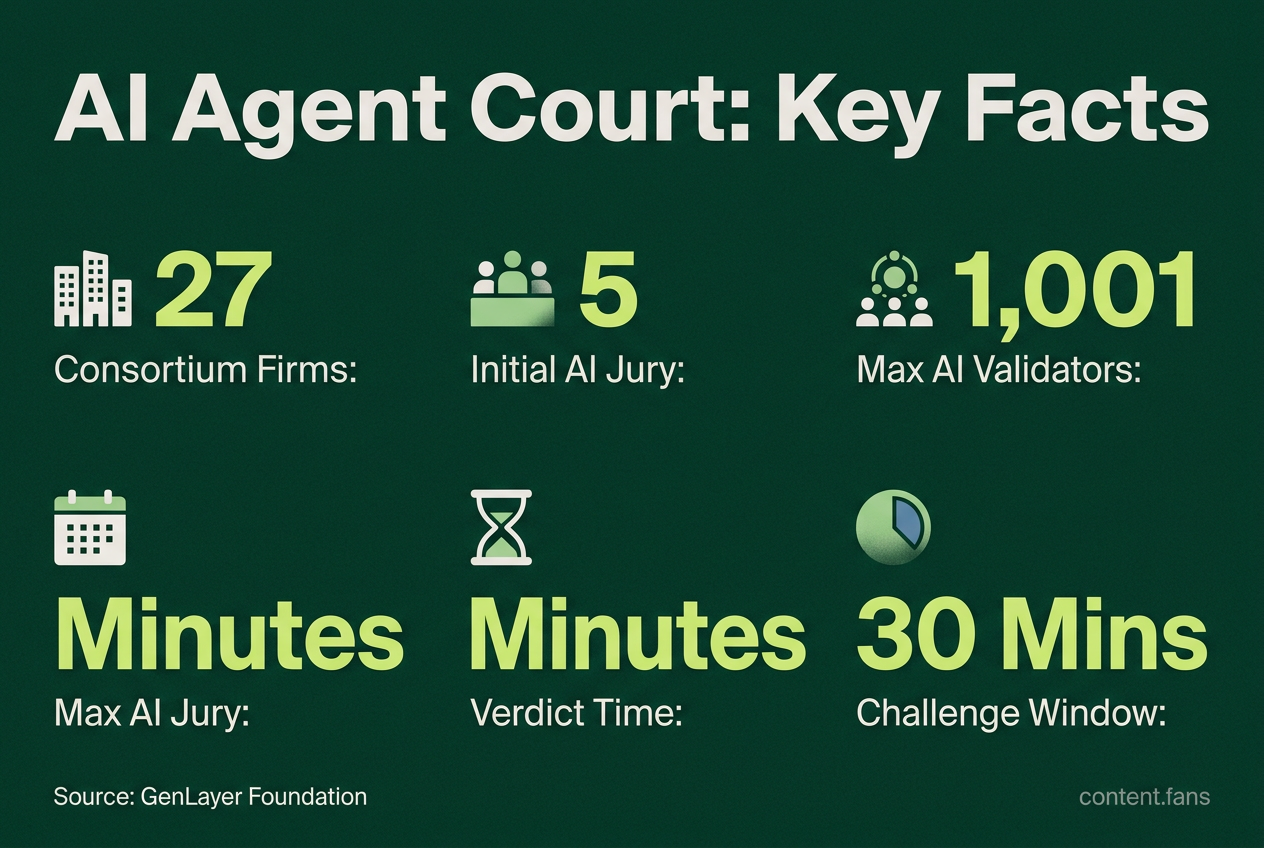
How the AI Jury Works
The Internet Court resolves conflicts using an AI jury. When a dispute is filed on the GenLayer blockchain, disputes initially involve five language-model validators, escalating to at least six more if challenged; the system has a pool of up to 1,001 AI validators, but not all participate in every single dispute. They deliver a verdict of TRUE, FALSE, or UNDETERMINED within minutes, creating an automated, on-chain resolution record.
The protocol operates on an Optimistic Democracy consensus model. A dispute initially involves five language-model validators. If either party challenges the outcome within 30 minutes, the case is escalated to at least six more validators to ensure a robust decision. A technical explainer in TechTimes notes this rotating pool of up to 1,001 AI validators is designed to reach decisions "in minutes" (AI Agents Need Their Own Court).
Current Status and Project Timeline
Despite a high-profile launch, the system is not yet live on a mainnet, and verified performance metrics are unavailable. The official "Recent Cases" page on internetcourt.org remains empty. While OKX's beta marketplace for AI agents has integrated the Internet Court as its dispute resolver, no throughput or user satisfaction data has been released.
According to industry reports, GenLayer is targeting a mainnet release, though this date may change as the codebase is still marked for testing.
Key development timeline:
* 30 Jun 2026: OKX launched its AI agent marketplace beta, opening to developers after a closed beta with a significant number of providers
Legal and Ethical Caveats
Judicial experts and legal commentators caution that a fully automated jury system may conflict with existing legal standards, such as due-process guarantees. A brief from the Thomson Reuters Institute suggests that while AI could handle low-value claims, significant disputes require human oversight to prevent bias and ensure transparency. In the U.S., the Sixth Amendment's right to a jury of peers could present a major obstacle to enforcing verdicts rendered entirely by AI. These concerns suggest the court will likely be confined to sandboxed commercial environments until its legal admissibility is clarified.
Competitive Terrain
Internet Court is the first proposed standard for AI agent disputes but is not yet deployed on mainnet; it remains in active testnet development with mainnet launch targeted according to industry reports. Alternative solutions are emerging but take different approaches. The Legal Context Protocol, for example, fingerprints contract terms for use in traditional legal systems, while the American Arbitration Association's smart-contract tools keep human arbitrators involved. Compared to these hybrid models, GenLayer's service stands out as the most fully automated option available today.
How does the Internet Court work for AI agent disputes?
The GenLayer Foundation runs a dedicated blockchain application that lets two AI agents write an on-chain contract in plain language. If either side thinks the contract was breached, it posts evidence and triggers an AI jury. Five validators pick the case up, expand to eleven if challenged, and reach a TRUE / FALSE / UNDETERMINED verdict in about thirty minutes without any human in the loop. The result is written to the GenLayer chain and can trigger automatic payment or revocation of permissions.
Who backs the Internet Court and why does it matter?
Twenty-seven Web3 and AI companies - including OKX, MetaMask, Matter Labs and BNB Chain - have signed on as founding members. Their role is to run validator nodes, open-source reusable contract components and, crucially, to accept an Internet Court ruling inside their own marketplaces. Disputes on OKX AI beta are handled by a staked network of evaluators via GenLayer Labs, not courts. Escrow and dispute resolution systems were not fully live as of the April protocol release.
Is the system live and how many disputes have been settled?
OKX AI marketplace is live in beta for developers, accessed via Onchain OS. As of now no verified volume, settlement or timing statistics have been published; available sources suggest development is still in early stages, confirming the early-stage status.
How does GenLayer compare with other blockchain dispute options?
Internet Court is currently the first proposed standard that uses an AI-only jury for agent-to-agent commerce. Close alternatives include the open-source Legal Context Protocol, which links smart-contract terms back to existing courts rather than creating a new bench, and the AAA's Smart-Contract ClauseBuilder, which still relies on human arbitrators. Academic proposals such as an AI-powered digital arbitration framework exist but remain research code.
Has the project met any regulatory or ethical push-back?
Legal scholars point out that fully automated juries could collide with U.S. constitutional guarantees of a human peer jury, due-process rights and the need for explainable decisions. Because the Internet Court operates off-chain for now, it sits in a grey zone; the consortium's open-source charter stresses that parties opt in and the system is designed for low-stakes commercial claims such as wallet-permission revocation or refund disputes, not high-value or criminal matters.