
Enterprises Adopt AI Agents to Cut IT Costs, Speed Loan Approvals
Serge Bulaev
Many companies are starting to use autonomous AI agents in areas like IT, finance, supply chain, and customer service. These agents may help reduce costs and speed up tasks, such as making loan approvals much faster or solving internal support requests. However, experts warn there are still security and management challenges, as many leaders may not fully control or monitor these agents yet. Companies are advised to treat each agent like an employee, with clear rules and oversight, and cross-functional teams are managing agent rollouts. Early results suggest these agents can cut manual work by 30 to 80 percent, but careful planning and oversight appear necessary.

The adoption of autonomous AI agents is rapidly moving from theory to production as enterprises embed them across IT, finance, and customer care to achieve faster cycle times and a clear return on investment. According to industry reports, a growing number of enterprises have deployed AI agents in production, with banking and insurance sectors showing particularly strong adoption rates. This guide explains what AI agents do, their proven results, and the essential guardrails for successful implementation.
Taxonomy and Current Adoption
AI agents are autonomous software programs that execute tasks independently, moving beyond merely suggesting actions. Enterprises primarily deploy them for service-desk triage, automated document processing, supply-chain orchestration, and customer support chat, aiming to streamline operations and reduce manual intervention in core business functions.
The transition from suggestion to execution is critical. For example, industry reports indicate that enterprise AI agents can resolve a significant portion of internal IT tickets, substantially reducing human workload. In finance, financial institutions have used agents to dramatically cut loan origination times while achieving strong first-year ROI.
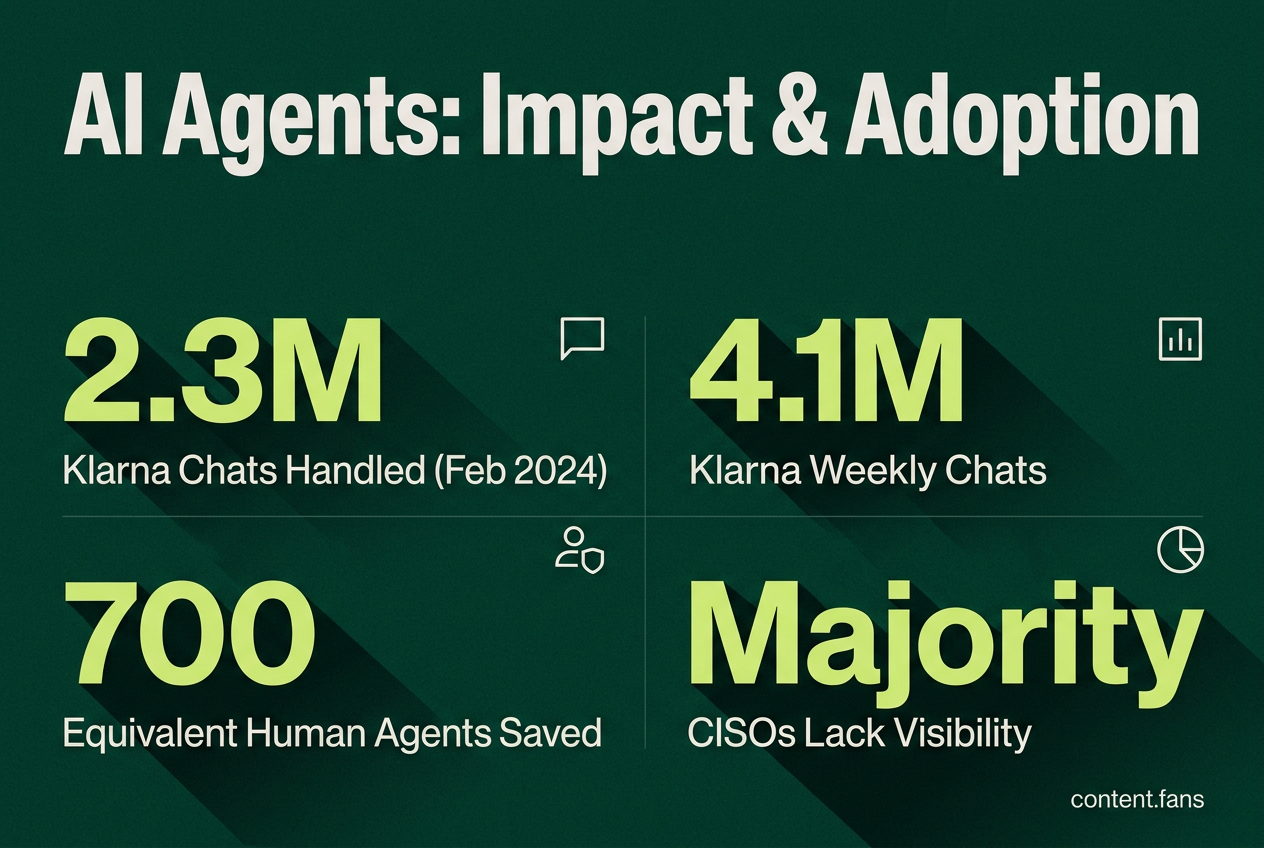
In operations, major retailers have deployed load-planning agents that optimize logistics operations effectively. Meanwhile, Klarna's customer service assistant initially handled 2.3 million chats in its first month (February 2024) and now processes approximately 4.1 million chats weekly, representing cost savings equivalent to avoiding the hiring of 700 human agent positions.
Governance and Security Essentials
This rapid adoption has created a significant governance gap. According to industry reports, a substantial majority of CISOs lack full visibility into agent identities, and most doubt they could contain a compromised agent. High-risk scenarios include shared credentials, unmonitored delegation chains, and untracked API calls. Experts recommend three immediate controls:
- Establish Agent Identity: Treat every agent as a unique identity with a named owner and clearly scoped permissions.
- Enforce Runtime Policy: Implement a centralized gateway to log every action and enforce policies in real-time.
- Maintain a Registry: Create an enterprise-wide Agent Registry that documents each agent's purpose, authority, and review schedule.
Quick-Start Checklist for New Teams
- Select one workflow with binary success criteria and measurable KPIs.
- Map required APIs and data scopes before granting access.
- Run human-in-the-loop checkpoints for the first 60 - 90 days.
- Automate evaluation tests on every prompt or model change.
- Attach budget and accountability to a single business owner.
Reading the Maturity Curve
Industry maturity models outline multiple levels of AI agent adoption: Initial, Repeatable, Defined, Capable, and Optimized. Organizations at higher maturity levels have documented standards and responsible-AI reviews; at advanced levels, the agent program is integrated with enterprise planning and features self-optimizing operations. Industry surveys suggest the main hurdle between early and intermediate levels is moving pilots into production. Mature companies run automated guardrail tests on every change and assign a budget-holding "agent owner" in most cases.
Implications for Org Design
A consistent pattern among successful adopters is strong cross-functional oversight. Product, engineering, legal, and security teams co-manage rollouts through dedicated "Agentic AI" committees. This structure points to an emerging best practice: treat AI agents as both a software product and a new class of workforce, requiring the combined rigor of DevOps and HR-style accountability. This alignment is central to sustaining significant reductions in manual effort reported by many organizations.
How do AI agents actually cut IT costs?
Industry reports show a clear pattern: agents that integrate with ServiceNow or Microsoft Teams can resolve a significant portion of repetitive tickets (password resets, asset requests, onboarding) without human intervention.
- Major telecommunications companies have reported substantial drops in internal service-desk volume after deploying AI agents across their workforce.
- IT service providers have documented large numbers of automated tickets processed annually, freeing L1 staff for complex work and reducing contractor spend.
Bottom line: every significant number of tickets deflected saves roughly 1 FTE; most enterprises see payback within months.
Where are loan approvals being sped up and by how much?
Financial institutions using agentic origination workflows have reported dramatic cuts in average processing time and substantial reductions in data-entry work. Regional lenders have pushed significant portions of retail loans through AI credit-scoring engines, improving approval rates for thin-file customers. Together the cases point to a triple win: faster revenue recognition, lower labor cost, and expanded market reach.
What measurable ROI are enterprises reporting?
Across industry deployments, organizations report strong first-year ROI. The highest returns belong to narrowly scoped agents (loan underwriting, invoice matching) that:
- Require zero new hires once live,
- Run 24/7 without overtime, and
- Exceed human accuracy on structured data tasks. ROI drops when agents are asked to cover ambiguous, multi-department processes without clear success metrics.
Which governance gaps create security risk?
Industry surveys indicate that most CISOs admit they cannot see every agent acting inside their environment and doubt they could stop a compromised agent. The biggest blind spots are:
- Agents sharing human credentials or long-lived tokens,
- Shadow agents spun up on SaaS without IT inventory,
- Delegation chains (orchestrator → sub-agent → API) that break traditional "who authenticated" logs. Experts recommend a runtime governance layer that treats every agent as an authenticated identity and enforces policy at the moment of action, not in quarterly audits.
When is a company ready to move from pilot to scaled agent fleet?
Industry maturity models converge on four exit criteria:
1. Single owner with budget and KPI accountability,
2. Binary success metric tied to one workflow (e.g., ticket resolved, loan booked),
3. Automated evaluation on every prompt or model change, and
4. 30-day production run with weekly human audits.
Organizations that meet these checkpoints show significantly higher rates of converting pilots to production within a year compared to those that skip these steps.