
Enterprises Isolate AI Workloads, Prioritizing Sovereignty and Security by 2026
Serge Bulaev
Enterprises are increasingly moving AI workloads into isolated, private environments, rather than shared systems. This shift appears to be driven by new privacy and security needs, with many companies now making AI sovereignty a key part of their strategies. Finance and technology firms may use these isolation models to follow strict regulations and protect sensitive data. Analysts suggest that demand for single-tenant setups and specialized hardware could reshape the cloud market. It is recommended that companies carefully consider data sensitivity, negotiate data handling terms, and prepare for changing costs as they plan their AI strategies.

As enterprises accelerate AI adoption through 2026, the strategy to isolate AI workloads is becoming the dominant architecture for sensitive applications. This shift, driven by data sovereignty mandates, security risks, and intellectual property protection, is fundamentally reshaping how organizations purchase, deploy, and govern AI infrastructure.
Why Are Enterprises Isolating AI Workloads?
Organizations are moving AI workloads to isolated environments to meet strict regulatory compliance for data sovereignty, enhance security against sophisticated threats like data leakage, and protect proprietary models and intellectual property from being exposed in shared, multi-tenant systems. This addresses key business and legal risks.
The move away from multi-tenant public AI services stems from three converging pressures:
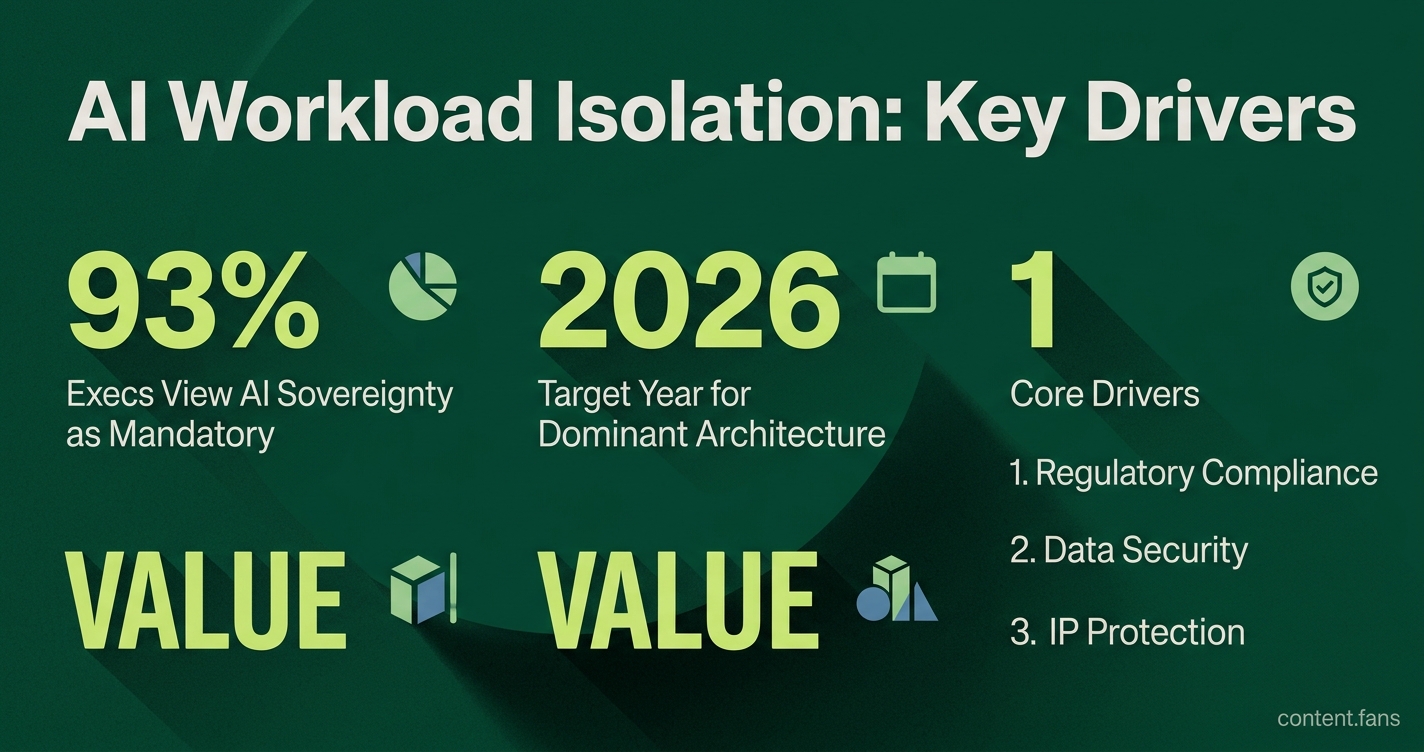
- Regulatory Compliance: With 93% of executives viewing AI sovereignty as mandatory, enterprises can no longer accept data residency ambiguity. Industry reports indicate that isolated deployments ensure processing stays within jurisdictional boundaries, satisfying GDPR and emerging AI governance frameworks.
- Data Security: As attackers weaponize AI, dedicated instances prevent prompt injection attacks, eliminate cross-tenant data leakage risks, and enforce strict permissioning that shared environments cannot guarantee. This addresses the significant concern over generative AI security reported by many AI leaders.
- Intellectual Property Protection: Organizations recognize that proprietary training data and fine-tuned models are competitive assets. Isolation prevents platform operators and other customers from accessing this valuable IP.
What Do Isolated AI Deployments Look Like in Practice?
Enterprise isolation models vary by risk tolerance and regulatory exposure, but common architectures include:
| Approach | Description | Typical Use Case |
|---|---|---|
| Single-Tenant Private Cloud | Fully dedicated infrastructure within controlled networks | Core banking AI, proprietary trading models |
| Ringfenced Architectures | Logical isolation within multi-tenant environments with data separation | Customer service automation, document processing |
| On-Premises AI Factories | Self-managed infrastructure for high-volume, sensitive workloads | Consistent inference where cloud costs become prohibitive compared to on-premises equivalents |
Financial institutions have been early adopters. Multiple EU and UK banks have deployed secure private clouds to maintain strict GDPR data residency. Similarly, a report from UK Finance documented how one major bank implemented ringfenced generative AI with mandatory human sign-off for all customer-facing decisions.
How Are Cloud Providers and Vendors Responding?
The demand for isolation has forced strategic pivots across the vendor ecosystem:
- Infrastructure Redesign: Cloud providers are creating AI-first regions where specialized GPUs and AI chips are projected to capture the majority of infrastructure spending. General compute is becoming secondary to inference-optimized hardware.
- Pricing Evolution: Economics are shifting from hourly compute to token-based billing and pay-per-execution models that align costs with AI consumption and value.
- Sovereignty Premiums: Hyperscalers now charge up to a 30% premium for sovereign cloud offerings, a cost enterprises increasingly see as non-negotiable for compliance and security.
- Neocloud Competition: Specialized providers are capturing market share with AI-centric infrastructure at lower rates, pressuring incumbents to justify premiums with integrated security and sovereignty features.
What Should Your AI Roadmap Include?
Organizations navigating this shift should prioritize the following actions:
- Classify Workloads: Map every AI use case by data sensitivity and regulatory zone before selecting a deployment model. Misclassification introduces unacceptable risk.
- Negotiate Data Handling: Secure explicit contractual clauses with model providers covering log retention, data usage rights, and prompt injection testing.
- Model Costs: Develop skills in GPU utilization metrics and token-based economics to manage budget volatility. Combine fixed instance reservations with usage caps.
- Adopt Governance Frameworks: Use frameworks like VALID (approved tools only, no proprietary data in public APIs, mandatory human validation) to operationalize isolation requirements.
When Is On-Premises a Better Choice Than Cloud Isolation?
Industry analysis suggests that when recurring cloud costs become a significant portion of the total cost of an equivalent on-premises system, organizations should evaluate building private GPU clusters or AI factories. This is especially true for consistent, high-volume inference workloads.
This strategy is gaining traction as GPU supply constraints create allocation uncertainty and predictable capital expenditures become more attractive than variable operational costs at scale. While experimental or volatile workloads remain cloud-appropriate, production systems with steady requirements increasingly justify private infrastructure.
The transition to isolated AI workloads signals AI's maturation into production-grade, regulated infrastructure. Organizations that fail to adopt isolation as a core design principle risk significant regulatory penalties and competitive disadvantage in a market that now defaults to sovereign, secure deployment patterns.