
EU, US diverge on AI data rights, licensing fees in 2026
Serge Bulaev
The United States and European Union may be taking different approaches to AI data rights and licensing fees. In the US, developers often rely on fair use to train AI, while Europe appears to suggest collective licensing with flat-rate fees for copyrighted data. Model outputs are now a contested area, as some developers restrict others from using their outputs to train new models, although open community models seem to be catching up in performance and lowering costs. Regulators are considering tools like privacy technologies and watermarking to balance openness, safety, and compensation. These changes might lead to new ways of managing AI rights and payments, but the exact rules are still under debate.

As the EU and US diverge on AI data rights, the core conflict over data licensing and intellectual property is reshaping the industry. Companies that built models on public data now restrict access to their own outputs, while creators demand compensation. This debate will define the future of AI development, potentially shifting significant licensing fees and determining whether innovation remains open or concentrated.
US Fair Use vs. EU Licensing: A Growing Divide
The United States and European Union are developing contrasting legal frameworks for AI training data. The US relies on fair use doctrine, while the EU currently has a list of explicitly permitted uses rather than fair use, with recent policy comments recommending rejecting mandatory collective licensing for AI training data in favor of voluntary market negotiation.
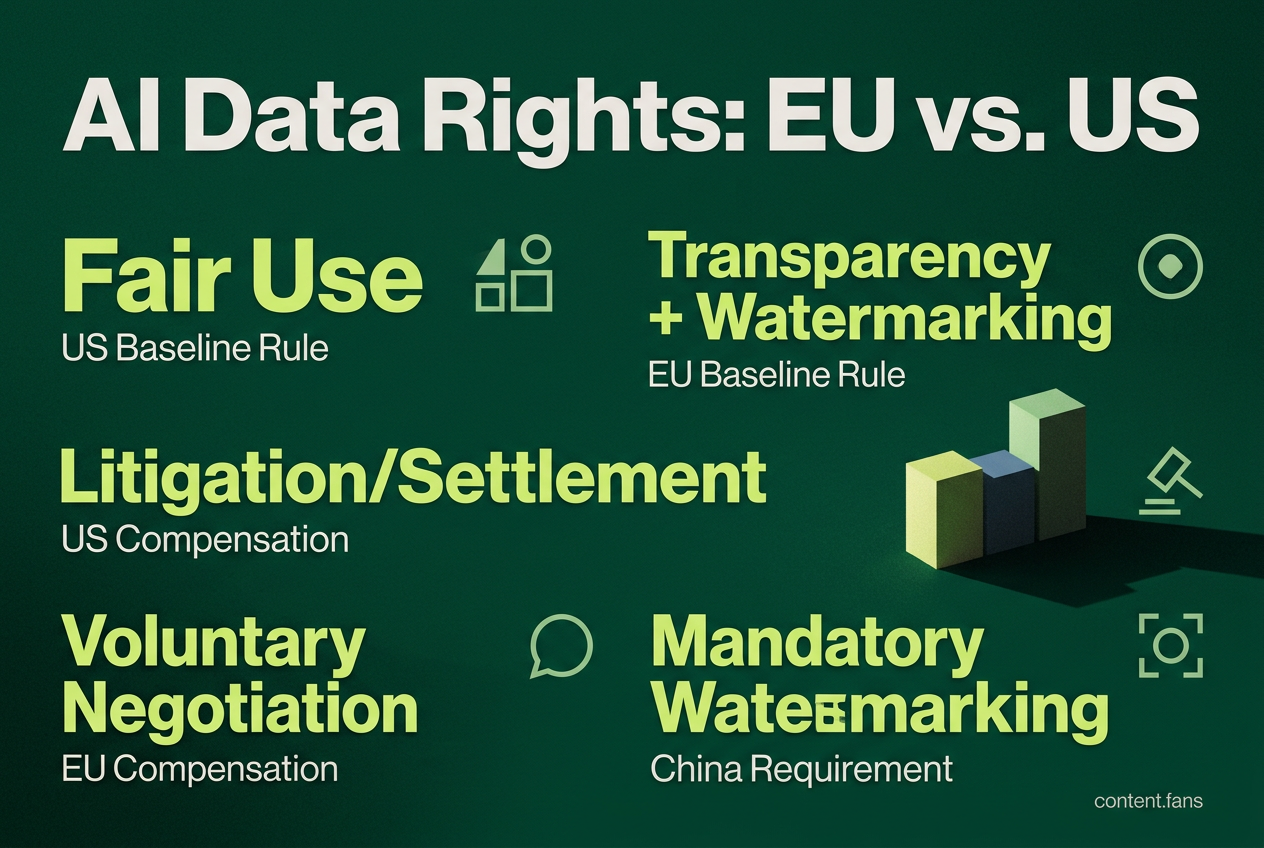
In the United States, AI developers widely use the fair use defense for large-scale data mining, a stance supported by industry analysis. In contrast, the European Union is pursuing a different path. Industry reports suggest some proposals for collective licensing with compensation mechanisms, though specific fee structures remain under discussion.
Diverging Legal Baselines at a Glance
A short table clarifies the split:
| Region | Baseline rule for training on copyrighted data | Compensation path |
| --- | --- | --- |
| United States | Transformative fair use, case-by-case | Litigation or private settlement |
| European Union | Transparency plus watermarking requirements | Voluntary market negotiation |
| Germany | GEMA decision treats lyric "memorization" as reproduction | Statutory damages; injunctions |
The Contested Ground: Training on Model Outputs
A key point of contention is the industry's double standard: developers who claim fair use for ingesting public data often prohibit competitors from training on their own model outputs. This proprietary stance is being challenged by open-weight models. Industry analysis suggests community models achieve substantial performance relative to closed models while significantly reducing inference costs. While proprietary vendors argue that restrictions are necessary for safety and alignment, the cost advantages of open models are fueling calls for freer secondary training.
Key Governance and Compliance Mechanisms
To manage these conflicts, regulators and industry bodies are developing a suite of governance tools to balance innovation, safety, and creator compensation:
- Privacy-Enhancing Technologies (PETs): These tools allow auditors to inspect datasets without accessing raw data, according to industry guidance.
- Neural-Compliance Frameworks: Policy rules are embedded directly into AI systems, a reported requirement for upcoming regulatory inspections.
- Mandatory Watermarking: China requires visible labels and implicit watermarking for AI-generated content. The EU AI Act's Article 50 machine-readable marking requirement applies from August 2, 2026 (with a grace period to December 2, 2026 for pre-existing systems), not yet fully active as of July 2026.
- Standardized Frameworks: Process controls like ISO/IEC 42001 and taxonomies from the NIST AI RMF help document human oversight, which is crucial for establishing copyrightable creativity.
This evolving regulatory architecture points toward a future of monitored, permission-based access rather than outright prohibitions. With various regulatory proposals under consideration, businesses are proactively mapping use cases by risk and documenting prompt-to-output chains to secure future licensing and compliance options.
What is the core conflict between the EU and US approaches to AI training data rights?
The fundamental divide centers on who pays for learning. The United States treats training on copyrighted material as fair use, with policy frameworks generally recommending letting courts resolve disputes rather than create new statutory rules. Meanwhile, the EU is exploring voluntary collective licensing with compensation mechanisms through market-based agreements backed by transparency obligations.
This creates a stark strategic choice for AI developers: optimize for cost-efficient, litigation-risky training in the US market, or accept structured payment obligations in exchange for regulatory clarity in Europe.
Why does the industry face accusations of hypocrisy around "open learning"?
The tension arises from asymmetric openness. AI developers routinely train on public web content, books, and media - treating human-created works as free educational material - while simultaneously restricting others from learning from their model outputs through terms of service, API limitations, and technical protections.
This one-way privilege contradicts the rhetoric of democratized knowledge. Industry analysis suggests the sector must decide whether learning flows bidirectionally or remains a proprietary advantage for those who reached scale first. Major settlements have demonstrated the financial exposure when this asymmetry faces legal challenge.
How are open-source and proprietary models reshaping competitive dynamics?
The market has produced a hybrid ecosystem rather than a winner-take-all outcome:
| Factor | Open-Weight Models | Proprietary Models |
|---|---|---|
| Cost | Significantly lower inference costs; substantially reduced training costs | Higher per-token pricing; massive compute budgets |
| Performance | Substantial capability relative to closed models, gap closing rapidly | Still lead on hardest benchmarks and frontier safety |
| Adoption | Growing share of usage | Majority of current inference tokens |
Industry leaders have noted that the choice between proprietary and open approaches is not binary. Organizations now select positioning along this spectrum based on data sovereignty needs, customization requirements, and risk tolerance - not ideological preferences.
What regulatory mechanisms are emerging to govern AI knowledge flows?
Several approaches are taking shape:
Transparency and labeling mandates
- The EU AI Act requires transparency measures for general-purpose AI providers
- China mandates watermarking systems for AI-generated content
- International processes recommend training data transparency principles
Economic instruments
- Various proposals for voluntary collective licensing arrangements
- Transparency requirements that shift compliance costs to non-transparent providers
Technical and architectural solutions
- Privacy-Enhancing Technologies enable secure regulatory access to training metrics
- Compliance frameworks embed regulatory requirements directly into AI system architecture
- Standardized frameworks provide risk classification and governance templates
Regulatory proposals under consideration could significantly impact high-risk AI obligations and data restrictions for AI training.
What are the strategic implications for enterprises navigating this fragmented landscape?
Organizations face jurisdiction-specific IP strategies with several critical imperatives:
Documentation of human contribution
- Patent and copyright rights increasingly depend on provable human creative decisions in selecting, arranging, or modifying AI outputs
- Disclosure requirements for AI involvement are expanding in registration filings
Protection of core assets
- Training data, model weights, and system workflows must be treated as trade secrets with appropriate security
- Vendor agreements should demand security reports, contractual retention limits, and audit rights
Risk-based governance
- Map all LLM use cases by regulatory risk tier (minimal, limited, high-risk, prohibited)
- Implement human-in-the-loop approval for customer and regulatory decisions
- Maintain prompt and output logs for accountability and version tracking
The unresolved question - who can learn from whom, under what conditions, and with what compensation - will determine whether AI research concentrates among well-capitalized incumbents or remains distributed across a broader innovation ecosystem. Current policy choices are effectively selecting that concentration curve.