
Generative Engine Optimization (GEO) emerges as new marketing frontier
Serge Bulaev
Generative engine optimization (GEO) is a new marketing approach focused on making brands visible to AI assistants that help shoppers choose products. Studies suggest that more people are using AI tools to make decisions, and and this may change how brands attract customers online. GEO aims for a brand to appear as a trustworthy answer in one AI-generated response, which is different from traditional search rankings. Early evidence suggests GEO visibility may drive significant customer visits and actions, especially as AI becomes more involved in shopping. Experts note that as AI tools evolve, brands may need GEO to ensure they are noticed by these systems during the buying process.

The new marketing frontier of Generative Engine Optimization (GEO) focuses on making brands the top choice for agentic AI tools. With a growing number of shoppers already using AI assistants for purchase decisions, and 80% of consumers planning to use GenAI to shop in 2026 according to Capital One Shopping, the consumer journey is rapidly compressing link. This shift sees buyers delegating complex product comparisons to AI, moving away from manual multi-tab research.
Unlike traditional search engine optimization (SEO), which targets high rankings in a list of links, GEO's primary objective is to become the credible, definitive answer within a single, AI-generated response. According to Joseph Levi of Noise Media, this requires brands to build both accuracy, through structured data, and authority, through external validation, ensuring AI agents both understand and trust their information link.
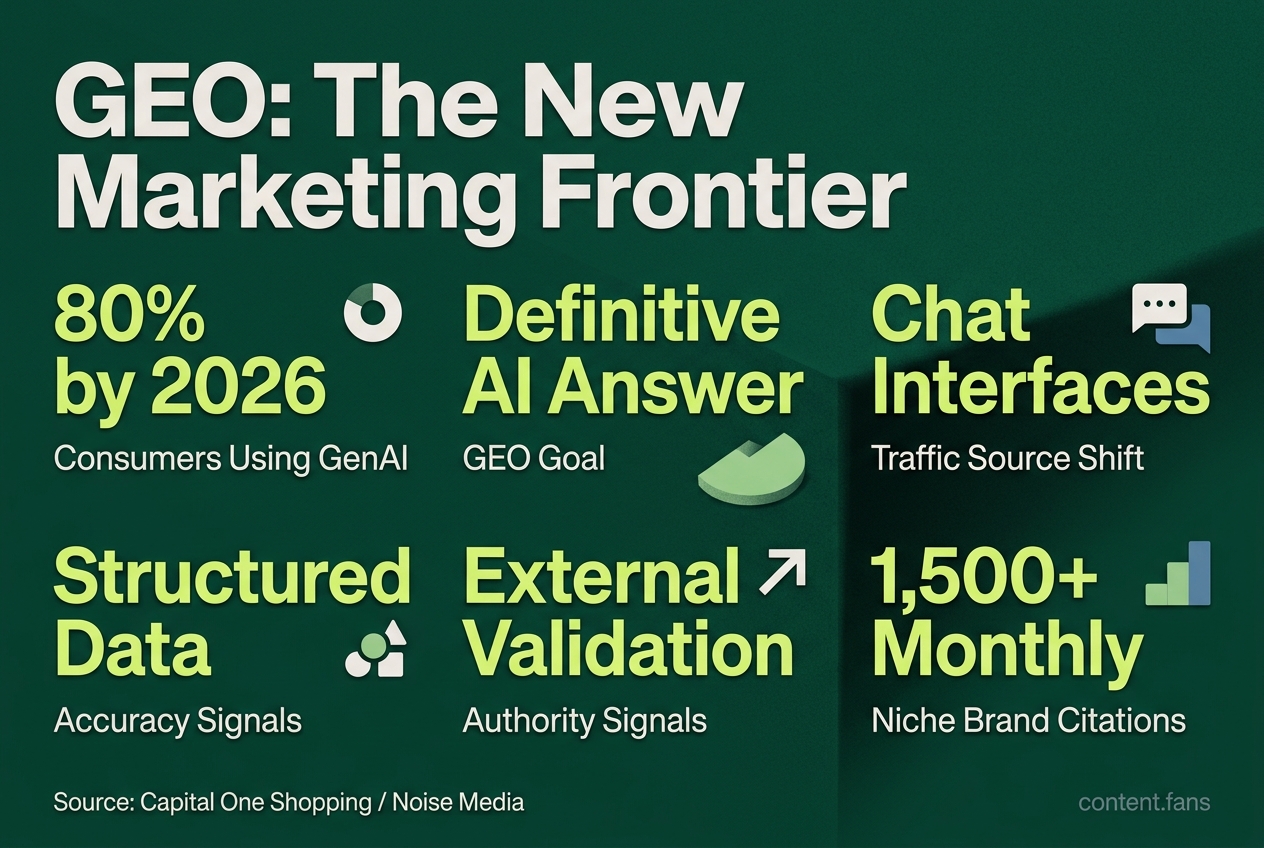
This shift is already impacting website traffic. Industry reports indicate that retailers are seeing a significant portion of their referral traffic originate from chat interfaces rather than traditional search engines or apps link. These early figures highlight a significant opportunity for agile brands to capture measurable traffic by establishing GEO visibility before the market becomes saturated.
How GEO signals are evaluated
Generative engine optimization signals are evaluated based on two main categories: accuracy and authority. Accuracy is determined by on-site factors like structured data and clear content, while authority is measured by external validation such as press mentions, expert reviews, and industry recognition from trusted third-party sources.
Large language models (LLMs) assess brand suitability by weighing two primary signal categories:
- Accuracy Signals: These include on-page technical elements like schema markup, product data feeds, comprehensive FAQs, and current policy pages that provide direct, unambiguous answers about the brand.
- Authority Signals: These are off-page trust indicators, such as independent product reviews, authoritative press mentions, and appearances on relevant podcasts that establish expertise within a specific category.
Levi highlights that niche brands with well-structured data and focused authority can outperform larger, established competitors. For example, one case study showed a design brand achieving over 1,500 monthly ChatGPT citations after optimizing its content, signaling a clear first-mover advantage for agile brands.
Early impact on consumer behavior
Industry research indicates that consumers use AI as a tool to accelerate conversions, with many acting on AI-driven suggestions they would not have otherwise found. AI agents are particularly effective for planning-intensive purchases, like weekly grocery shopping or home redesign projects. As these agents integrate with seamless checkout processes, brands that provide clear, structured data on inventory, pricing, delivery, and return policies will be best positioned to meet the AI's rigorous comparison criteria.
Measuring success inside AI answers
Success in GEO is measured by visibility and influence, not traditional click-through rates. Key performance indicators (KPIs) include:
1. Share of Voice: The frequency your brand is mentioned in AI responses for a target set of prompts.
2. Citation Coverage: The number of times your brand's pages are cited as a source.
3. AI Referral Traffic: Sessions identified in analytics platforms coming from AI chat interfaces.
4. Description Accuracy: The correctness of your brand's information within generated answers.
5. Attributed Conversions: Leads or sales directly linked to an AI-driven session.
While tools like LLMrefs and GA4 can track these metrics, manual prompt testing provides the fastest way to audit performance against emerging user queries.
Practical next steps for brands
To begin with GEO, brands should first identify 10-20 high-intent customer prompts relevant to their business. The next step is to update on-site content and schema markup to ensure AI agents can easily parse key data like pricing, stock availability, and policies. Concurrently, building authority through outreach to review sites and industry publications is critical. Finally, establishing a process to regularly monitor brand mentions in ChatGPT, Perplexity, and Google SGE is essential for tracking share of voice over time.
Industry experts predict that as AI agents evolve from advisors to autonomous purchasers, brand invisibility will become increasingly costly. Therefore, GEO should not be viewed as a replacement for SEO but as an essential, complementary strategy. It ensures a brand remains visible and accurately represented to the machine-based decision-makers that are reshaping the entire customer journey.