
Google, Meta, Shopify update platforms for 'agentic commerce'
Serge Bulaev
Major e-commerce platforms like Google, Meta, and Shopify have updated their systems in 2026 to support "agentic commerce," where AI agents can shop for users. These companies are adding new tools for tracking how often products appear in AI searches and are offering features that may make shopping easier and faster, including AI chatbots that help with checkout. Some updates check if a real person is behind an AI purchase, which might help with trust. Early reports suggest AI tools may help retailers reduce inventory and increase sales, but analysts note that benefits might differ by store type and that new tracking and verification tools may become standard.

Leading e-commerce platforms like Google, Meta, and Shopify are developing updates to integrate agentic commerce, a system where AI agents shop on behalf of users. This industry-wide shift aims to standardize the protocols between AI agents and merchant systems, moving from speculative pilots to measurable deployments.
Agentic commerce reaches major platforms
Agentic commerce enables autonomous AI to browse, compare, and purchase products for users, shifting the retail paradigm. Major platforms are operationalizing this by standardizing the technical handoff between AI agents and merchant systems, allowing for seamless, automated transactions from initial product discovery to final checkout.
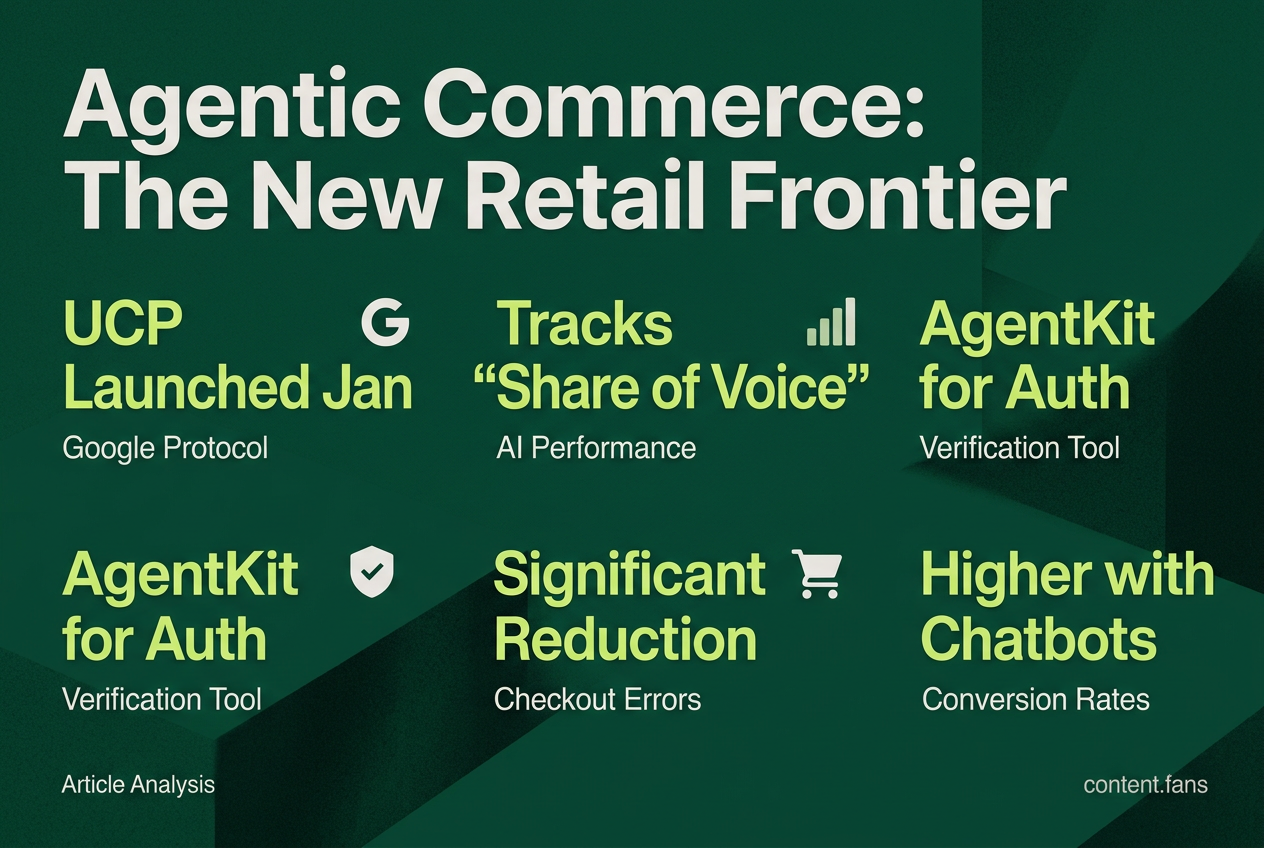
Google launched its Universal Commerce Protocol (UCP) in January, with direct checkout in AI Mode and Gemini currently in beta and invite-only status, rolling out US-first using Google Pay with PayPal integration coming soon, where retailers remain the seller of record. Meta is developing AI shopping tools that use enhanced product discovery features in Instagram ads. Shopify is integrating its Sidekick AI into various merchant workflows, while AWS provided a starter kit for building branded assistants on its Alexa for Shopping stack.
Visibility tracking becomes its own category
With traffic shifting from human search to AI recommendations, a new category of measurement tools is emerging to track brand performance. Google's AI Performance Report in Merchant Center now tracks "share of voice" in AI-driven results. Similarly, Adobe Brand Visibility monitors product appearances in answers from ChatGPT, Copilot, and Perplexity. This trend points toward a new discipline of "generative engine optimization" (GEO) to complement traditional SEO.
Verification and buyability checks
To build trust in automated transactions, new verification tools are being introduced. AgentKit, from Tools for Humanity, verifies that a human user has authorized an AI agent's final purchase decision. Other solutions audit e-commerce stores for technical issues such as data mismatches or slow APIs that could block agent-led purchases, with industry reports showing significant reductions in checkout errors.
Conversational checkout for small businesses
AI-powered chat integrations are streamlining the path to purchase. Industry reports indicate that customers who interact with AI chatbots show higher conversion rates and faster transaction completion. The ability to manage the entire shopping journey, from inquiry to payment, within a single chat thread is projected to significantly reduce cart abandonment through express checkout buttons and guest checkout options. A common playbook for implementation includes:
- Connect live order data first to deflect Where-Is-My-Order questions.
- Pilot a single use case such as checkout help before expanding.
- Enable the bot on web, Instagram, and Messenger to avoid fractured conversations.
Early operational impact
The initial operational impact of these AI tools is significant. Predictive demand modeling is enabling many retailers to decrease inventory and reduce stockouts substantially. Furthermore, a significant portion of retailers report higher annual revenue attributed to AI, though results vary by sector. Analysts predict that as the landscape matures, retailers dependent on external AI platforms will need to adopt visibility tracking and trust verification as essential capabilities, not optional features.
What is agentic commerce and why are Google, Meta, and Shopify investing in it now?
Agentic commerce represents a fundamental shift from "search then buy" to "close deals through conversation" - where AI agents browse, compare, and purchase products autonomously on behalf of consumers. A growing number of consumers now turn to generative AI tools instead of traditional search engines for product recommendations, making this infrastructure investment critical for platform survival. For Google, Meta, and Shopify, the stakes are clear: industry reports suggest early adopters in AI-driven personalization achieve significantly higher revenue than non-AI counterparts.
How does Google's Universal Commerce Protocol (UCP) actually work?
Google's commerce initiatives focus on enabling AI agents to work seamlessly across discovery, checkout, and post-purchase support. The protocol enables direct checkout from U.S. retailers in AI Mode, letting agents navigate fragmented retail ecosystems without human intervention. This infrastructure layer addresses a critical friction point: previously, AI agents couldn't reliably complete transactions across different platforms. Now, many retailers report that AI implementation actively decreases annual operating costs.
What specific tools is Meta rolling out for agentic shopping?
Meta is developing AI commerce tools that allow users to find products from business catalogs via AI, featuring enhanced product discovery and recommendation features to influence purchase decisions. The company is also leveraging AI to improve user experience and offer targeted promotions directly within ads on Instagram and Facebook. Industry data suggests that visitors engaging with AI chatbots show significantly higher conversion rates and faster purchase completion when assisted by AI.
How is Shopify helping small businesses compete in this AI-driven landscape?
Shopify is developing Sidekick AI integration into various merchant workflows and introducing AI-powered recommendation engines for checkout and post-purchase experiences. For small businesses specifically, the platform enables simplified checkout processes that let customers complete purchases without leaving chat interfaces. This matters because many businesses report increased conversion rates and reduced cart abandonment when using AI chat integrations.
What new visibility tracking solutions help brands monitor their AI presence?
As AI agents drive more traffic, specialized tools now track brand visibility in these environments:
| Platform | Key Capability | What It Measures |
|---|---|---|
| Google AI Performance Report | Native Merchant Center integration | "Share of voice" in AI responses across AI Mode, AI Overviews, and Gemini app |
| Adobe Brand Visibility | Cross-platform tracking | Mentions and reach across ChatGPT, Google AI Mode, Microsoft Copilot, Perplexity AI |
| Emerging AI Shopping Analytics | Product-level insights | Win rate, position, referral locations, comparison attributes |
These tools address a critical challenge: generative engine optimization (GEO) is becoming as essential as SEO, with brands now competing for visibility in AI-generated answers rather than just search result rankings.