
Gartner: CMOs increase AI spend despite low readiness
Serge Bulaev
Many marketing leaders say artificial intelligence is changing their work, but they may not feel fully prepared yet. Surveys suggest more money is being spent on AI, even though only a small group feels highly ready to use it. Some tools, like LinkedIn's new analytics feature, could help teams understand their audience better. The reports suggest leaders are now focusing on using AI for bigger tasks, not just small experiments, but readiness gaps might slow down progress.

Recent data shows many CMOs increase AI spend despite low readiness, a trend highlighting how artificial intelligence is reshaping marketing. Three new reports from Gartner, BCG, and LinkedIn reveal a convergence of budgets, analytics, and leadership priorities, though execution remains cautious. This analysis breaks down the latest research for marketing teams planning their AI strategies.
BCG Report: AI Transformation Is Here, But Execution Varies
CMOs are investing more in AI to secure a competitive advantage and drive transformation, even if their teams are not fully prepared. Studies show leaders are shifting from isolated AI tasks to orchestrating entire workflows, signaling a strategic commitment to scaling the technology across the marketing function.
According to industry reports, a significant portion of CMOs see an end-to-end AI transformation in marketing, though many still use generative AI for isolated tasks. However, a shift is underway: a growing number are boosting AI investment, with many targeting workflow orchestration. Notably, CMOs are increasingly leading AI spending decisions in organizations, representing a substantial increase from previous CEO or board-led decision making.
LinkedIn's New Analytics Reveal Audience Discovery
LinkedIn recently introduced a new metric in its Post Analytics, splitting impressions into 'in-network' and 'out-of-network' reach. In-network impressions come from existing followers, while out-of-network impressions track views from non-followers via recommendations, shares, and search. Creator analyst Matt Navarra confirmed this update, which provides clearer insight into content discovery pathways. Matt Navarra's Post - LinkedIn.
Quick ways practitioners are already using the metric:
- Compare topic performance among existing followers versus new audiences.
- Adjust hashtag strategy when out-of-network reach stalls.
- Test post formats to see which earn higher non-follower discovery.
Gartner: AI Budget Rises Amidst Readiness Gap
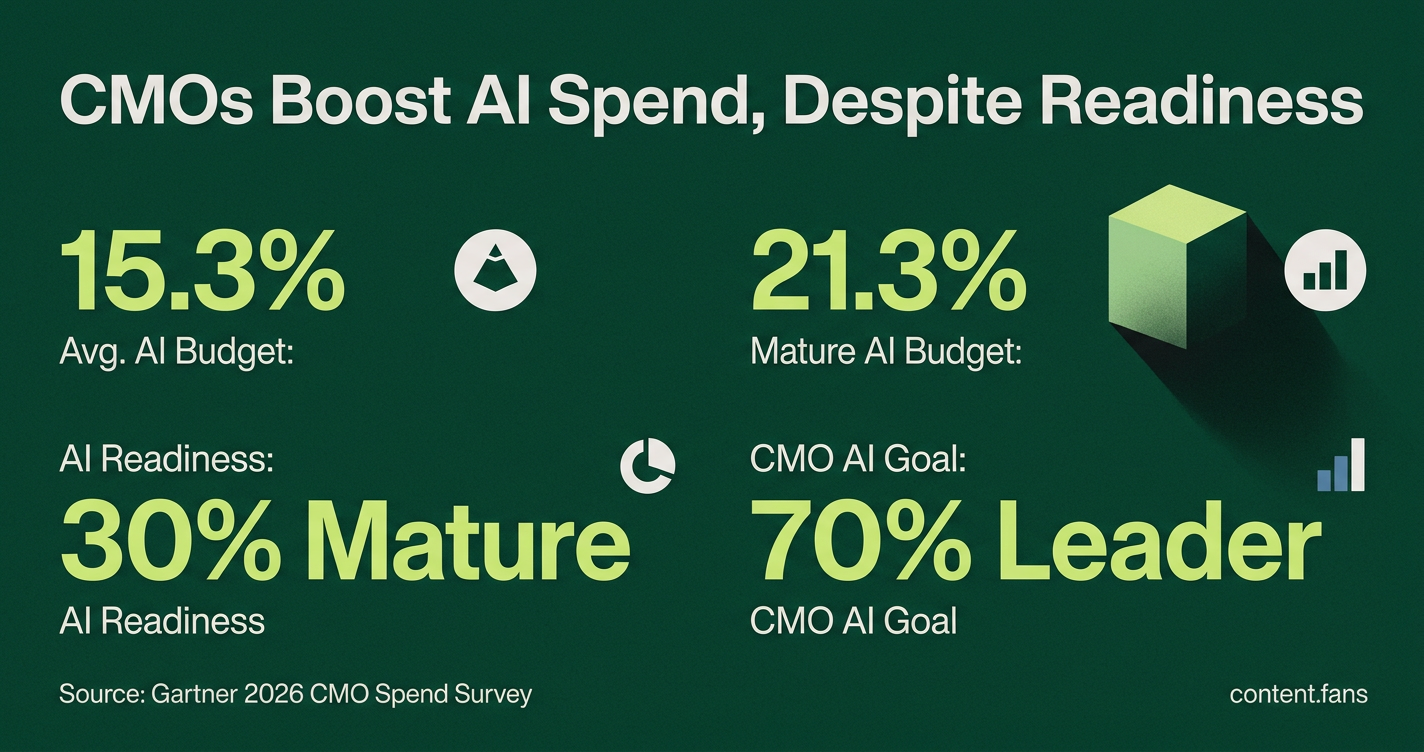
Confirming the trend, Gartner's 2026 CMO Spend Survey reports that marketing teams now allocate an average of 15.3% of their budgets to AI. This investment comes despite only 30% of leaders classifying their AI readiness as mature. The more mature group allocates a higher 21.3% to AI, linking confidence with increased funding. According to Gartner, becoming an AI leader remains a critical 2026 goal for 70% of CMOs, underscoring the pressure to invest. CMOs increase AI spending despite limited readiness, Gartner finds.
Taken together, these reports indicate a strategic shift in marketing AI. The focus is moving from simple experiments like chatbots to orchestrating complex workflows, precisely measuring audience growth, and urgently closing organizational readiness gaps. This ensures that increased AI funding translates into scalable and profitable results.
Gartner's 2026 CMO survey shows a clear tension: 15.3% of the marketing budget is now earmarked for artificial intelligence, yet only 30% of CMOs believe their function is ready to scale AI safely and profitably. Below are answers to the questions most asked by boards, CMOs and their teams following the data release.
Why are CMOs raising AI spend when readiness is still low?
The pressure to lead in AI is overriding caution. Gartner found that 70% of CMOs view becoming an AI leader as a critical 2026 mandate, while only 30% report mature AI readiness capabilities (meaning 70% lack maturity). In effect, budget allocation is being treated as a competitive signal to stakeholders and talent markets rather than a calibrated milestone matched to capability maturity.
What does "AI-ready" mean in the Gartner survey?
Gartner does not publish a numeric readiness score. Instead, it classifies organizations as "mature or fully developed" versus "developing or limited" in three areas:
- Workflow integration: AI is embedded across campaign planning, creative, media and measurement cycles, not just bolted on as point solutions.
- Talent and operating model: presence of dedicated AI product owners, data-science pods, and change-management routines.
- Governance and measurement: clear KPIs, brand-safety guardrails, and ROI tracking that goes beyond vanity metrics.
Only 30% of the interviewed CMOs fit the "mature" group, yet this slice already allocates 21.3% of budget to AI, showing that higher maturity correlates with higher spending discipline.
How does the budget split compare between AI-ready and non-ready teams?
- Average AI allocation: 15.3% of total marketing budget.
- Mature AI-ready cohort: 21.3%.
- Non-ready cohort: While not explicitly stated in the Gartner report, this group allocates less than the mature cohort, indicating that AI investment is accelerating faster than readiness can realistically grow, which Gartner warns could erode ROI unless paired with capability building.
What immediate actions can CMOs take to close the readiness gap?
The survey interviewees who moved from "limited" to "mature" in twelve months shared three repeatable steps:
1. Re-skill before re-tooling: prioritise data-literacy sprints and prompt-engineering workshops ahead of new tool licenses.
2. Appoint a single AI owner: firms with an AI product owner in marketing moved twice as fast through pilot-to-scale cycles.
3. Create an "AI war-room": a 90-day cross-functional team that maps existing workflows, ranks high-impact use-cases, and removes process roadblocks before full rollout.
These tactics allowed the cohort to double budget efficiency (measured as revenue per AI dollar) within two quarters.
What early warning signs should boards watch for?
Gartner flags three leading indicators that AI spend is outpacing organisational ability:
- Flat or declining campaign ROMI despite higher AI budgets.
- Vendor sprawl: more than five AI point solutions in use without integration architecture.
- Talent leakage: rising turnover among data scientists or performance marketers citing "lack of strategic AI support."
If any two of these appear, boards should pause incremental AI investment and require a 30-day readiness audit.