
Gartner: AI Accelerates Vulnerabilities, Exposure Management Needs Network Context
Serge Bulaev
Gartner's new guidance suggests that using network context is important for managing security exposure, since counting vulnerabilities alone may not show real risk. AI tools now find thousands of weaknesses much faster than companies can fix them, so old ways of making simple lists may not work anymore. The report recommends focusing on which systems are most important, how easy they are to attack, and whether the problems can really be exploited. Steps like tagging assets, linking vulnerabilities to real risks, and automating fixes may help teams keep up. Reports to leadership should focus on reducing risk to business, not just on how many patches were applied.

Recent Gartner guidance on how AI accelerates vulnerabilities argues that effective exposure management needs network context to overcome the sheer volume of AI-driven discoveries. As security teams are inundated with raw vulnerability counts, attackers are exploiting the attack paths that truly matter, creating a velocity gap that traditional remediation lists can no longer bridge.
Why context beats count
The guidance emphasizes that prioritizing vulnerabilities requires network context - understanding an asset's business value, its network reachability, and active exploits. This risk-aligned approach moves beyond simple CVSS scores, enabling security teams to focus resources on mitigating the most critical and exploitable threats within their specific environment.
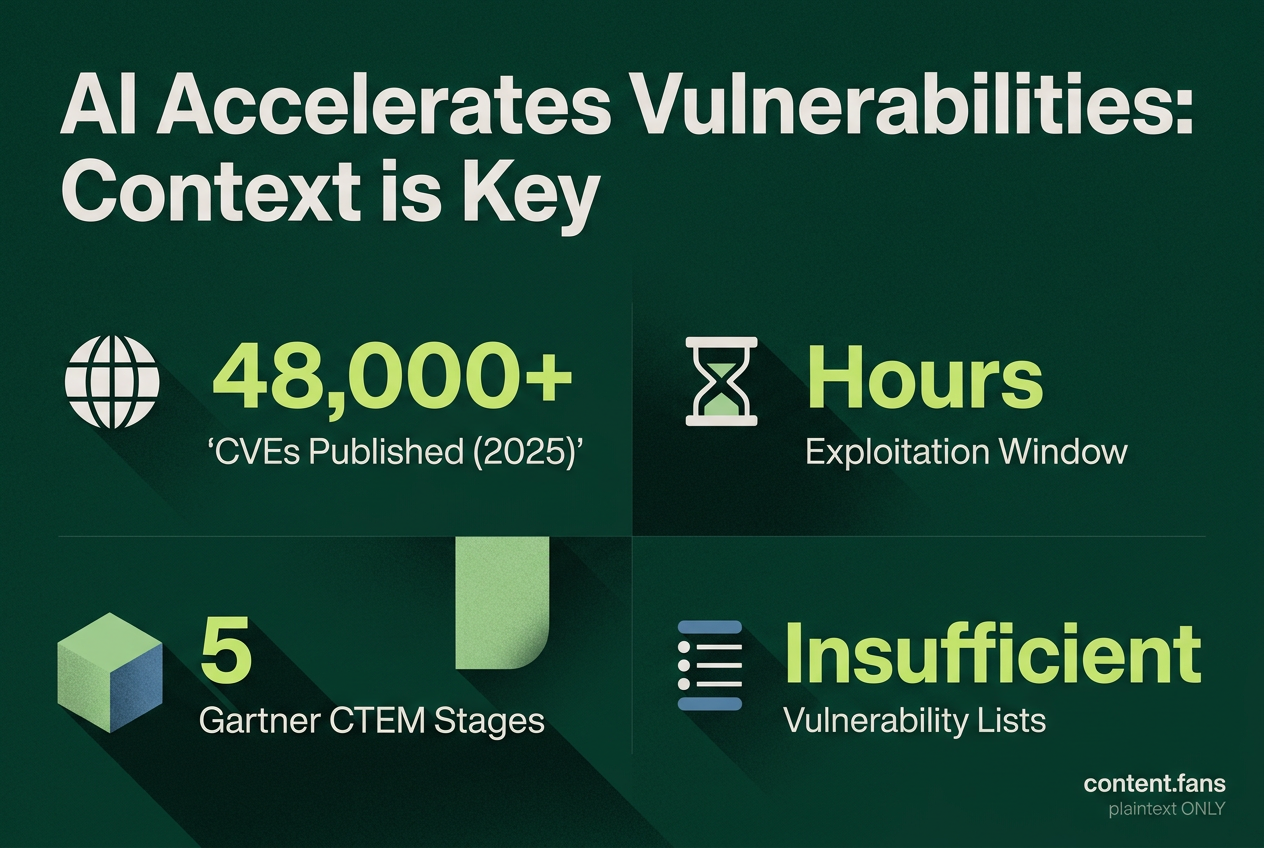
In its guidance on evolving vulnerability management, Gartner states that factors like asset value, exploit prevalence, and network reachability must outweigh raw CVSS scores. According to industry reports, ranked vulnerability lists alone are insufficient and must be replaced by continuous, risk-aligned programs.
This argument is amplified by the acceleration of AI-powered discovery tools. Multiple sources indicate that over 48,000 CVEs were published in 2025; early‑2026 growth is substantial but continues to accelerate. Compounding this issue, gaps in the National Vulnerability Database often leave new entries without severity data, making organizational context essential for effective triage.
From lists to five stage programs
Gartner structures this context-driven triage within its Cyber Threat Exposure Management (CTEM) framework. This is a continuous, five-stage program encompassing scoping, discovery, prioritization, validation, and mobilization, as detailed in a five stage CTEM model summary. The process begins with scoping business priorities and discovering threats across all attack surfaces, followed by validating whether prioritized weaknesses are genuinely exploitable in the live network.
Organizations that enrich this process with data on network segmentation, compensating controls, and asset ownership report significant improvements in Mean Time to Remediation (MTTR), as tickets are routed to the correct teams with appropriate urgency.
AI compresses the window to hours
This need for speed is critical. According to industry reports, the average time from public disclosure to active exploitation has dropped significantly in recent years. For some vulnerabilities, this window shrinks to mere hours. Security programs reliant on monthly patch cycles are ill-equipped to manage this compressed timeline.
Practical steps highlighted in the guidance
Gartner-aligned summaries outline repeatable moves that reduce exposure without overwhelming staff:
- Maintain a dynamic asset inventory with tags for business criticality and ownership.
- Correlate vulnerabilities with threat intelligence and network path data to pinpoint currently exploitable issues.
- Automate remediation workflows by integrating with ITSM or developer platforms, enforcing clear service level agreements (SLAs).
- Validate remediation effectiveness through follow-up scans, tracking metrics like MTTR and the closure rate of high-risk exposures.
- Apply compensating controls, such as virtual patching or network segmentation, to protect legacy or unpatchable assets.
Advisories from vendors like Device42, Ivanti, and CrowdStrike reinforce these steps, emphasizing the need for continuous asset discovery and automated deployment to reduce human bottlenecks.
Reporting that resonates with executives
Gartner emphasizes that executive reporting must shift from patch counts to risk reduction. As highlighted by industry analysts, metrics tied directly to business impact are essential for securing leadership engagement and budget. Effective KPIs include the percentage of "crown jewel" assets free of exploitable flaws or the total reduction in exposure hours quarter-over-quarter.
By framing vulnerability data within the context of network architecture and business risk, an exposure management program enables organizations to focus finite resources on the weaknesses that adversaries are most likely to exploit, effectively shrinking the critical window between discovery and defense.
What has changed in vulnerability management that makes this Gartner guidance urgent?
AI is finding vulnerabilities orders of magnitude faster than humans ever could, while exploit timelines have collapsed to negative seven days - attacks now arrive before patches exist. The 2025 CVE inflow reached significant levels, and conservative projections suggest we could approach substantial growth as AI tools mature. Traditional, monthly patch cycles simply cannot keep pace, so context-aware prioritization and automation are no longer nice-to-haves; they are the only mechanisms that can shrink the mean time to exposure reduction instead of watching it grow.
How does Gartner define "network context" for prioritizing remediation?
In Gartner's framing, network context is the combination of environmental factors that determine whether a vulnerable asset is actually exploitable in your specific environment. This includes:
- Asset value and business criticality - a server that hosts customer PII is treated differently than an internal dev box
- Current network reachability - is the asset directly exposed to the internet, or inside a segmented subnet?
- Compensating controls - firewalls, zero-trust agents, WAF rules or EDR protections may render an otherwise high-CVSS flaw moot
- Real-time exploitability data - active threat-intel showing exploit code is already circulating
By weighing these factors, security teams can stop over-patching low-risk assets and instead reduce the exposure window of the small percentage of issues that truly matter.
What concrete metrics should security leaders track to measure success?
Replace raw CVE counts and patch-percentage dashboards with outcome-oriented KPIs that map directly to risk reduction:
- Mean Time to Exposure Reduction (MTER) - hours or days between discovery and verified mitigation of a critical exposure
- SLA adherence rate - percentage of exposures remediated within the pre-agreed service-level threshold (often 48-72 h for critical assets)
- Critical asset exposure window - the cumulative minutes per month that top-tier assets remain reachable with exploitable flaws
- Validation failure rate - percentage of "fixed" tickets that later tests still show exploitable
Programs that track these numbers see significantly faster mean remediation times compared to those still chasing simple patch volume.
Which automation steps actually reduce exposure time without increasing risk?
Forward-looking teams run a seven-step closed loop supported by playbooks and integrations rather than ad-hoc tickets:
1. Continuous, risk-scoped discovery - asset inventory plus vulnerability scans limited to the business-critical scope first
2. Automated risk scoring - combine CVSS, asset criticality, exploit prevalence and network path into a single priority score
3. Auto-ticket creation - findings push into ServiceNow/Jira with owner, SLA, rollback plan and test criteria already pre-filled
4. Staged automation - low-risk systems get auto-patching; mission-critical systems trigger a workflow that includes QA gates
5. Pre- and post-validation scans - confirm exploitability both before and after the fix
6. Status-sync back to CMDB - so the asset inventory stays accurate for the next cycle
7. Executive dashboard roll-up - real-time exposure metrics for leadership without manual spreadsheet work
This approach has enabled organizations to shrink median remediation times significantly.
How do you handle legacy or unpatchable assets that are nevertheless business-critical?
For OT systems, medical devices, or end-of-life software, Gartner-aligned guidance recommends compensating controls in place of traditional patching:
- Virtual patching (IPS/WAF signatures or host IPS rules) blocks known exploit patterns
- Network segmentation isolates the asset so lateral movement requires an additional breach
- Recertification of least-privilege access ensures only necessary users or services can reach the device
- Enhanced monitoring triggers alerts on any anomalous traffic or authentication attempt
Industry studies show that teams combining virtual patching with strict segmentation can substantially reduce the effective exposure surface of unpatchable systems, demonstrating that "can't patch" does not have to mean "can't protect."