
GameDiscoverCo Warns Studios on AI "Shovelware" and Data Leaks
Serge Bulaev
GameDiscoverCo warns that game studios may face two problems with AI: sensitive data might leak, and stores could fill up with low-quality AI-made games. Some studies suggest that AI tools have limits, and many players might avoid games made with AI. There is a risk that AI changes or mixes up important information, making it harder for real indie games to be noticed. Studios appear to be testing ways to protect their data and control what AI can use, instead of waiting for new laws. The newsletter suggests that balancing automation with human checks may help studios use AI safely without losing trust or quality.

GameDiscoverCo warns studios on the dual threat of AI "shovelware" and data leaks, as technical gaps and player mistrust grow. The warning highlights that sensitive game data can be exposed while storefronts flood with low-quality, AI-generated content. Citing recent trends, the analysis points to AI memory limits and growing concerns about AI-generated content quality (Steam's 2026 biz update).
The core problem is data access. For agentic AI to be effective, it requires deep integration with build logs, quest scripts, and telemetry. However, this broad access increases the risk of data leaks and unintentional content reuse. Studios are now balancing the benefits of AI automation against the need for proprietary controls to manage these exposure risks.
Rising editorial drift
Game studios face a dual AI threat: the risk of sensitive internal data leaking through integrated AI systems, and the challenge of discovery as digital storefronts become saturated with low-quality, AI-generated "shovelware." This trend threatens both data security and the visibility of genuine indie titles.
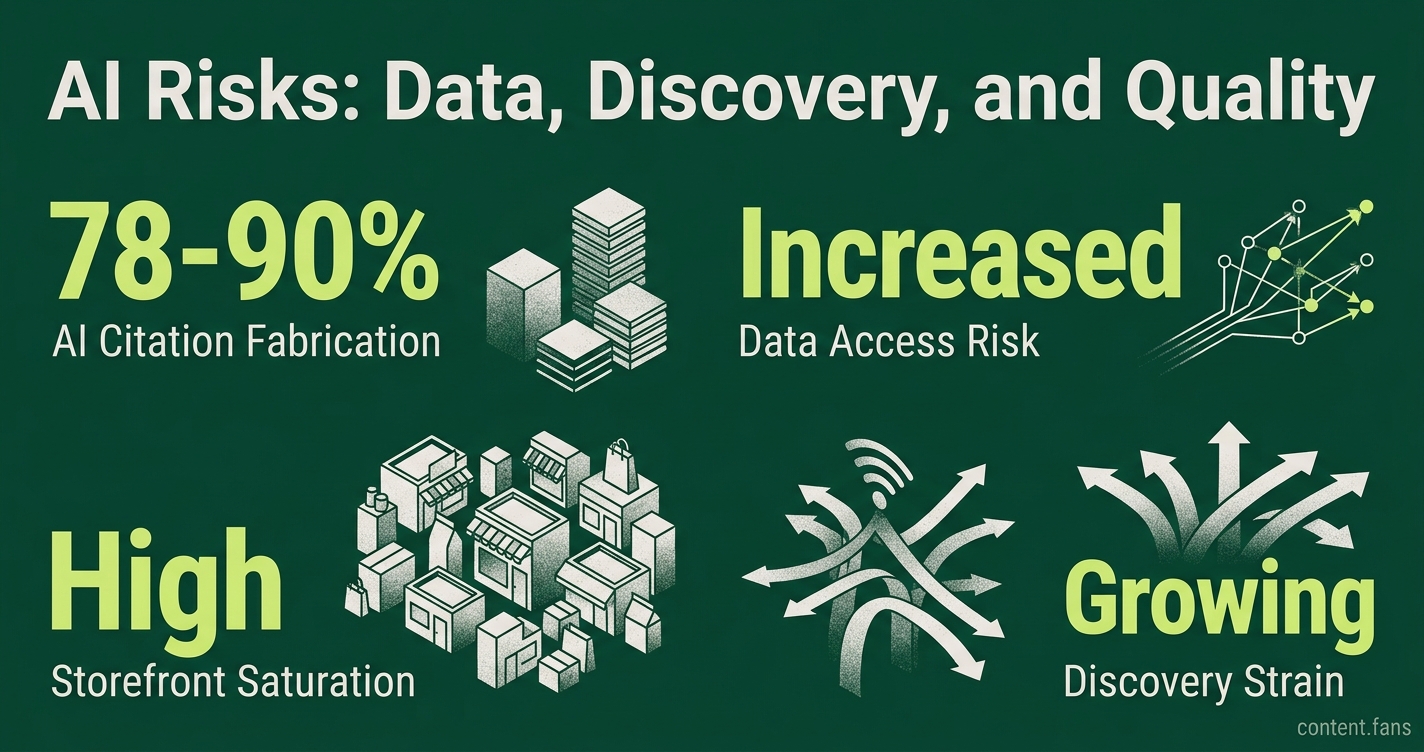
The danger of AI altering curated content is already evident in other fields. A 2026 report describing University of Washington and Ai2 research said GPT-4o fabricated 78% to 90% of research citations in tests. This proves that AI models can reshape facts and tone, even when working with existing data. In gaming, this translates to a surge of "AI shovelware flooding storefronts," which makes it increasingly difficult for authentic indie games to gain visibility and forces curators to expend more effort on filtering low-quality releases.
Governance responses to Beware Agent-Driven Editorializing and Content Borrowing
In response, studios and publishers are proactively implementing layered safeguards using existing legal frameworks, rather than waiting for new AI-specific legislation.
- Data segmentation - isolate raw source assets from agentic tools unless a feature requires live linkage.
- Machine-readable rights reservations under EU DSM Article 4 for public webpages.
- Contract clauses that bar model training on licensed telemetry or narrative scripts.
- Human-in-the-loop review of store copy, trailers and any AI-flagged content before submission.
Legal experts note that existing laws like the DMCA and CFAA can address unauthorized scraping that bypasses access controls. Copyright claims remain a key tool, contingent on proving substantial similarity. However, with U.S. fair-use litigation still evolving, the legal landscape remains dynamic.
Discovery tooling under strain
As AI lowers the barrier to game creation, the volume of new releases is outpacing the ability of store algorithms to keep up. GameDiscoverCo suggests this puts discovery tools under strain and increases the value of third-party curators who can verify a game's originality and provenance. The ease of creating derivative content is amplified by AI, making quality curation more critical than ever.
The recommended path forward is not to abandon agentic AI but to adopt a balanced and strategic policy. Studios can harness the benefits of automation while mitigating risks by carefully mapping data flows, embedding clear licensing signals, and maintaining human oversight on all public-facing content. This approach allows for innovation without sacrificing quality or trust.
What exactly does GameDiscoverCo mean by AI "shovelware" and how is it already hurting curation on Steam?
GameDiscoverCo points to a surge of low-value or derivative releases that generative AI now makes possible at very low cost. In their latest Steam 2026 ecosystem newsletter they note that AI shovelware is flooding storefronts, raising the burden on human curators and recommendation systems. Industry reports suggest that many players express concerns about games produced with generative AI, according to Circana numbers quoted by GameDiscoverCo. The result is noisier catalog growth that drowns out titles that took genuine creative curation.
Why is proprietary game data more at risk once an "agentic" AI system is plugged in?
Agentic AI needs broad, cross-tool access to design docs, telemetry, code, and live-ops workflows to be useful. Industry analysts warn that this creates a data-governance problem: the more internal assets are connected, the greater the risk of over-permissioned access or inadvertent leakage. GameDiscoverCo's practical advice is to segment data so agents only reach the minimum assets necessary and to keep raw source files behind tightly scoped permissions.
Are players really turning against AI-generated content?
Yes. GameDiscoverCo relays findings from Circana showing that US player sentiment around generative AI is worsening. A significant portion of potential buyers would skip a game labelled "AI-ed", and Google DeepMind's own GDC demo of Genie 3 showed memory limits that break world consistency within about a minute, reinforcing player distrust. Studios therefore need to disclose AI use clearly and keep human review in the loop for store copy, trailers, and localization.
What legal tools can curators use today to prevent LLMs from reusing their datasets?
A comprehensive approach includes layered protection:
- Copyright - copyright law may support an infringement claim if a model reproduces protected expression without permission.
- Contract - add machine-readable opt-out clauses and license terms that ban training.
- Access controls - use DMCA anti-circumvention rules and CFAA claims against anyone bypassing paywalls or logins.
- Trade-secret designation - mark nonpublic parts of a curated database and document access logs.
The EU offers an extra lever: Article 4 of the DSM Directive lets rights holders reserve rights in machine-readable form, giving a clear legal basis to block text-and-data mining. In the US, courts are still deciding whether training itself is fair use, so provenance documentation is critical.
Where have we already seen curated content being editorialized or reshaped by AI?
Recent examples across 2024-2026 include:
- Scientific literature systems - A 2026 report found that GPT-4o fabricated citations in 78-90% of cases when asked to cite recent papers, showing how curated corpora can be editorialized into misleading output.
- Media archives - Fox trained LLMs on a vast library of articles, videos and images to extract "takes" (strong pundit opinions) for personalized engagement.
- Synthetic-data pipelines - arXiv papers document LLMs generating, curating, and then reshaping training sets, embedding prior model biases into downstream datasets.
These cases confirm that borrowing is rarely verbatim plagiarism; it is subtle reframing, ranking, or tone-shaping that can undermine the original curator's brand if attribution is weak.