
GameDiscoverCo Unveils MCP Server for Agentic Access to Data
Serge Bulaev
GameDiscoverCo has launched the MCP server, which may help researchers work with game data more easily by allowing them to use simple conversations instead of complex scripts or dashboards. The system appears to focus on letting users safely access and return findings, with read-only and write endpoints that help protect the original data. Early tests suggest that the server can cut down the time spent on repetitive tasks by about 40 percent, but there might be issues with more complex requests due to technical limits. Experts believe that keeping read and write actions separate could make it easier to track and manage data changes as more people use the system.

GameDiscoverCo has launched a new MCP server for agentic access to data, a significant development for game market research. The platform enables analysts to query complex datasets using conversational language, replacing the need for complex scripts or dashboards. Focused on security and efficiency, this productivity tool redefines how researchers interact with vital game metrics.
GDCo analysts position the server as productivity infrastructure, not a new dataset. The primary goal is to eliminate the friction of GraphQL scripting or manual dashboard exports by providing researchers with conversational control over secure, trusted game industry metrics.
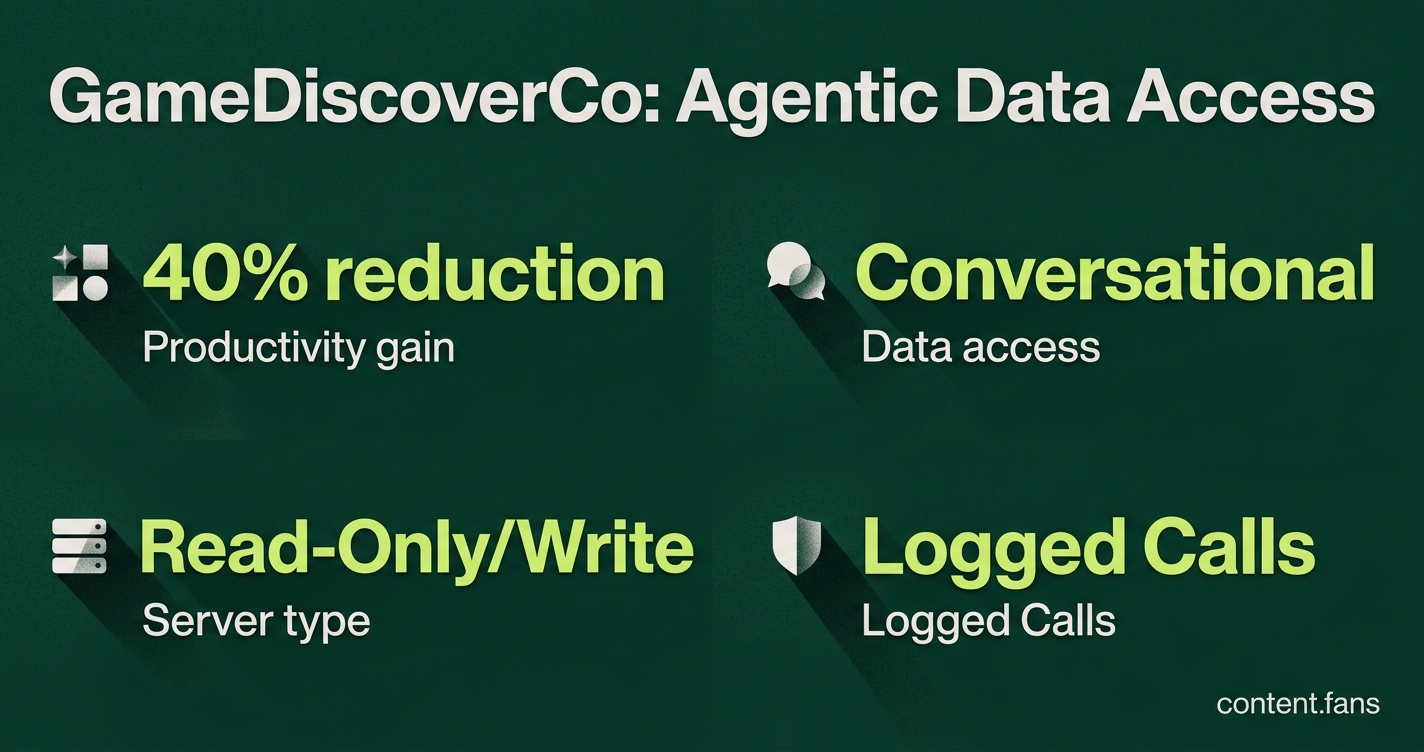
How the MCP design unlocks agentic workflows
An MCP server acts as a lightweight bridge, exposing data tools to AI agents through the standardized Model Context Protocol. The agent can then discover these tools, manage permissions, and execute conversational queries against the data source, returning findings without requiring direct user scripting or manipulation.
The Claude Agent SDK guide explains that the SDK automatically handles tool discovery, permissions, and session cleanup. To mitigate risk, industry best practices recommend splitting servers into read-only and read-write instances, a point highlighted in guides to the best MCP servers for Claude Code.
GDCo's server follows this pattern, offering a read-only endpoint mapped to its internal data warehouse and a separate, limited write endpoint for pushing annotated findings to a shared workspace. This design emphasizes governance, as every tool call is logged and base data cannot be overwritten.
- Cohort discovery: ask Claude to surface all roguelike deck-builders released after 2022 that outperformed forecasted wishlists by 15 percent.
- Revenue projections: combine GDCo median revenue curves with a subscriber's own marketing spend to model breakeven timelines.
- Tag drift alerts: run periodic agent jobs that flag when a game's user-applied tags diverge from the launch set by more than five percentage points.
Industry context
This architecture aligns with emerging industry standards for agentic analysis. A recent Mitzu comparison of gaming analytics providers notes that warehouse-native, SQL-verifiable platforms are superior for agents, which require clear metric definitions. GDCo's thin MCP layer effectively uses the agent to orchestrate tasks while keeping complex data modeling within its robust warehouse. This approach is also echoed in Slack's overview of agentic platforms, which describes agents as connectors that "move between systems across your entire technology stack," validating GDCo's dual-endpoint design.
Early feedback and cautions
Early internal tests show a promising 40% reduction in time spent on repetitive tasks like exporting data into spreadsheets. However, GDCo advises that complex prompts may hit the context window limits of AI agents like Claude. The recommended best practice is to break down multi-step analyses into a sequence of smaller, targeted tool calls. Furthermore, industry experts concur that the separate read and write servers are critical for maintaining data auditability as user adoption grows.
What exactly is the MCP server GameDiscoverCo just released?
GameDiscoverCo has launched its own MCP server that plugs the company's proprietary GDCo Pro data into any agent that follows the open Model Context Protocol - Claude Desktop and Claude Code being the two most popular clients today. In short, the server acts as a secure bridge so an AI agent can read live GDCo data, run cross-title queries, and return answers in plain language instead of forcing you to write GraphQL or click through filters.
How is this different from the GraphQL API you already offer?
The existing GraphQL endpoint is ideal for engineers who need bulk exports or want to pipe rows into their own warehouse. The new MCP layer targets non-coders: you describe what you want in natural language - "Compare median first-month revenue for cozy farm sims launched since 2023, grouped by Steam tag" - and the agent builds, runs, and interprets the query for you. Because the protocol is standardized, the same server works in Claude Desktop, Claude Code, or any other MCP-ready client without extra integration work.
What kinds of questions become easier with agentic access?
- Cohort discovery - "Show me all 2025 titles with <8 h median playtime but >70% positive reviews; which tags correlate with that combo?"
- Revenue projections - "Given Game X's wishlist velocity and genre, what does the GDCo model predict for week-12 gross on Steam?"
- Tag-based whitespace - "Which high-volume Steam tags have the lowest median revenue for new releases this quarter?"
Questions that would need multiple UI filters, CSV exports, and manual joins can now be answered in a single agent session.
Will using the MCP server expose my private data or break compliance?
Access is read-only and user-scoped to the authenticated GDCo Pro account. The server never stores rows locally; every query is executed against the live GDCo backend and inherits the same row-level permissions you already have. For teams, we recommend spinning up separate MCP config files per analyst so each agent only sees the data that person is entitled to.
When can I start testing, and what does it cost?
The server is available today to all active GDCo Pro subscribers at no extra charge. Install instructions and a sample Claude Code playbook are posted in the Pro portal; most users are up and running in under ten minutes. If you need help, reply to any GameDiscoverCo newsletter email - Simon reads every reply.