
GameDiscoverCo report: Steam player average age hits 33
Serge Bulaev
A recent GameDiscoverCo report suggests the average Steam player age is about 33 years. The study uses voluntary surveys from players who bought certain popular games and found that older players often prefer strategy and singleplayer games, while younger players may like multiplayer or horror games. The results might not show the whole picture because the survey was only in English and had more responses from very active players. Marketers may use this data to better target different age groups, but the report notes that interest in buying games may depend more on how much someone plays than just age alone.

The latest GameDiscoverCo report establishes new insights, revealing that the median age of its sampled Steam Fan Snapshot group is 33 years. This key figure comes from the company's Steam Fan Snapshot, which analyzed data from popular titles that have achieved significant sales since early 2020. The research is based on an opt-in survey linking anonymized user libraries to survey responses, enabling detailed demographic analysis.
How the Snapshot Was Built
The methodology relies on voluntary participation, which means the data primarily represents highly engaged Steam users - a factor GameDiscoverCo notes creates a 'filter bubble.' However, by connecting survey answers directly to individual Steam libraries, the Snapshot provides granular, game-specific demographic insights that standard analytics cannot offer.
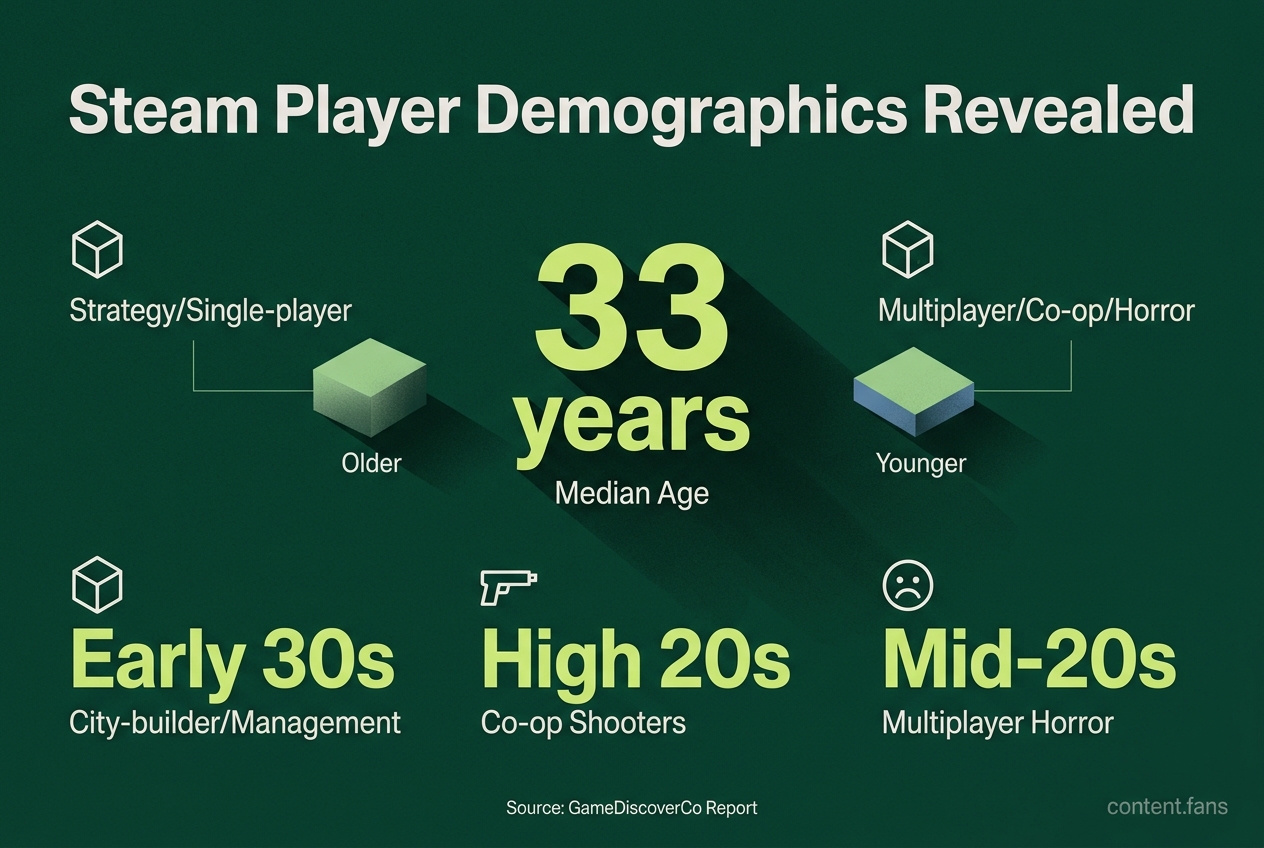
A comprehensive analysis by GameDiscoverCo indicates the median age of its Steam Fan Snapshot sample is 33 years old. This data comes from a large-scale, opt-in survey of players who own popular games. The findings reveal demographic trends that vary significantly across different game genres and play styles.
Age Differences by Tag Profile
The data reveals significant age disparities based on Steam's game tags. Strategy and single-player games attract an older demographic, with industry reports suggesting these genres skew toward older players. In contrast, genres like multiplayer, co-op, and horror appeal to a younger audience in their mid-to-late twenties. These patterns confirm that genre is a strong indicator of a player's age.
Key age distributions by genre include:
* Strategy & Single-player: Older demographic
* City-builder & Management: Early 30s
* Co-op Shooters: High 20s
* Multiplayer Horror: Mid-20s
* Puzzle & Casual: Broad distribution across age ranges
Sample Constraints and Limitations
It is crucial to acknowledge the report's limitations. The survey was conducted only in English and used incentives for participation, leading to potential sampling bias. This resulted in an over-representation of 'hardcore' players and Steam Deck owners, while likely undercounting non-Western audiences. Consequently, the figures should be interpreted as directional indicators, not precise demographic facts.
Why This Data Matters for Marketers
This demographic data is invaluable for game marketers. As the player base ages and weekly engagement peaks in the 25-44 age bracket, publishers can use these insights to refine their strategies. The report's tag-specific age data helps guide marketing channel selection and creative tone. For example, a city-builder campaign might target adults on YouTube, while a co-op horror title could leverage creator partnerships on TikTok. While the report cautions that purchase intent is influenced more by engagement than by age, these demographic patterns offer a practical map for targeting players by genre.
What does "median Steam Fan Snapshot age = 33" actually mean and how was it calculated?
The figure comes from the GameDiscoverCo Steam Fan Snapshot, an opt-in player survey linking anonymized Steam library data to over 10,000 English-language responses. To qualify, players owned games released in recent years that achieved significant sales success. Due to voluntary participation, the sample skews heavily toward core enthusiasts, so the 33-year median should be seen as a directional insight, not a precise census of the entire platform.
Which genres are pulling the age curve older or younger?
The dataset reveals clear age divisions by genre tag. The trend is consistent across both AA and AAA titles, making genre a reliable proxy for age.
* Older Skew: Single-player, Strategy, Turn-Based Strategy
* Younger Skew (Mid-to-Late 20s): Multiplayer, Co-op, Horror
The difference is significant: a "Turn-Based Strategy" game's audience is, on average, several years older than that of a "Co-op Horror" title.
How reliable is the data for marketing segmentation?
The data is best used as a high-level guide for initial segmentation, not a definitive plan.
* Strengths: The sample size is large enough to identify consistent correlations between genre and age. The linked data also allows developers to benchmark their titles against category averages privately.
* Limitations: The English-only, opt-in nature creates a strong Western and enthusiast bias, under-representing casual players and other regions. GameDiscoverCo advises against using this "snapshot" for granular user research.
How are publishers adjusting marketing strategies after seeing these age curves?
Publishers are evolving from age-based targeting to motivation-based campaigns.
* For Older Cohorts (Strategy, RPGs): Marketing emphasizes nostalgia and gameplay depth, using long-form content on platforms like YouTube and Reddit, where viewer demographics align with the 30-45 age group.
* For Younger Cohorts (Multiplayer, Co-op): The focus shifts to short-form content and creator partnerships on TikTok and Twitch, which resonate with the younger, socially-driven audience.
This aligns with broader industry data showing the 25-44 age group has the highest engagement and spending, prompting even youth-focused brands to broaden their messaging.
Can I replicate the age-genre analysis for my own Steam game?
Yes, developers can create a similar analysis for their own titles. This hybrid approach provides a defensible starting point for developing creative briefs and planning user acquisition channels.
1. Export your game's Steam tags and public review data.
2. Use a public resource like the Steam Games Metadata and Player Reviews 2020-2024 dataset to benchmark genre classifications.
3. Analyze the self-reported ages in public reviewer profiles to calculate a weighted average, then compare this figure to GameDiscoverCo's published medians.