
Game studios face new AI agent copyright and liability risks
Serge Bulaev
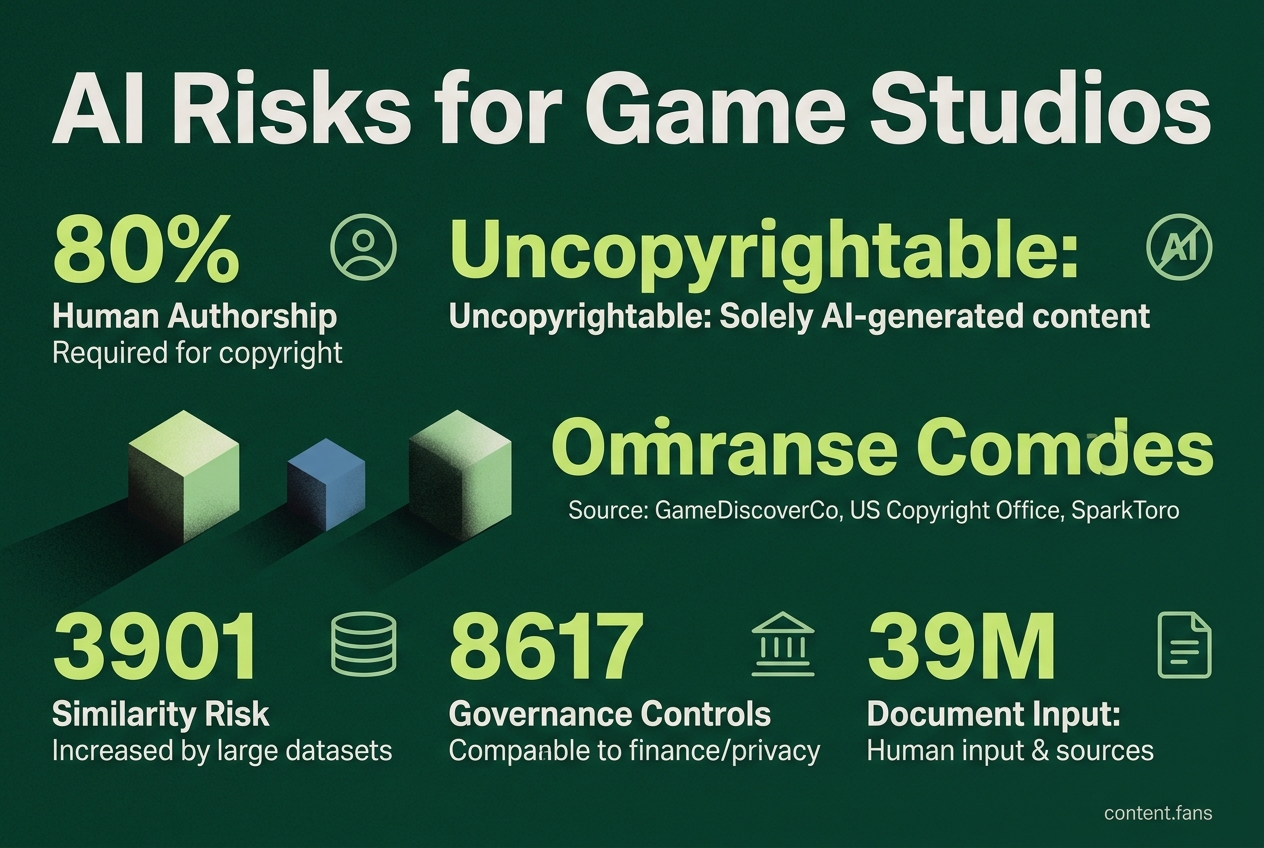
Game studios may face new risks when using AI agents, including copyright and liability problems. AI systems might remix or copy original content without proper credit, and outputs made only by AI may not be protected by copyright. Legal experts warn that when AI uses large datasets, it becomes easier to accidentally copy parts of protected works. Because of these risks, studios are advised to use strong controls and human oversight when letting agents access curated data. Continued legal uncertainty suggests that studios should document human input and sources carefully to protect their work.

Game studios may face new risks when using AI agents, including copyright and liability problems. AI systems might remix or copy original content without proper credit, and outputs made only by AI may not be protected by copyright. Legal experts warn that when AI uses large datasets, it becomes easier to accidentally copy parts of protected works. Because of these risks, studios are advised to use strong controls and human oversight when letting agents access curated data. Continued legal uncertainty suggests that studios should document human input and sources carefully to protect their work.
Thought Piece: Beware Agent-Driven Editorializing and Content Borrowing has moved from theory to daily risk for game publishers and content curators. GameDiscoverCo flags that giving autonomous agents direct access to proprietary data increases the chance that the agent will remix or paraphrase curated text without correct attribution.
Recent legal analysis shows the same pattern in court filings. Plaintiffs argue that AI systems can reproduce near-verbatim passages that undermine the market for the original work. This suggests a growing tension between productivity gains and intellectual-property exposure.
The nut graf: Current guidance says firms should treat agent access to curated datasets as a copyright and brand-protection issue, with governance controls comparable to finance or privacy policies.
Why Game Studios Care About Thought Piece: Beware Agent-Driven Editorializing and Content Borrowing
Game studios face significant IP risks from AI agents, which can reproduce copyrighted material without attribution. Outputs created solely by AI may be uncopyrightable, leaving assets unprotected. This dual threat involves both infringing on existing IP and failing to secure ownership of new, AI-generated content.
Legal sources point to two core dangers. First, outputs created wholly by an AI agent may be uncopyrightable. The U.S. Copyright Office's 2025 "Copyrightability Report" states that material generated without meaningful human authorship is outside normal protection. Second, similarity risk rises because models draw from massive training sets. A 2025 EU-focused legal guide for gaming warns that unintentional overlaps with protected works become more likely when prompts are broad or generic.
SparkToro's "AI content is the new floor thesis" adds a market angle: low-cost LLM text floods the web, compressing the value of genuine analysis. GameDiscoverCo echoes that fear, warning that loyalty built on hand-curated insights can erode when an agent silently repackages the same insights at scale.
Output Liability and Ownership Gaps
Industry reports note that expressive assets such as character icons or level layouts generated by an unsupervised agent might sit outside copyright and invite cloning. Lawyers reportedly describe this as a two-sided threat - studios may infringe someone else while failing to protect their own derivative output. Ongoing U.S. and EU litigation over training data also raises questions about who shoulders liability when a model reuses protected fragments.
Governance Controls to Reduce Borrowing Risk
Regulators and industry bodies recommend agent-specific controls:
- Inventory every agent that can read or write content inside the CMS.
- Enforce read-only access by default and log every transformation.
- Require citations for each external fact and quotation marks for verbatim text.
- Route high-impact outputs to human review before publication.
- Maintain immutable audit trails that capture prompts, retrieved sources, and approval decisions.
IMDA's Model AI Governance Framework stresses strong authentication and scoped credentials, while CSA research advises tiered guardrails that limit agent action boundaries. These measures may deter silent editorializing and simplify incident response when attribution fails.
Economic Signals Worth Watching
SparkToro observes that LLMs display recency bias and prefer extractable structured data, meaning fresh curated reports could be summarized faster than older archives. At the same time, industry reports indicate multiple complaints alleging that agentic systems reproduced headlines or paragraphs without permission. Experts believe that continued legal uncertainty will push studios to prove human creative input in key assets and to document sources meticulously.
What new IP risks do AI agents introduce for game studios?
AI agents can now autonomously browse proprietary databases, forums and curated asset libraries faster than any human, which means they can unintentionally reproduce or remix protected content at scale. Recent legal commentary notes that if an agent generates expressive game elements (icons, UI layouts, character sketches) without meaningful human authorship, those assets may receive no copyright protection and become easy targets for cloning. National Law Review and Bird & Bird both stress that purely AI-generated outputs fall outside traditional copyright boundaries unless a human has demonstrably shaped the final expression.
How can agentic reuse devalue curated game content?
SparkToro frames the danger succinctly: "AI content is the new floor" - a flood of cheap, derivative text and imagery that can compress the perceived value of carefully curated guides, wikis and lore libraries that studios host to support their communities. When agentic systems surface recency-biased or extractive summaries without clear attribution, original curators often lose traffic and brand authority, even when no formal infringement has occurred. This commoditization risk is separate from, but parallel to, the legal exposure that arises when outputs overlap with third-party copyrighted material.
Which governance controls best protect proprietary curation?
Many studios are implementing tiered agentic guardrails:
- Inventory and classification of every content agent and its data sources
- Read-only access by default to editorial databases and asset libraries, with explicit approval required for any publish/write action
- Immutable audit logs that record prompts, retrieved sources, citations inserted and human reviewer decisions
- Attribution rules baked into workflow, forbidding "silent rewriting" of creator content, and mandating quotation marks plus source metadata for verbatim excerpts
These controls sit inside broader AI governance programs that emphasize human-in-the-loop publication decisions as the final safeguard.
What happens if an AI agent accidentally reproduces third-party IP?
The studio faces two simultaneous liabilities:
- Infringement risk: if the generated asset is too close to an existing protected work, the studio can be sued for direct or vicarious infringement;
- Loss of exclusivity: even if no third-party claim emerges, the asset may receive no statutory copyright protection because the Copyright Office requires human authorship to grant rights. The U.S. Copyright Office 2025 report concludes that purely AI-generated material is not protected by copyright, but AI-assisted works can still receive protection for human-authored expressive elements, perceptible human contributions, and creative selection, coordination, arrangement, or modification.
How should studios balance agentic productivity against these risks?
The most effective approach is to treat agents as amplifiers of human creativity, not replacements:
- Define human creative checkpoints - every asset or article must pass a human review that confirms originality and adds protectable expression
- Use prompts that require explicit citation and attach any reused source under a CC-BY or studio-approved license
- Maintain a living risk register that quantifies potential IP exposure per agent use-case (marketing blog vs. internal QA documents)
- Deploy continuous monitoring to catch drift, citation failures or duplication before publication
By embedding these governance layers, studios can still reap the speed benefits of agentic workflows while preserving both the commercial value of their original curation and their liability shield against third-party claims.