
FTI unveils $80.5M modular plant in Louisiana, creating 500 jobs
Serge Bulaev
Faith Technologies Incorporated (FTI) announced plans for an $80.5 million modular manufacturing plant in Ouachita Parish, Louisiana, which is expected to create around 500 jobs. The company says the plant will use modular and lean methods to build electrical houses and substations, aiming to make construction faster, safer, and more consistent. Reports suggest this approach may lower labor hours and improve quality by moving work indoors. While 500 jobs is a small part of Louisiana's recent manufacturing growth, the project might offer higher wages and benefit from local incentives. Construction could start later this year, with production lines starting up in phases if permits are approved.

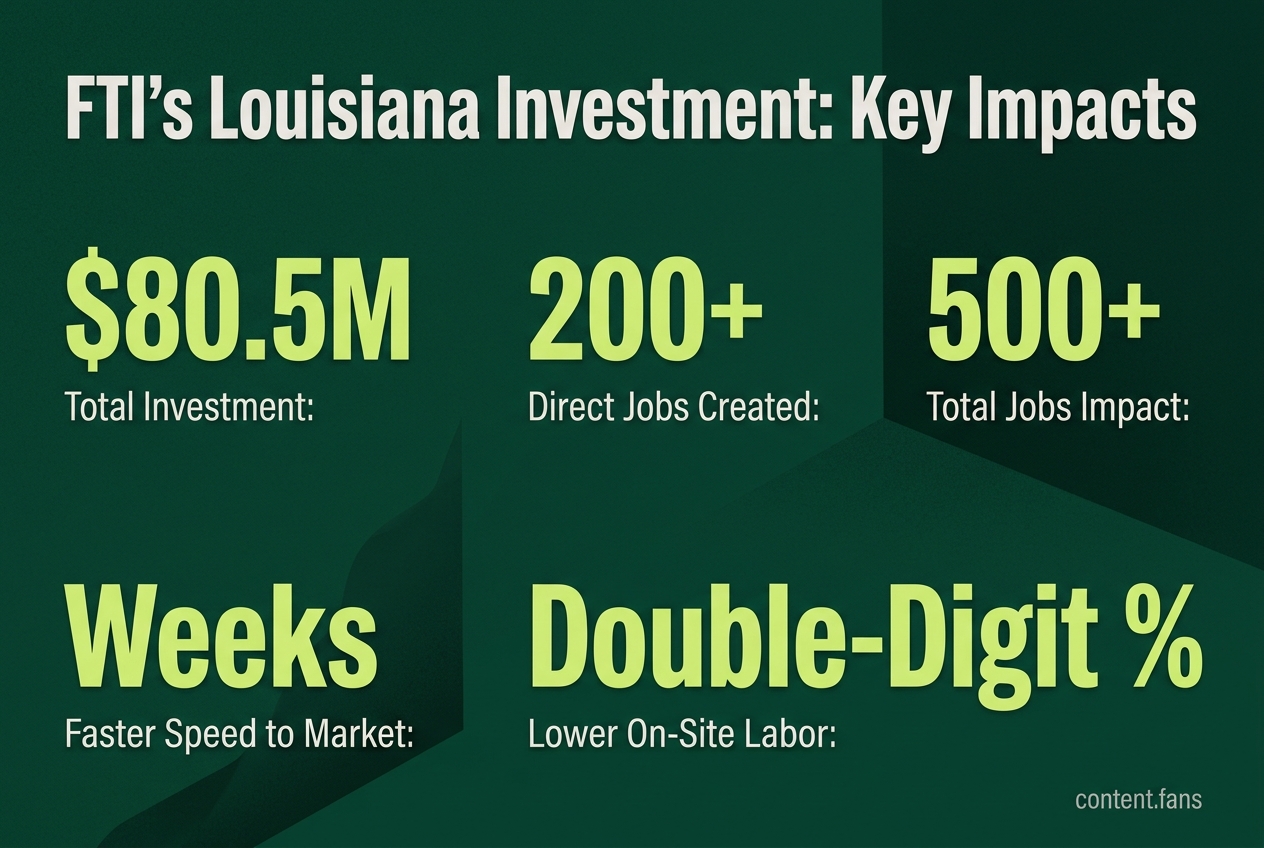
Faith Technologies Incorporated plans an $80.5 million manufacturing facility in Ouachita Parish that is expected to create at least 200 direct jobs, with an additional 350 indirect jobs estimated for a total potential impact of more than 500 jobs. The Ouachita Parish facility, operating under FTI's Excellerate brand, will use lean manufacturing methods to produce integrated electrical assemblies for industrial clients.
A brief filed with Louisiana Economic Development confirms the plant will fabricate electrical houses (e-houses), unit substations, and other power assemblies in a controlled manufacturing setting. FTI officials state this industrialized construction approach shifts labor off the jobsite, cuts waste, and increases schedule certainty.
Core update signals and modular momentum
FTI's modular construction approach moves complex electrical assembly from an unpredictable job site into a controlled factory. This method is designed to accelerate project timelines, improve quality through standardization, enhance safety by reducing on-site hazards, and provide greater cost and schedule certainty for large-scale industrial clients.
The benefits of modular construction are well-documented. FTI quantifies these advantages for its Excellerate brand:
- Faster Speed to Market: Fully wired modules reduce on-site commissioning time by weeks.
- Lower On-Site Labor Hours: Internal studies show double-digit percentage drops in field man-hours after work is moved inside the plant.
- High Consistency and Repeatability: Repetitive builds in a climate-controlled space limit variability.
- Improved Safety: FTI reports lower incident rates by minimizing high-risk on-site activities like trenching and lifting.
- Tighter Quality Control: Inspections are centralized at fixed stations instead of scattered job locations.
- Reduced Site Disruption: Pre-assembled eSkids minimize excavation and heavy-equipment movements.
Industry publications echo these claims. Expansion Solutions Magazine noted that Excellerate's lean manufacturing model "enhances quality, productivity, and safety" for large industrial clients link. A company service page also details how industrialized construction builds can "reduce labor hours" while improving repeatability link.
Louisiana's recent manufacturing growth
FTI's investment joins a significant wave of industrial growth in Louisiana. According to industry reports, the state has attracted many new projects representing substantial capital investment and creating thousands of direct new jobs in recent years. While Excellerate's job footprint is a smaller piece of this total, it is meaningful, particularly as wages at similar FTI plants often track above local industrial norms. The 1012 Industry Report said the Ouachita Parish project could draw on Louisiana's existing incentives for advanced manufacturing and a workforce pipeline tied to technical colleges link.
Competitive field for prefabricated electrical buildings
According to industry reports, the global market for prefabricated electrical buildings represents a significant and growing sector. Global Info Research places FTI in a fragmented market that includes competitors like ABB, Eaton, GE, and Siemens. In response to strong demand from data centers and other power-dense projects, Excellerate has been expanding its capacity with new facilities in Alabama and Texas.
Construction on the Louisiana facility is scheduled to begin later this year, pending final permit reviews. FTI representatives said production lines will ramp up in phases, reflecting the modular ethos of building in repeatable, scalable blocks.
What exactly will the new Louisiana facility manufacture, and why is it a big deal for industrial clients?
The $80.5 million plant in Ouachita Parish is FTI's first Louisiana location for Excellerate, FTI's brand that builds modular electrical buildings (eHouses), unit substations, generator enclosures, and related power modules in a controlled factory environment.
Industrial users - especially data-center and advanced-manufacturing operators - see several immediate benefits:
- Faster speed to market: Factory-built assemblies can be shipped "ready to integrate," reducing installation, commissioning and startup time at the jobsite.
- Safer, cleaner sites: Off-site construction reduces trenching, excavation hazards and weather-related delays.
- Higher repeatability: Each module is built to spec, delivering high consistency and repeatability that, according to FTI, has already improved productivity across existing Excellerate factories.
Sources: Excellerate overview, eHouse product page
How many jobs will the project create, and what does "500 direct and indirect" actually mean?
FTI publicly commits to more than 500 direct and indirect jobs. Based on recent Louisiana manufacturing announcements tracked by the state, the split typically follows this pattern:
| Recent LA projects | Direct jobs | Indirect + construction | Total |
|---|---|---|---|
| Hyundai steel mill | Many | Thousands | Thousands |
| Sasol complex | Over 1,000 | Thousands | Thousands |
| FTI Excellerate (announced) | 200+ | 350 | >500 |
- Direct jobs: Permanent positions at the plant, such as assembly technicians, engineers, supervisors, and logistics staff.
- Indirect jobs: Supply-chain roles, local transportation, maintenance, and professional services that expand as the facility ramps up.
According to industry reports, industrial capital investments typically generate multiple jobs across all categories for each million dollars invested.
Why is Louisiana winning many modular-construction investments right now?
Louisiana Economic Development has announced many new projects worth substantial capital investment and thousands of jobs in recent years, with many more projects in development.
Key drivers behind the growth include:
- Competitive incentives: LED routinely packages performance-based grants, workforce-training dollars, and fast-track permitting for major projects.
- Strong wage benchmarks: Recent clean-manufacturing and steel projects advertise competitive average salaries, helping suppliers like Excellerate attract skilled labor.
- Deepwater port and rail access: Moving oversized eHouse modules benefits from direct barge and heavy-haul corridors into the Gulf Coast industrial corridor.
These macro tailwinds mean FTI's job creation project slots into a much larger project pipeline the state is managing.
How does Excellerate's modular approach compare with traditional stick-built electrical rooms?
The source confirms the process improves safety and reduces on-site labor through factory integration. The gains come from shifting a significant portion of electrical work into a climate-controlled factory, where panels, busways, lighting, and fire suppression are pre-tested before shipment. Customers also gain possible accelerated depreciation because the eHouse can be booked as capital equipment rather than construction-in-progress.
Sources: FTI safety blog, Excellerate eHouse page
What does the expansion mean for FTI's competitive position?
The source discusses safety improvements and the Excellerate process. The Louisiana plant positions Excellerate to significantly increase modular output without adding shifts at existing sites - crucial leverage in a market where lead time often decides the bid.
- Capacity boost: The Louisiana site joins existing plants, expanding total Excellerate manufacturing capacity.
- Market context: According to industry reports, the prefabricated electrical buildings market represents a significant and growing sector. FTI operates in North America alongside competitors like ABB, Eaton and Schneider Electric.
- Demand signal: FTI cites strong growth from data-center customers, with analysts expecting substantial increases in U.S. data-center power demand in coming years, keeping prefabricated electrical houses in high demand.