
Founders Mis-Hire Finance Talent By Ignoring Growth Stage, Outcomes
Serge Bulaev
Founders may mis-hire finance staff by not matching the hire to their company's growth stage or by focusing on job titles instead of needed outcomes. Bookkeepers handle past records, while strategic finance roles help plan for the future and may be needed as the company grows and finances get more complex. The text suggests listing clear, measurable outcomes for finance hires and adjusting roles as the company advances. Hiring senior finance talent too early might waste resources, so using part-time or outsourced options could be better until a full-time role is truly needed. Creating the right finance role for the company's stage may lead to better forecasts and fewer hiring mistakes.

Founders often mis-hire finance talent by defaulting to the first available accountant, only to find their cash projections are unreliable and board questions go unanswered. This expensive hiring loop is avoidable. The solution is to match the company's growth stage to the correct finance altitude and write the job description around outcomes, not titles.
Bookkeeping versus strategic finance
While bookkeeping records what happened, strategic finance uses that data to shape what happens next. According to Burkland Associates, bookkeeping is "recording prior activity," whereas strategic finance "helps plan runway, model growth, and prepare for fundraising." Mis-hiring often occurs when founders prioritize pedigree over capability and ignore the required "operating altitude" for their company's stage, as noted in a growth-stage hiring guide.
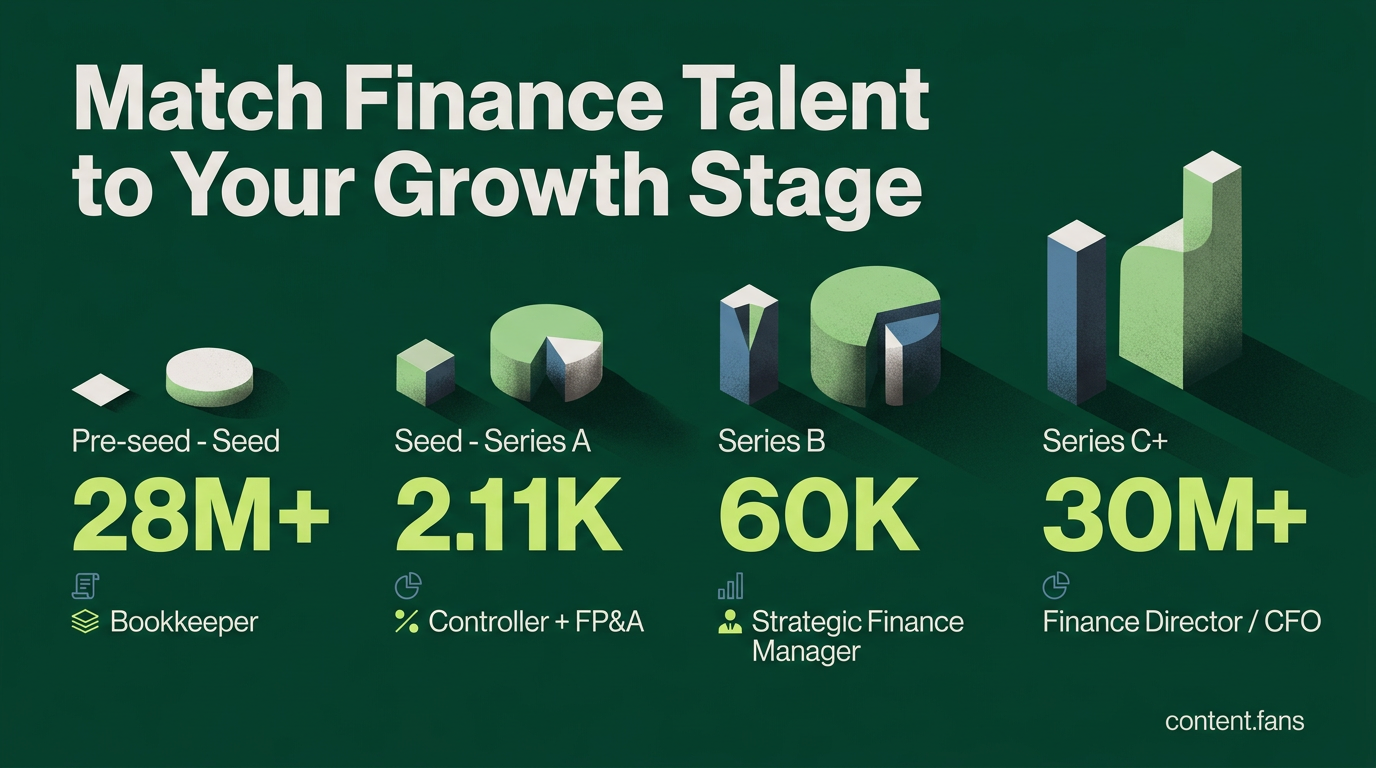
Founders frequently mis-hire finance talent by failing to align the role with their company's specific growth stage. They may hire a strategic CFO too early or a bookkeeper when forecasting is needed, leading to wasted resources, unreliable financial data, and a costly search for a replacement.
Stage-based triggers
| Stage | Common pain | Right hire | Contracting option |
|---|---|---|---|
| Pre-seed - Seed | messy books, tax stress | Bookkeeper or outsourced accountant | Fractional, hourly |
| Seed - Series A | monthly close still drifts; first forecasts needed | Controller plus part-time FP&A | Outsourced FP&A adviser |
| Series B | hiring spree, runway questions, board packs | Strategic finance manager | Fractional CFO for fundraising windows |
| Series C+ | multi-product P&L, scenario planning | Finance director or CFO | Project-based analysts |
As the table indicates, a full-time strategic finance role becomes essential only when the complexity of forecasting and modeling justifies the cost of senior talent.
Writing the job description
To attract the right talent, start by defining three to five measurable outcomes for the role. Example for a Series B strategic finance hire:
- Deliver a 24-month driver-based model within 60 days.
- Cut budget variance reporting cycle to five business days.
- Provide scenario analysis for headcount plans before each quarterly board meeting.
Avoid vague descriptions like "own finance." A strong candidate will test your clarity by asking, "What defines success for this role in one year?" If you can't answer specifically, the hire is likely to fail.
Interview framework (single bullet list)
- Request a real-world example of how they built a forecast from incomplete data that led to a change in spending.
- Present a messy trial balance and ask for their first three corrective actions.
- Propose a hypothetical revenue shortfall scenario and ask for distinct mitigation strategies.
- Assess their comfort with ambiguity: "Describe a time you made a critical recommendation without perfect data. What was the outcome?"
Onboarding checklist
- Secure admin access to accounting and payroll systems on day one.
- Agree on KPI definitions with founders within the first week.
- Map chart of accounts to the board reporting package by day 30.
- Schedule a monthly variance meeting with each budget owner.
- Document a rolling 13-week cash forecast cadence.
Reporting structure and runway stewardship
A bookkeeper or controller typically reports to the head of finance or can be an outsourced service. In contrast, a strategic finance leader thrives with a direct reporting line to the CEO. This ensures rapid decision-making while maintaining dotted-line accountability to the controller for data integrity.
Contracting versus full-time
Hiring senior talent prematurely "burns precious runway," as WTT Solutions warns. A fractional CFO can often handle fundraising and board prep for less than half the cost of a full-time hire. Transition to a full-time role only when the fractional cost exceeds a salary or when investors mandate a dedicated finance executive.
Final thought
Ultimately, precise role scoping, outcome-based job descriptions, and keen stage awareness are the keys to avoiding a costly finance mis-hire. The result is cleaner books, sharper forecasts, and founders who can focus on building their business, not rewriting job posts.
What is the real difference between bookkeeping and strategic finance?
Bookkeeping is transactional and backwards-looking: it records what already happened, reconciles accounts, closes the books, and ensures tax compliance. Strategic finance is analytical and forward-looking: it forecasts runway, builds scenario models, supports pricing decisions, and delivers the insight founders need to raise the next round or decide when to ramp burn.
How do I know which finance hire my startup needs right now?
Match the hire to the stage-appropriate job, not the title.
- Pre-seed / Seed: if you simply need clean books, hire a bookkeeper or fractional controller.
- Series A: once monthly closes are reliable and you must model headcount vs runway, bring in a controller + FP&A analyst.
- Series B/C and beyond: when the P&L has multiple products or segments and board decks must answer investor questions, add a strategic finance lead or head of finance.
Founders who jump straight to a senior strategic finance hire before the data foundation exists often burn runway on the wrong problems (Hager Executive Search checklist).
How should I write the job description to avoid mis-hiring?
Define three to five specific, measurable outcomes for the role in Year 1.
Example for a Strategic Finance Manager at Series B:
- Deliver a rolling 18-month cash forecast updated every two weeks
- Build a cohort-based churn model tied to product roadmap
- Prepare board package within five business days of each month-end
- Reduce cash burn variance through monthly re-forecasting
- Support next fundraise with investor-ready model, data room, and KPI definitions
If a role description cannot list such outcomes, you are hiring for optics, not impact (Hager Executive Search).
Is it safer to contract or go full-time first?
Many early-stage companies save significant costs by starting fractional. Industry practitioners commonly suggest:
- Bookkeeping: outsource until significant revenue and employee growth
- Controller: fractional until substantial burn rate and audit requirements emerge
- Strategic finance: fractional until later-stage funding rounds, then convert to full-time when monthly board reporting and fundraising become core business functions
This mirrors the caution voiced across sources that hiring a senior strategic finance leader too early can erode runway without added value (WTT Solutions).
Who should the first finance hire report to, and why does it matter?
The reporting line sets altitude and authority:
- Bookkeeper / Controller reports to the CEO or COO for day-to-day discipline.
- Strategic finance / Head of Finance reports directly to the CEO and sits in every exec meeting because their role is to transform numbers into operating decisions.
Anthony Rosen, CFO at Propeller Industries and veteran across 60+ startups, emphasizes that finance leaders who also understand operations, procurement, and margin improvement can only impact the business if they have seat-at-the-table authority (Anthony Rosen profile).