
Alibaba Unveils Zhenwu M890 Chip, Challenges Nvidia H100 with 144GB Memory
Serge Bulaev
Alibaba has announced the Zhenwu M890 AI chip, which is part of China's plan to depend less on US-made chips. The M890 has 144 GB of memory, which is more than Nvidia's H100, but its actual computing power is not yet confirmed. Experts suggest it might be a good local alternative for restricted US chips, though it may not match in all ways. Alibaba plans to update the chip line every year and says it has already shipped many units to different industries. Reports suggest China's share of its own AI chip market could reach about 50 percent in 2026, but there are still challenges with memory and technology supplies.

The introduction of the Alibaba Zhenwu M890 AI chip marks a pivotal moment in China's strategy for technological self-reliance. As part of a push to reduce dependence on U.S. hardware, Alibaba's T-Head unit positions the M890 as a powerful domestic alternative for AI workloads. The company claims the new chip is three times faster than its predecessor and has unveiled a multi-year roadmap extending to 2028. The accelerator is designed for both training and inference, making it suitable for advanced, long-context "agent" models link.
Beijing's backing of the Zhenwu line highlights a strategic fusion of industrial policy and corporate engineering, aimed at constructing a parallel AI hardware ecosystem within China's borders.
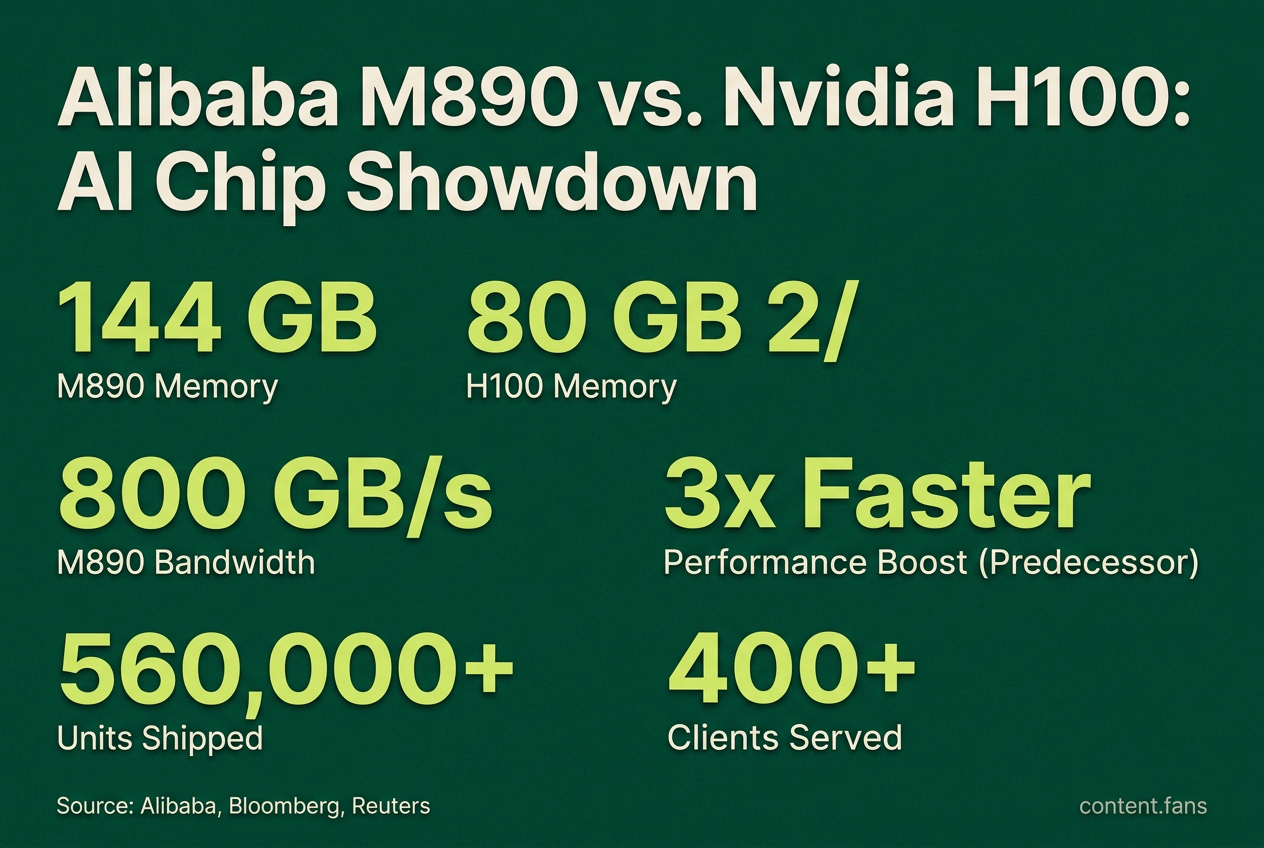
Alibaba M890 Specs: A Head-to-Head with Nvidia H100
The Alibaba Zhenwu M890 chip is a domestic AI accelerator designed to compete with restricted U.S. hardware. It features 144 GB of onboard memory, significantly more than Nvidia's H100. While its memory capacity is a key advantage, its actual compute performance (FLOPS) remains unconfirmed.
While Alibaba has confirmed the 144 GB memory and an 800 GB/s inter-chip bandwidth, critical details like peak FLOPS, manufacturing process, and power consumption have not been disclosed. Analysts note that while the M890's memory surpasses the 80 GB in a standard Nvidia H100, its overall throughput and efficiency are still unverified. This positions the M890 as a viable domestic substitute for restricted U.S. chips, though not necessarily a direct performance equivalent.
| Reported spec | M890 | Nvidia H100* |
|---|---|---|
| On-board memory | 144 GB | 80 GB |
| Inter-chip bandwidth | 800 GB/s | system dependent |
| Public FLOPS | n/a | 2,000+ TFLOPS (FP8) |
| * H100 figures reflect vendor documentation, not direct benchmarking. |
Roadmap Through 2028
Alibaba's T-Head has committed to an aggressive annual refresh cycle, signaling a long-term commitment to developing domestic AI hardware. The roadmap, detailed in a Reuters report, includes the V900 in Q3 2027 and the J900 in Q3 2028, with each generation aiming for a threefold performance increase. The company has already reported significant traction, with 560,000 cumulative Zhenwu units shipped to over 400 enterprise clients across 20 industries, including major telecom operators and automakers. This scale represents one of the most substantial deployments of a Chinese-designed AI accelerator to date.
Policy Backdrop and Market Ripple
U.S. export controls, rather than hindering China's AI ambitions, have seemingly accelerated its drive for self-reliance, according to research from RAND and CSIS. This policy push is complemented by significant domestic incentives. For instance, the U.S. - China Economic and Security Review Commission notes that provinces like Gansu and Guizhou offer data centers using domestic AI chips power discounts of up to 50%. Despite this progress, key technological dependencies on foreign high-bandwidth memory (HBM) and EUV lithography remain, suggesting that cutting-edge model training will likely continue to rely on imported hardware where possible.
Key highlights of the current landscape:
- China's domestic share of its internal AI chip market is projected to hit 50% by 2026, per TrendForce data cited by CSIS.
- Alibaba is marketing the M890 for "agentic" AI tasks that require large context windows to be held in active memory.
- Real-world performance parity with the Nvidia H100 remains unconfirmed pending independent benchmarks.
- Aggressive provincial electricity subsidies are in place to encourage the construction of domestic data centers.
Implications for Global Vendors
The shift toward domestic hardware creates significant challenges for international technology vendors. CSIS analysis points to procurement headwinds for foreign toolmakers as Beijing mandates that fabs source local equipment. While Nvidia may retain demand from Chinese hyperscalers in the short term, its market share is likely to erode as domestic alternatives like the M890 become more prevalent in local cloud infrastructure. However, as noted by RAND, global memory suppliers will remain indispensable, as China's own high-bandwidth memory (HBM) production capacity is still insufficient to meet demand.
What technical specs has Alibaba confirmed for the Zhenwu M890?
Alibaba's T-Head division has confirmed the Zhenwu M890 features 144 GB of on-chip memory and 800 GB/s inter-chip bandwidth. The company also reports the chip is three times faster than its Zhenwu 810E predecessor but has not released official figures for FLOPS, process node, or power consumption, making direct comparisons to Nvidia's H100 incomplete.
How does the 144 GB memory compare with Nvidia's H100?
The M890's 144 GB of memory provides 80% more capacity than the standard 80 GB Nvidia H100 SXM. This allows larger AI models or bigger data batches to fit on a single chip. However, analysts caution that memory size alone does not overcome Nvidia's lead in compute efficiency and its mature NVLink/NVSwitch ecosystem.
Is the chip already in customers' hands?
Yes. Alibaba reports it has shipped over 560,000 Zhenwu units (from all generations) to more than 400 enterprises across 20 industries, including notable clients like China Telecom and FAW Group. A hyperscale server with 128 M890 GPUs is also operational on Alibaba Cloud's Bailian platform.
Why is Alibaba releasing a roadmap now?
By announcing a roadmap with the V900 in Q3 2027 and J900 in Q3 2028, Alibaba signals its commitment to annual upgrades and its role as a long-term domestic alternative to Nvidia. This move comes as U.S. export controls block the most advanced Nvidia chips from China, compelling local cloud firms to secure domestic supply chains.
What wider supply-chain shifts are under way?
Beijing's industrial policies are fostering a bifurcated global AI infrastructure, with one track based on U.S. chips and a parallel one on Chinese designs. CSIS projects the domestic share of China's AI chip market could reach 50% by 2026. However, near-term reliance on foreign suppliers for high-bandwidth memory and advanced lithography tools continues.