
Bain: AI Agents Render Traditional SaaS Seat Pricing Obsolete
Serge Bulaev
AI agents may be making the traditional way of charging for software by the number of users, or "seats," less useful and possibly outdated. Experts notice a slow shift toward pricing based on usage, computer power, or results instead of seats. Hybrid models that mix a base fee with usage or outcome charges appear to be gaining ground. Some companies might still use seats for collaboration tools, but many are exploring new ways to charge that better match the value delivered by AI agents. This change is happening gradually, with vendors often testing new pricing methods before making a full switch.

The rise of autonomous AI agents is making traditional SaaS seat pricing obsolete, forcing a fundamental shift in how software value is measured and sold. As product leaders plan for 2025, they see autonomous software performing tasks that once required multiple human users, calling into question the logic of paying per seat. Analysts observe a steady, not sudden, shift toward formats that map price to compute, usage, or tangible business results.
Why Seat-Based SaaS Pricing Is Becoming Obsolete
As autonomous AI agents handle more tasks in the background with minimal human input, the number of user logins, or "seats," no longer correlates with the value delivered. This misalignment forces a move toward pricing models that better reflect agent-driven productivity gains and business outcomes.
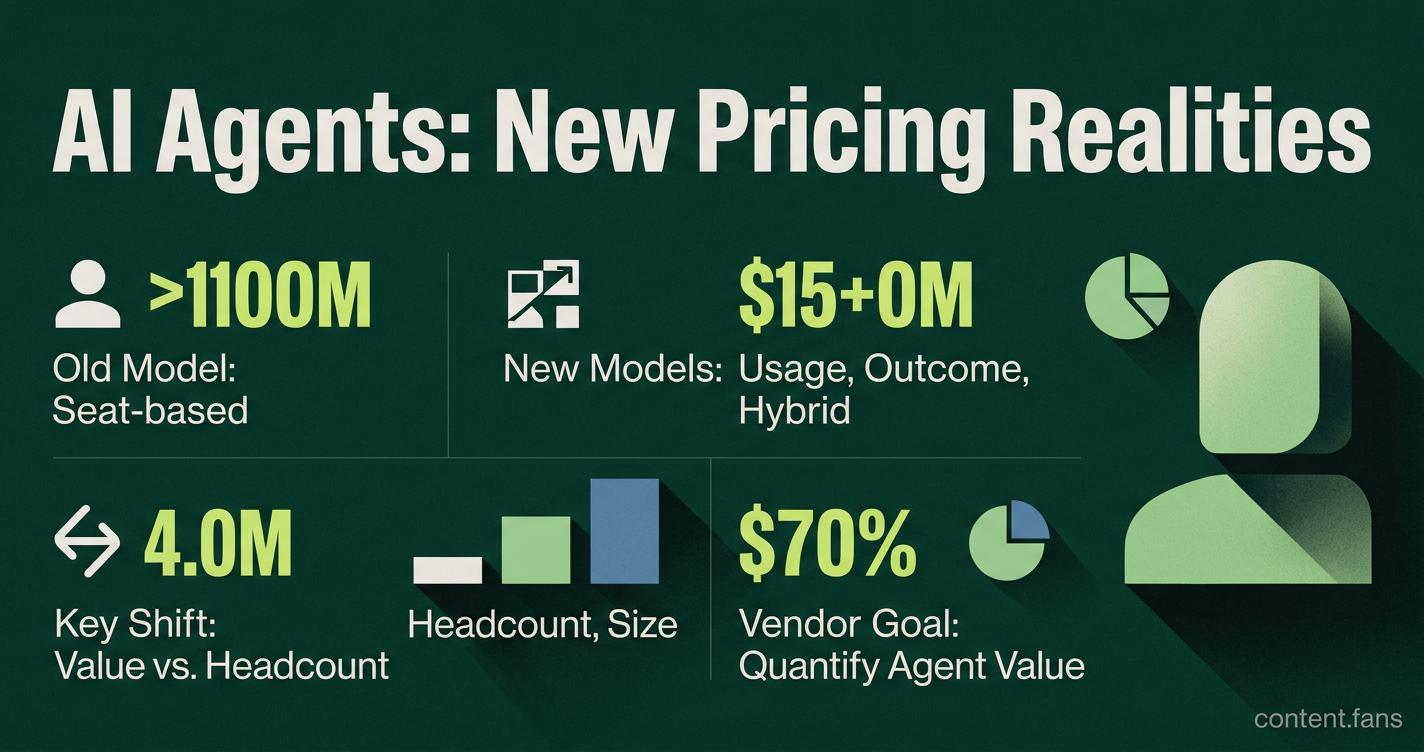
The core issue is a decoupling of headcount from value. Bain & Company argues that as AI agents complete tasks with less human involvement, they "render the traditional seat-based model misaligned and even obsolete" (Bain analysis). Industry reports suggest that as employees paired with agents become more productive, subscriptions could give way to hybrid approaches that blend usage and outcome-based pricing.
Emerging Pricing Models: From Usage to Outcomes
In response, vendors are deliberately transitioning from the rigid seat metric to more dynamic models. The most common alternative is hybrid pricing, which combines a base platform subscription with variable charges for usage or credits. Also gaining significant traction are outcome-based fees, where costs are tied directly to measurable results like a qualified lead or a resolved support ticket. Vendors favor this model when an agent's output cleanly aligns with revenue generation or cost savings, often retaining a small platform fee for budget predictability.
A Framework for Measuring AI Agent Value
To transition successfully, vendors must first quantify the value their agents deliver. Industry practitioners suggest a practical role-to-metric framework for connecting agent performance to commercial value. This involves four key steps:
- Map the agent's responsibilities and workflows.
- Define the desired business outcomes (e.g., reduced handle time, higher lead conversion).
- Identify observable performance signals from operational data and logs.
- Select key performance indicators (KPIs) for leadership to monitor.
Once these metrics are established, a vendor can choose the most appropriate billing unit. For instance, an agent improving support efficiency may justify a per-resolution fee, while a code assistant with variable usage is better suited to a credit-based model. This multi-lens view helps prove stable economics before fully moving away from older models.
A Phased Migration Path for SaaS Vendors
Experts advise a gradual migration rather than an abrupt switch to maintain customer confidence. A proven pattern involves a phased rollout, often starting with pilots or premium "AI seats" to test new metering. A practical checklist for vendors includes:
- Inventory all workflows where agents reduce or replace human interaction.
- Quantify agent-specific variable costs like model inference and orchestration.
- Pilot a metrics stack to track adoption, task success rates, and marginal costs.
- Align a billing unit - be it a seat, credit, task, or outcome - with the most reliable value metric.
- Communicate transparently with customers using dashboards, caps, and alerts to ensure spend predictability.
While hybrid models currently dominate by balancing risk and reward, companies that can clearly link metrics to value will have the most freedom to sunset pure per-seat pricing. For tools where human collaboration remains central, vendors will likely retain the seat model while layering metered agent functionality on top.