
Forward-Deployed Engineers Shorten AI Discovery-to-Pilot Timelines to Weeks
Serge Bulaev
Forward-deployed engineers work directly with customers to turn AI ideas into working code, which may help companies move from discovery to pilot much faster. Recent reports suggest these engineers are in high demand because they quickly test and refine solutions by watching users in real time. Their tasks often include both coding and understanding business needs, and new tools may help them work even faster. Some early reports from healthcare companies claim that this model has reduced development timelines from months to weeks, but these results are not yet peer-reviewed. Overall, the role appears to be effective when paired with strong product leadership and good processes.

Forward-deployed engineers shorten AI discovery-to-pilot timelines by embedding directly with customers, turning ambitious ideas into production-ready code. This hands-on model gives companies a direct line from real-world user challenges to shipping software, and recent hiring trends suggest the role is becoming mission-critical for accelerating deployment.
What an FDE actually does
A forward-deployed engineer operates at the intersection of product development and customer implementation. They are responsible for understanding user context, rapidly prototyping solutions, writing production code, managing cloud infrastructure, and feeding insights from the field back into the core product roadmap to drive continuous improvement.
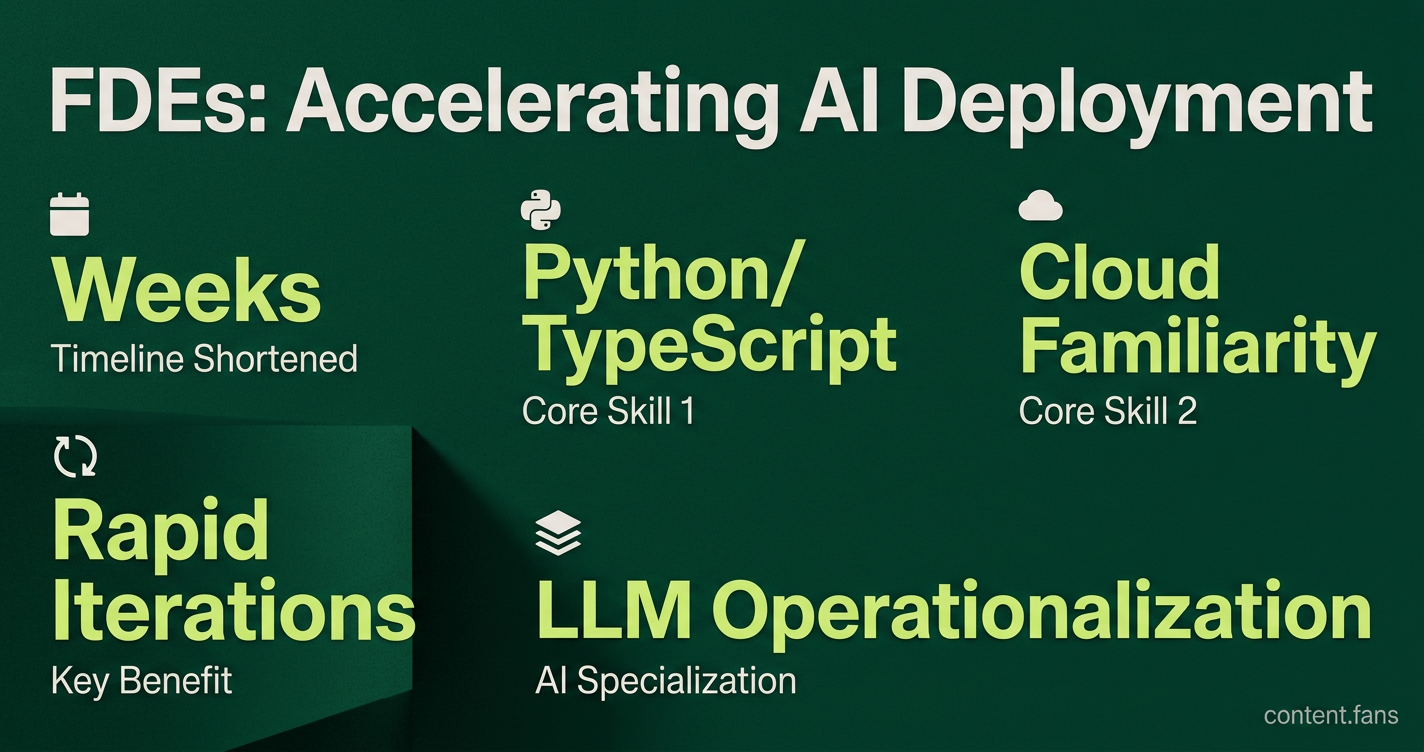
Industry reports describe FDEs as spending "intense time embedded with customers" to understand context, prototype rapidly, and refine solutions. Typical responsibilities include:
- framing ambiguous business needs into technical specs,
- writing production code across APIs, backends, and sometimes frontends,
- managing cloud infrastructure and CI/CD,
- debugging live incidents, and
- feeding recurring patterns back to the core product roadmap.
For AI projects, sources emphasize added tasks such as prompt design, evaluation harnesses, and safety guardrails, suggesting FDEs are evolving into a specialized bridge between large-language models and enterprise workflows.
Skills companies request most
Industry analysis shows that demand centers on a blend of full-stack coding and customer communication skills. The most commonly requested qualifications include:
• Python or TypeScript proficiency
• Familiarity with AWS, GCP, or Azure
• Comfort with authentication and third-party APIs
• Production debugging under strict uptime targets
• Ability to explain trade-offs to non-technical stakeholders
In AI-centric job postings, experience operationalizing LLMs - including prompt testing and evaluation pipelines - is frequently flagged as a strong advantage.
Why organisations embed FDEs in business units
Industry experts note that the FDE model "creates a delivery approach that enables rapid iterations and swift movement from needs to impact." This acceleration occurs because engineers observe user challenges firsthand, eliminating the delays of secondhand reports and support tickets.
However, organisational research from Alvarez & Marsal cautions that FDEs can drift into one-off services without proper structure. To prevent this, experts recommend assigning FDEs to specific product lines with clear checkpoints for reviewing field code, ensuring the role supports a robust "field-to-product" feedback loop backed by senior product leadership.
Tooling and process upgrades emerging in the field
Modern tooling further enhances FDE effectiveness. Industry analysis identifies lightweight experiment trackers, containerized sandboxes, and automated evaluation suites as key enablers. These tools allow an embedded engineer to iterate on prompts, models, or features without full deployments, maximizing speed while maintaining the audit trails required by enterprise security.
Early outcomes companies report
Early results are promising. Industry reports indicate that healthcare firms using the FDE model have reduced discovery-to-pilot timelines from months to just weeks. While these outcomes are self-reported, they align with the expected benefits of a rapid, qualitative feedback loop. Over time, each engagement contributes reusable patterns to a central knowledge base, lowering the cost and effort of future deployments.
Ultimately, the evidence positions the forward-deployed engineer as a high-leverage solution to AI complexity. The role is most effective when supported by strong product management, disciplined tooling, and a clear mandate to convert field insights into scalable platform value.
What exactly is a Forward-Deployed Engineer, and why is it suddenly the most valuable new hire?
A Forward-Deployed Engineer (FDE) is a software engineer who is embedded directly inside customer or product teams to design, build, integrate, deploy, and troubleshoot production systems in the field. The role combines full-stack engineering, AI/LLM deployment, and customer-facing collaboration under one roof. Industry reports show that mentions of "FDE" have grown significantly year-over-year, making it one of the fastest-expanding titles in AI-centric companies. Recruiters now use a cross-functional impact lens instead of traditional "platform engineer" criteria, valuing proven ownership of end-to-end systems and direct customer interaction.
How do FDEs shorten AI discovery-to-pilot timelines from months to weeks?
By sitting inside the customer environment, FDEs eliminate classic hand-offs between sales, solution architects, and core engineering. Practitioners report three concrete accelerators:
- Rapid problem framing - FDEs translate ambiguous business requirements into concrete engineering tasks in hours rather than weeks.
- Live iteration loops - Engineers tweak prompts, APIs, and agent workflows while users watch, turning feedback into code within the same day.
- Reusable pattern capture - Every deployment writes back to a shared knowledge library, so the next customer starts from a significant completion baseline instead of zero.
Industry experts note the effect: teams using FDEs move from "pressing needs to tangible business impact" in short sprint cycles, compared with multi-month enterprise pilots of previous years.
What skills and tools should we screen for when hiring an FDE?
Look for a T-shaped profile:
| Core skill stack | Evidence to request |
|---|---|
| Full-stack production code | GitHub repos showing backend, API, and light front-end shipped to prod. |
| Cloud & infra fluency | Terraform or Pulumi examples; hands-on with AWS/GCP and containers. |
| AI/LLM integration | Prompt eval harnesses, LangChain traces, or open-source guardrail examples. |
| Customer-empathy signal | Case write-ups or Loom demos explaining trade-offs to non-technical users. |
Tooling checklist:
- Experiment sandbox like Cursor for quick prompt tuning
- Evaluation & observability via platforms such as OpenClaw.ai or custom dashboards
- Secure customer data enclaves that meet SOC 2 / HIPAA constraints without blocking velocity.
How should we redesign our org so FDE work compounds instead of becoming one-off consulting?
Emerging best-practice org model:
- Cross-functional pods of 1 PM, 1 FDE, 0.5 designer for every group of pilot customers.
- Product interface - a formal intake board where FDEs surface repeatable patterns; the core team decides what becomes platform.
- Governance guardrails - explicit criteria for productization vs. paid customization to avoid "perpetual services trap."
- Rhythmic feedback loop - weekly retro with core engineering to fold deployment lessons into the roadmap.
Alvarez & Marsal warn that without these rails, companies risk slipping into "custom delivery that never compounds."
What early indicators tell us the FDE model is working?
Track these three lagging-to-leading metrics:
- Median days from first customer call to working pilot (target < 14 days)
- Reusability score - % of code or prompts that appear unchanged in the next deployment
- Customer NPS delta after pilot vs. traditional proof-of-concept
When the first two numbers improve and NPS stays steady or grows, you have proof the FDE model is accelerating impact without sacrificing trust.