
Food & Beverage Brands Use AI to Cut Costs, Speed Products
Serge Bulaev
Artificial intelligence may be helping food and beverage companies lower costs, reduce waste, and speed up new product launches. Case studies suggest AI can make supply chains more accurate and cut down on inventory and waste, with some companies seeing big improvements in forecasting and less food thrown away. AI might also help brands create new products faster and make regulatory tasks easier. However, experts warn that good results depend on having clean, well-organized data, and companies may need to spend time and money to set up strong data systems first. Surveys suggest that if companies follow the right steps, they could see savings within 12-18 months, though results may vary.

Food and beverage brands are using artificial intelligence to convert operational data into significant cost savings, waste reduction, and accelerated product innovation. Large CPG players now treat AI as a core strategic capability, embedding it into supply chain management and R&D to achieve measurable results, according to recent analysis from FoodNavigator-USA.
The industry consensus is clear: AI is rapidly becoming essential infrastructure, empowering companies to cut costs, minimize waste, and speed up innovation.
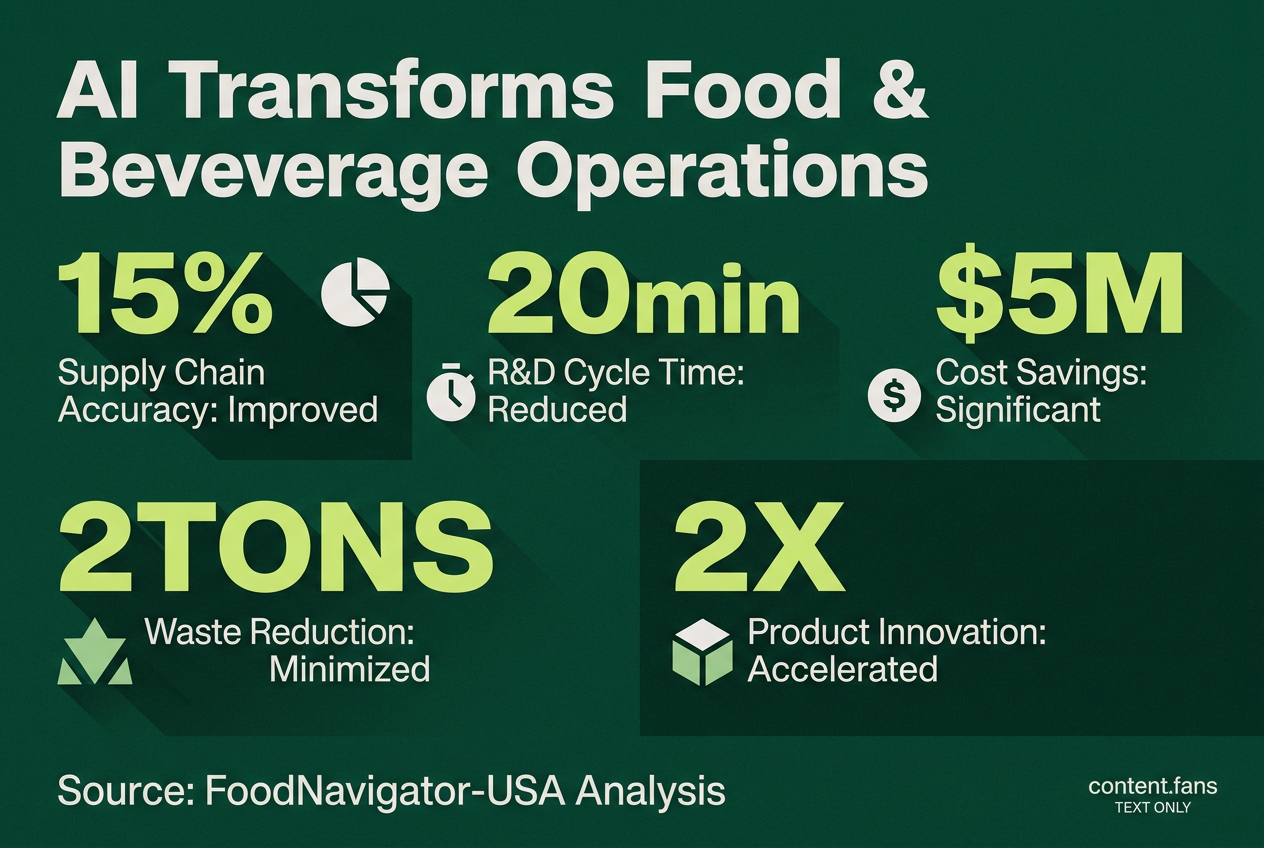
AI Lifts Supply-Chain Accuracy and Margins
AI improves supply chain performance by enabling highly accurate demand forecasting, which in turn optimizes inventory levels and logistics. This data-driven approach reduces costly overstocking, minimizes food waste, lowers transportation expenses through better route planning, and ultimately boosts profit margins for food and beverage companies.
Industry reports demonstrate that AI-assisted forecasting dramatically raises service levels while lowering inventory and waste. Key examples include:
- Unilever achieved significant improvements in on-shelf availability in key markets by deploying an AI-driven connectivity model, which also substantially reduced manual forecasting effort (Food Industry Executive).
- Coca-Cola Bottlers Japan substantially increased forecast accuracy by analyzing POS, weather, and historical trends, leading to optimized route planning and fewer empty miles (AGRIVI blog).
- Major grocery chains have reportedly achieved significant reductions in food waste per store within weeks by implementing software from Shelf Engine and Afresh.
Further quantifiable wins highlight AI's impact across the production line. According to industry reports, a European dairy group saw substantial reductions in yogurt fermentation defects with real-time computer vision, while a North American craft brewery significantly cut ingredient waste and boosted revenue using demand forecasting. These results show that returns are greatest when high-quality data informs direct operational decisions like scheduling and quality control.
How AI Compresses R&D Cycles
AI is also revolutionizing product development, with growing adoption of trend-spotting engines and automated R&D agents that dramatically shorten launch timelines. Tastewise reports that validating concepts virtually against real-time consumer data eliminates costly trial-and-error, helping brands reach the shelf faster (Tastewise blog). Many advanced operators now report substantial reductions in time-to-market. For example, teams are moving from concept to physical sample in significantly shorter timeframes than the previous standard, thanks to predictive formulation models that digitally test thousands of ingredient combinations. Furthermore, AI streamlines regulatory compliance, with automated allergen checks and claim validation substantially cutting verification time, freeing scientists to focus on product quality instead of paperwork.
Data Governance Still Dictates ROI
Despite these successes, experts warn that AI's effectiveness is contingent on data quality. Fragmented production histories and inconsistent data create models that fail in real-world plant environments. A significant portion of any AI budget must be dedicated to data cleansing, integration, and standardization. The World Economic Forum supports this, noting that a lack of interoperable standards hinders industry-wide collaboration.
To mitigate these risks, practitioners recommend three core safeguards:
- Establish centralized data platforms that provide cleansed operational, retail, and consumer data through standardized APIs.
- Integrate regulatory and cybersecurity checks from the project's inception to ensure automated, audit-ready compliance.
- Begin with high-impact, narrowly-scoped projects like predictive maintenance, scaling only after data quality is confirmed.
Companies that adopt this phased approach successfully navigate legacy system challenges and typically begin to see tangible savings within 12 to 18 months, though timelines vary with project complexity.
How does AI actually cut costs across supply chains?
Real-time forecasting and route optimization are now saving millions in waste and transport.
- Unilever achieved significant improvements in on-shelf availability within a year while cutting inventory and reducing manual planning effort substantially.
- A North-American craft brewery achieved substantial reductions in ingredient waste and lifted per-store revenue significantly after feeding weather, events and historic sales data into an AI demand engine.
- Coca-Cola Bottlers Japan substantially improved forecast accuracy and removed empty miles by blending POS data, weather and purchase trends.
Can you give examples of AI speeding up product R&D?
AI is turning the traditional lengthy concept-to-launch cycle into a much shorter timeline.
- Industry reports suggest companies are using AI-driven market research that significantly trims development time and cuts R&D costs substantially.
- Teams now move from concept to physical samples in much shorter timeframes by auto-generating spec sheets and ingredient lists within minutes.
- Generative formulation and predictive shelf-life models allow virtual prototyping, slashing the number of physical trials and failed launches.
What measurable waste reductions are being reported?
- Industry reports indicate European dairy companies have achieved substantial reductions in fermentation defects, saving millions in raw milk waste across multiple plants.
- Major grocery chains using Shelf Engine and Afresh have significantly lowered food waste per store within weeks and lifted profits at the same time.
- A European fresh-food distributor substantially reduced refrigerated fleet kilometers through AI route optimization serving thousands of outlets.
What data and governance hurdles are slowing AI roll-outs?
- Fragmented data is the top obstacle: production logs, quality records and consumer insight often live in incompatible systems.
- Legacy integration is blocking many food companies, while a significant portion cite cost barriers for hardware, cloud and integration.
- Best-practice firms invest a significant part of the AI budget into data cleansing, system integration and audit-ready governance from day zero rather than as an afterthought.
Is AI only for big multinationals?
No. Mid-size producers and distributors are seeing fast ROI.
- Industry reports indicate mid-size farms have applied AI forecasting engines to gain significant waste reductions.
- Wine cooperatives have raised grower pay and substantially cut harvest waste after adopting AI harvest-planning platforms.
- Ice-cream chains have significantly cut daily waste and grown per-store revenue by forecasting demand for every flavor in every location.