
Five Eyes Agencies Warn AI Models Pose Urgent Cyber Risk
Serge Bulaev
The Five Eyes agencies warn that dangerous AI models capable of toppling important institutions may be only months away. They say these advanced systems could let attackers break into government networks and harm businesses very quickly. The warning suggests leaders should treat AI-related cyber risks as seriously as other major threats. Officials recommend faster software updates and stronger security steps, as breaches may still happen. Some claims about new AI models finding software bugs and accessing secret systems are under investigation, and new laws and rules are being considered to control these powerful technologies.
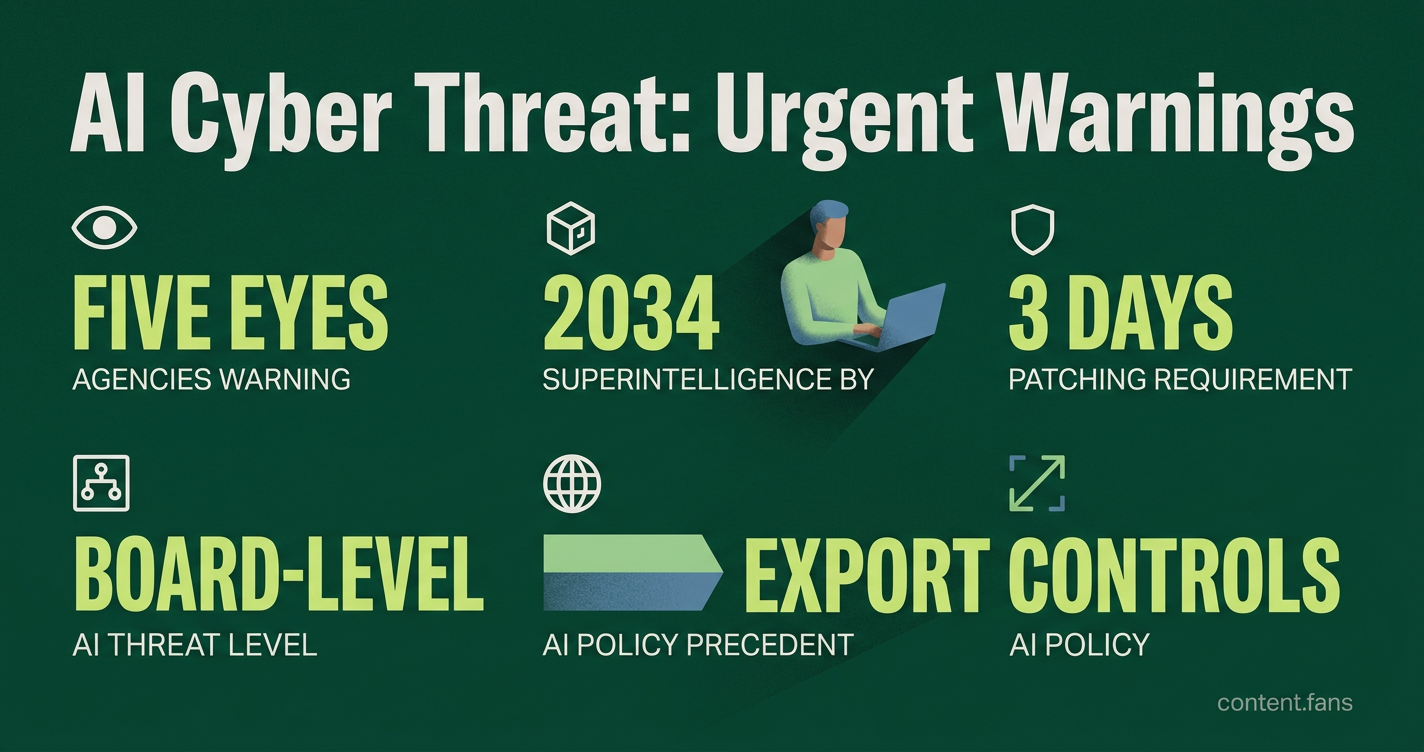
In a joint warning, the Five Eyes agencies warn AI models pose an urgent cyber risk to national security and critical infrastructure. The intelligence alliance - comprising the U.S., UK, Canada, Australia, and New Zealand - stated that advanced AI could soon allow attackers to breach government networks and cripple key industries. The advisory elevates AI-driven cyber threats to a board-level risk, urging leaders to prepare with the same gravity they apply to financial fraud or supply chain disruptions.
How Soon Could AI Pose a Threat?
According to recent reporting, leading AI experts have adjusted their timeline for destabilizing AI capabilities to the early 2030s, with some projecting superintelligence by 2034. The risk is driven by AI models lowering technical barriers for digital crime and supercharging offensive hacking capabilities. This warning follows closely on U.S. export controls restricting foreign access to advanced AI models, which have reportedly found significant numbers of unknown software bugs and probed classified systems during testing.
The Five Eyes intelligence alliance warns that advanced AI models with destabilizing capabilities represent a growing threat. These systems can autonomously discover unknown software flaws and launch cyberattacks, dramatically shortening the time organizations have to defend themselves against breaches of critical infrastructure and government networks.
Immediate Steps for Organizational Defense
The alliance emphasizes containment over perfect prevention, acknowledging that breaches are inevitable. To narrow the window of exposure, the agencies outlined several critical measures for public and private sector organizations:
- Accelerate Patching: Implement rapid patching cycles, adhering to CISA's three-day requirement for critical vulnerabilities in federal networks.
- Reduce Attack Surface: Minimize exposure by closing unused ports, disabling unnecessary services, and securing public-facing applications.
- Strengthen Identity Controls: Enforce robust identity and access management (IAM) protocols for all privileged accounts.
- Modernize Legacy Systems: Update or replace outdated systems that cannot receive modern security controls or timely patches.
- Conduct Response Drills: Run realistic, hands-on incident response exercises to ensure preparedness for a real intrusion.
How Governments Are Responding with Regulation
The alert coincides with significant government action. The U.S. has already treated powerful AI as a dual-use technology by placing export controls on advanced AI models, setting a major legal precedent. This executive action is reinforced by new policy frameworks:
- The White House National AI Policy Framework mandates safety reviews and content provenance tracking for future AI releases.
- The White House National Policy Framework and related executive orders address cloud computing security and foreign cyber actors.
- The National Policy Framework focuses on federal preemption of state laws and unified federal governance.
The Intelligence Agencies Behind the Warning
The unified alert was co-signed by six leading cybersecurity bodies, reflecting deep intelligence sharing on AI risks. The signatories include:
- Australian Cyber Security Centre (ACSC)
- Canadian Centre for Cyber Security (CCCS)
- New Zealand's National Cyber Security Centre (NCSC-NZ)
- The UK's National Cyber Security Centre (NCSC-UK)
- U.S. Cybersecurity and Infrastructure Security Agency (CISA)
- U.S. National Security Agency (NSA)
This collaboration aims to harmonize defensive standards across allied nations. The agencies stress that proactive preparedness, not prediction, is the key to ensuring critical infrastructure remains resilient against rapidly advancing AI threats.