
Firms adopt NIST, ISO 42001 to close AI governance gap by 2026
Serge Bulaev
Many large companies are using NIST and ISO 42001 frameworks to help close gaps in how they manage AI, especially as AI use grows faster than oversight. Reports suggest that these frameworks, along with real-time tracking of AI systems and better board oversight, may help firms meet new rules like the EU AI Act. Early results from some firms show fewer compliance delays and fewer fines, but experts note that missing basic controls can still lead to problems and loss of trust. As regulations become stricter, accurate classification of AI risk and ongoing monitoring appear to be essential, although these activities might increase costs, especially for smaller firms.

As AI adoption outpaces formal oversight, leading enterprises are implementing AI governance using the NIST AI RMF and ISO 42001 frameworks to close critical policy and compliance gaps. With AI shifting from pilots to core business functions, many firms still lack the documentation and controls that regulators now demand.
This guide outlines how organizations are achieving regulatory alignment and operational control through these recognized frameworks, real-time AI inventories, and clear board-level accountability.
The stack that is becoming standard
Enterprises are creating a standardized governance stack by combining the voluntary NIST AI RMF for operational risk management with the certifiable ISO/IEC 42001 standard for external assurance. This dual approach provides a verifiable playbook for managing AI systems and aligning with emerging regulations like the EU AI Act.
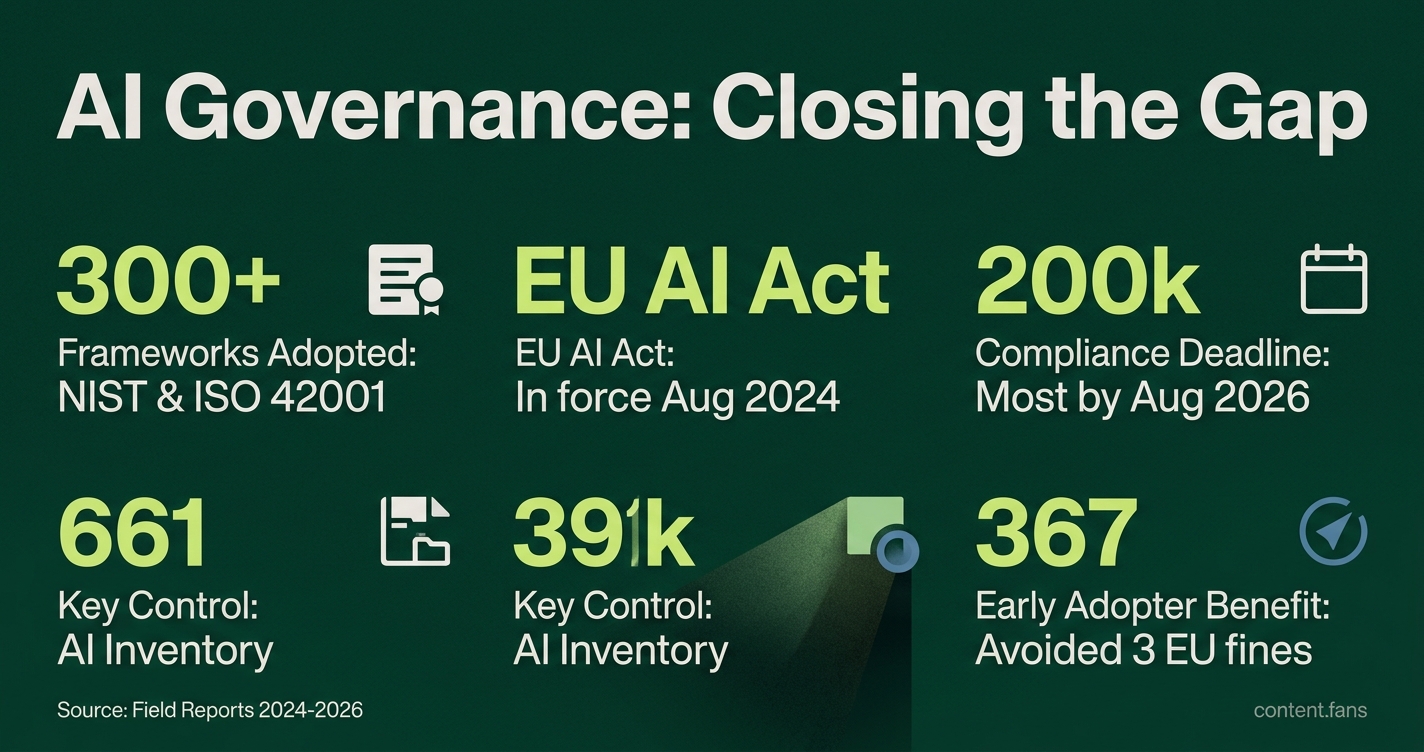
Mature AI governance programs now integrate the NIST AI RMF with the certifiable ISO/IEC 42001 standard. This combination allows firms to map additional obligations from regulations like the EU AI Act. While the NIST framework provides a structure of Govern, Map, Measure, and Manage, ISO 42001 adds a verifiable management system layer for auditors. For companies in Europe, the compliance timeline is fixed: the EU AI Act entered into force on 1 August 2024; most provisions apply from 2 August 2026, with certain provisions applying later on 2 February 2025, 2 August 2025, 2 August 2027, and 2 August 2028 depending on the category.
What Effective AI Oversight Looks Like
Field reports from 2024-2026 highlight a common set of controls for effective AI governance:
- Maintain a complete inventory: Keep a living catalog of all internal, vendor, and shadow AI systems.
- Tier use cases by risk: Classify models to ensure higher-impact systems undergo deeper review.
- Mandate pre-deployment testing: Systematically check for bias, security vulnerabilities, and performance drift before launch.
- Monitor production systems: Track live behavior with automated dashboards and assign clear system owners.
- Standardize third-party oversight: Apply the same contractual and audit requirements to both third-party and in-house AI models.
Implementing these controls ensures that version-controlled evidence is available for each model, a critical requirement for regulatory incident investigations.
Early Results from the Field
Early adopters are already demonstrating tangible benefits. One Fortune 500 firm, "Global Alpha," established a dedicated Technology and AI Governance Committee, anchoring its process in NIST and ISO 42001. By implementing an automated usage dashboard, the company reported significant reductions in compliance delays and successfully demonstrated conformity to regulators, avoiding fines during three separate EU inquiries.
Broader industry adoption is accelerating. According to industry reports, a significant portion of Fortune 500 companies have adopted AI governance frameworks. Experts attribute this rapid adoption to lessons learned in 2023, where a lack of ownership and monitoring stalled a substantial number of AI projects.
In contrast, public sector reports from the OECD and academic institutions reveal the consequences of poor governance. Recurring issues include the absence of a central AI inventory, unclear escalation paths, and unauditable documentation, leaving organizations exposed to penalties and a loss of public trust.
Navigating the Compliance Clock and Resource Pressure
As the EU AI Act solidifies and various US state rules emerge, enterprises must navigate a landscape of fragmented regulatory duties. Analysts emphasize that the critical first step is accurately classifying each AI system as prohibited, high-risk, or lower-risk. A misclassification can trigger expensive redesigns and delays. While continuous monitoring and versioned evidence are becoming standard, experts warn that the associated auditing and documentation requirements are increasing program costs, particularly for small and medium-sized businesses.
To manage these pressures, leading boards are integrating AI governance directly into enterprise risk management. The winning strategy combines cross-functional oversight committees, automated evidence collection, and strict alignment with the NIST AI RMF and ISO 42001 standards. This approach is proving to be the most effective path to accelerating AI deployment while ensuring regulatory compliance.
Why are NIST AI RMF and ISO/IEC 42001 becoming the default enterprise anchors?
NIST AI RMF is used by a growing number of Fortune 500 firms as the operational risk baseline because it breaks governance into four concrete steps: Govern, Map, Measure, Manage.
ISO/IEC 42001, released in 2023, is the first internationally certifiable management system for AI; by early 2026 external auditors are already seeing significant increases in certification requests.
Together they give executives a repeatable playbook: NIST for day-to-day controls, ISO 42001 for external assurance.
What is the single most common cause of AI governance failure today?
Lack of complete AI inventory.
Studies from OECD, Granicus and IE.edu show that when organizations cannot see every model, vendor AI tool or embedded SaaS feature, incidents stall because no one knows who owns the system or what data it touches.
In surveys of stalled AI projects, many organizations trace the root cause to hidden "shadow AI" that was never catalogued.
How fast are compliance delays actually slowing AI roll-outs?
According to industry reports, many AI projects have stalled due to governance gaps.
By early 2026, compliance and governance delays are now a top-three blocker, with enterprises citing significant lag times between technical readiness and regulatory sign-off for high-risk use cases.
Early adopters who mapped NIST tiers and ISO 42001 controls up-front report documented reductions in these delays.
What practical steps close the gap between 2025 and the EU AI Act deadline of 2 August 2026?
- Run a two-week AI census - catalog every model, API and vendor tool.
- Risk-tier each system - label prohibited, high-risk, or low-risk under EU definitions.
- Align documentation templates - match NIST AI RMF model cards and ISO 42001 records so one artefact can satisfy both regulators and auditors.
- Assign named owners - legal, product, data and security leads sign off on a single RACI sheet for each system.
- Stand up continuous monitoring dashboards - drift, bias and security checks feed directly into the evidence package needed for August 2026 audits.
Which metrics prove governance is creating value, not just cost?
Operational metrics tracked by best-in-class enterprises:
- Audit response time - from incident report to documented evidence: governance leaders demonstrate significantly faster response times compared to laggards.
- Vendor contract re-negotiations - fewer surprise clauses after implementing ISO 42001-aligned vendor controls.
- Deployment velocity - faster release cycles for low-risk systems due to pre-approved NIST-tiered playbooks.
- Regulatory fines - companies with dedicated Technology & AI Governance Committees that reference NIST and ISO 42001 report better regulatory compliance outcomes.