
Finance adopts AI agents for audited workflows, eyes healthcare expansion
Serge Bulaev
Financial institutions are testing whether AI agents can meet strict regulatory standards, with most banks now building systems to track every decision for audits. Experts suggest that because finance requires clear records and human oversight, agents are designed to be tightly controlled and easily reviewed. Early data shows these AI agents may shorten processing times in finance and healthcare, but regulators remain cautious and may require more proof of reliability. Success in finance appears to signal that similar AI systems could be useful in healthcare and government, though adoption may be slow for higher-risk uses. Overall, the evidence suggests AI agents might work alongside risk controls instead of replacing them.

The adoption of AI agents for audited workflows is being rigorously tested by financial institutions to meet strict regulatory demands. Industry reports highlight the core requirement: banks must meticulously document all inputs, outputs, and human overrides for full auditability. This makes finance the ultimate proving ground for agentic AI, as success here signals their viability for other regulated sectors.
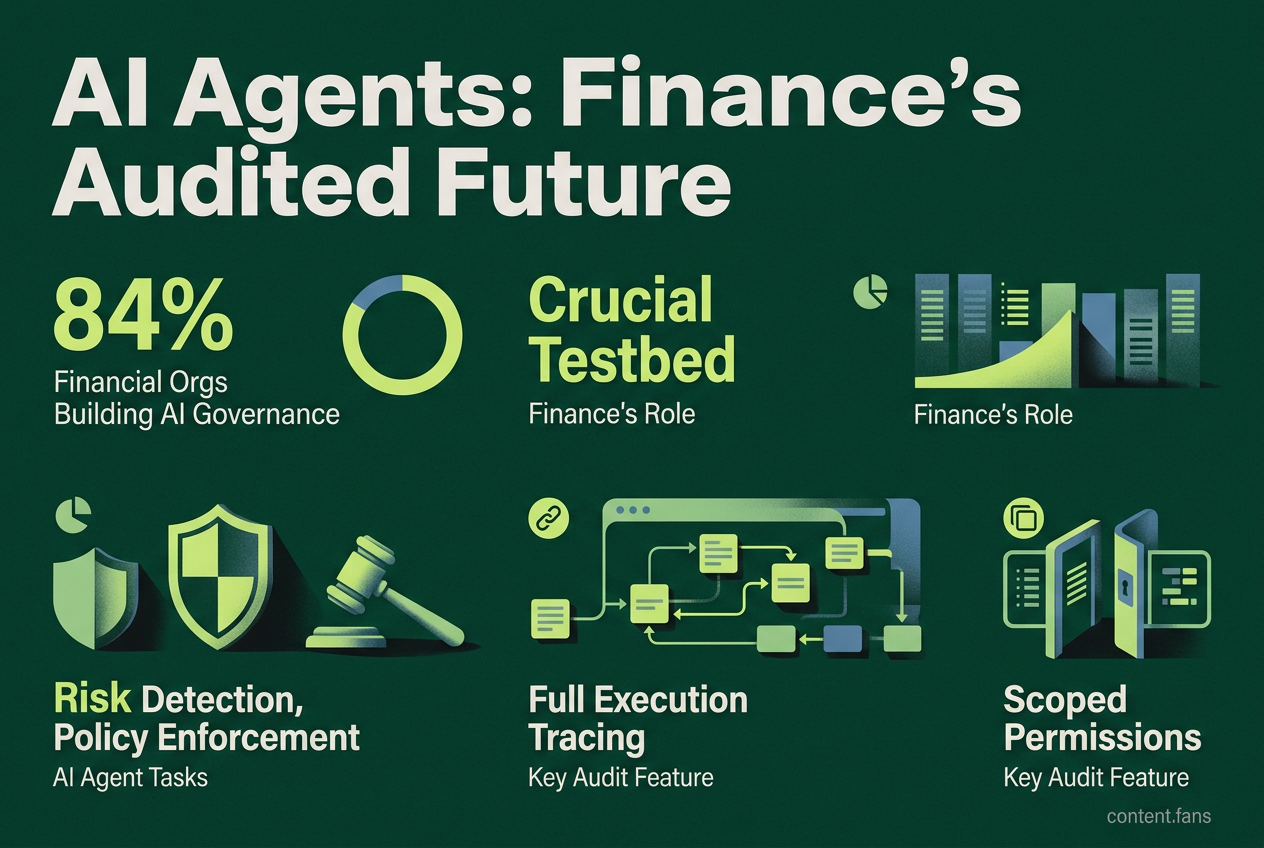
Underscoring this trend, a World Economic Forum survey reveals that 84 percent of financial organizations are actively building governance frameworks to oversee AI development and auditing (WEF report). This shift establishes auditability not as an optional feature, but as a fundamental requirement for enterprise AI.
This article explores why finance is pivotal, how AI agent architectures are evolving to meet compliance needs, and the implications for sectors like healthcare and government.
Why Finance Will Decide If AI Agents Are Practical Workflow Software
Finance serves as the crucial testbed for AI agents because its workflows demand immutable records, strict approval gates, and constant monitoring. These regulatory constraints compel developers to build in the robust controls and transparent audit trails that all large enterprises, especially in regulated fields, ultimately require.
According to a Fenergo compliance brief, AI agents are already automating critical tasks like risk detection, policy enforcement, and regulatory change management, all while maintaining clear data provenance. In practice, these are not free-roaming chatbots. Production AI agents operate within scoped environments, use pre-approved tools, and require human confirmation for significant actions. This controlled structure ensures every decision is reproducible, a key factor for satisfying regulatory bodies like the SEC, OCC, and FINRA.
Design patterns that satisfy audit teams
Leading vendors are developing specific design patterns to ensure auditability. For example, Anthropic's finance templates emphasize a narrow, traceable approach, featuring "full execution tracing" and "scoped permissions" to limit potential risks, as outlined in their deployment guide (Anthropic guide). Industry reports suggest common controls in these implementations include:
- Sequential workflows that map one agent step to one logged action
- Automatic capture of source documents and tool calls for every inference
- Permission layers tying each credential to a single workflow
- Explicit escalation paths so unresolved exceptions reach human approvers
- Versioned prompts and policies stored with output for later replay
These architectural patterns support a "human-in-the-loop" model, ensuring accountability for AI behavior. To manage this, firms are establishing AI Centers of Excellence to centralize oversight across risk, IT, and business units.
Signal strength for healthcare and government adoption
The success of AI agents in finance is providing a clear blueprint for other regulated industries. Early case studies show dramatic efficiency gains: industry reports indicate significant improvements in invoice processing times, while healthcare appeals cycles have shown substantial reductions in processing duration. These results signal the potential for automating similar workflows like claims processing, fraud detection, and document triage in both healthcare and public administration.
The OECD suggests that proven AI agents could enhance government services through predictive policy planning and faster benefit administration. This optimism is echoed in market forecasts, with analysts projecting the agentic AI market in healthcare to expand from approximately $538 million in 2024 to nearly $5 billion by 2030, driven by the transferability of finance-hardened technologies.
Despite this potential, regulators are proceeding with caution. Current outlooks suggest a move toward risk-based supervision, where high-stakes applications like credit scoring or automated trading face the strictest controls. This measured approach may slow adoption but also provides clear compliance targets for technology vendors.
Ultimately, widespread adoption depends on proving that AI agents can deliver efficiency without compromising data integrity. When agents reliably reconcile ledgers with full transparency or compile KYC dossiers with perfect sourcing, they build a powerful case for broader use. Each successful, compliant workflow in finance serves as a crucial demonstration that agentic AI can enhance, rather than circumvent, existing risk controls.