
FDA Expands AI Toolkit With Elsa 4.0, Changes Pharma Audits
Serge Bulaev
The FDA has introduced and expanded its AI tool called Elsa, which now helps staff read, write, summarize documents, and identify important inspection targets. Elsa 4.0, combined with the HALO data platform, may support more advanced tasks like custom analysis and reviewing inspection data. The FDA appears to be using AI for faster, pattern-based inspections, and companies are advised to prepare by tracking their AI systems, monitoring for issues, and keeping good documentation. Organizations might need to continuously update their controls and evidence to match the FDA's new AI-driven approach. This shift suggests that AI could make inspections faster and require companies to be ready at all times.

Preparing for AI-driven pharma audits is a new reality for regulated companies as the FDA expands its AI toolkit with Elsa 4.0. In June 2025, the FDA launched Elsa, an agency-wide generative AI tool to help staff work more efficiently and support tasks such as reviewing, writing, summarizing, and identifying high-priority inspection targets (FDA press release). FDA says Elsa 4.0 was launched with HALO, enabling staff to query data and build workflows across consolidated data sources, with features including quantitative data analysis and visualization, OCR, voice-to-text, and secure web search (May 2026 expansion).
This article translates those public capabilities into a practical readiness plan for quality, compliance, and data teams.
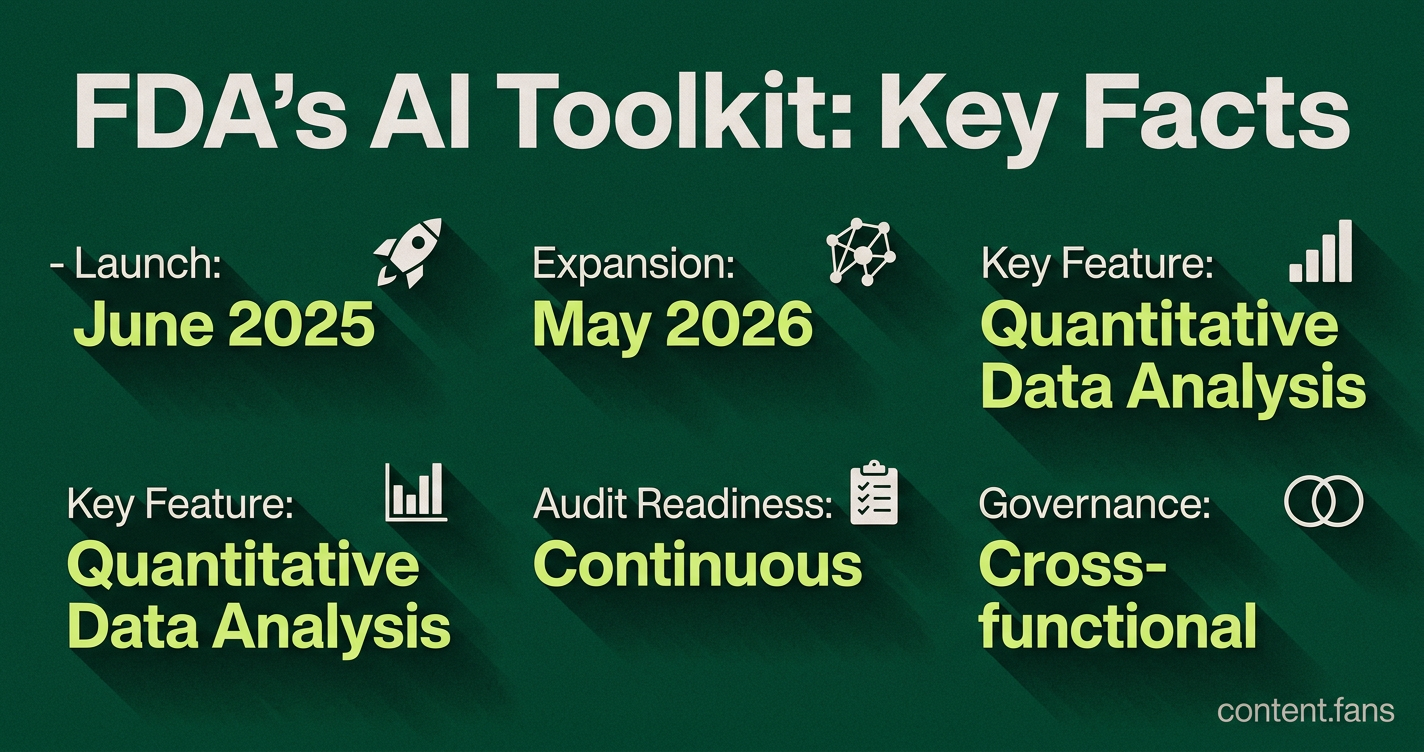
FDA's Expanding AI Toolkit
Elsa initially supported summarization and related review tasks; Elsa 4.0 added chart/graph creation, OCR, and voice-to-text, among other features. The FDA announcement and related coverage describe AI-assisted querying, data analysis, and workflow support across FDA data systems (FDLI report). This signals that inspectors will likely arrive with AI-generated questions and demand immediate evidence retrieval.
To prepare for AI-driven FDA inspections, companies must shift from reactive documentation to continuous readiness. This involves creating a detailed AI model inventory, implementing robust governance frameworks, and establishing internal audit processes that mirror the FDA's analytical capabilities to ensure evidence is always available on demand.
Checklist - Preparing for FDA AI Inspections and Integrating AI Into Internal Audits
To align internal controls with the FDA's new approach, teams can use the following action sequence to align internal controls with emerging external scrutiny:
- Build an enterprise AI inventory using a structured register such as the free RiskTemplates spreadsheet, then map each model to data sources and regulatory touchpoints.
- Classify each AI use case by risk tier and document required validation rigor, referencing the NIST AI RMF or ISO 42001 for baseline controls.
- Assign named accountability at the senior level and establish a cross-functional governance committee spanning quality, data, legal, and security.
- Enforce documentation gates for every production model: purpose, training data, validation methods, known limitations, and monitoring results.
- Configure continuous monitoring to capture drift, bias, and access logs, feeding alerts into internal audit workflows that mirror Elsa's analytics capability.
Turning Policy Into Evidence
Effective inspection readiness means producing evidence on demand. Instead of compiling documents reactively, governance teams should embed templates into daily workflows to generate evidence automatically. Key artifacts include AI inventories, risk worksheets, and remediation trackers, which serve as baseline proof of control. For showing due diligence, many firms adapt structured frameworks like Microsoft's Responsible AI questionnaire to satisfy both EU AI Act and FDA expectations.
Internal audit teams must conduct dry runs simulating AI-driven queries. The ability to produce model cards, validation records, and monitoring data in minutes proves operational maturity and minimizes further scrutiny. Any identified gaps should be tracked as remediation tickets within the production repository for full traceability.
Building a Two-Way AI Audit Loop
Proactive organizations are now deploying their own AI analytics to detect compliance issues before regulators do. By using pattern recognition on their own manufacturing or clinical data, firms can identify the same outliers that Elsa might flag. When these internal systems generate an alert, governance logs help teams decide whether to retrain, adjust, or decommission a model ahead of an inspection.
This strategy transforms audit preparation from an episodic event into a state of continuous readiness, where AI acts as both a compliance monitor and an evidence generator. The outcome is a dynamic control framework that keeps pace with the FDA's evolving algorithmic inspection capabilities.
What exactly is Elsa 4.0 and how is it reshaping FDA inspections?
Elsa 4.0 is the agency's upgraded AI assistant that now sits on the HALO consolidated-data platform. It can read, write, summarize, search, generate documents, run code, and visualize data across more than 40 agency sources.
The FDA has described how Elsa supports agency workflows including identifying high-priority inspection targets and data analysis capabilities. The system also enables more efficient inspection processes, though specific details about abbreviated inspections remain limited in public announcements.
How can a company mirror the FDA's own AI capability internally?
Create the same three-layer capability the agency now uses:
- Governance layer - risk-tiered inventory of every model, algorithm, or vendor AI tool (use the free RiskTemplate AI Inventory sheet to start).
- Analytics layer - dashboards that flag drift, bias, or anomalies in near-real time.
- Audit layer - immutable logs + evidence packages so every prediction can be traced back to training data, model version, and approver.
Doing this means you are speaking the same "language" as the investigator who arrives with an Elsa-generated report.
What five concrete records should teams prepare before the next GMP / GxP audit?
- Model inventory - one row per system, including risk tier and regulatory impact (EU AI Act "high-risk" classification if relevant).
- Validation summary - evidence that each high-risk model met pre-defined acceptance criteria (can follow the Microsoft Responsible AI Impact Assessment template).
- Data provenance log - source, transformation, and QA sign-off for every dataset used to train or re-train the model.
- Risk-assessment worksheet - documented risks, mitigations, residual risk rating, and signatories.
- Remediation tracker - open Jira-style list of closed and pending actions with due dates and owners.
Keep these living documents in a single read-only folder so they can be handed over within minutes of an inspector's request.
Does the FDA accept vendor or open-source models, and what extra proof is needed?
Yes - the agency does not require that every model be built in-house.
However, you must still supply:
- Vendor SOC 2 / ISO 27001 or equivalent security attestation.
- Vendor model card or data sheet showing intended use, known limitations, and bias test results.
- Your own down-stream validation study proving the model still performs correctly in your specific operating conditions.
Tip: store the vendor artifacts and your validation report side-by-side in the AI Governance Toolkit (download here) to keep the evidence chain unbroken.
How often should the governance committee meet, and who must sit on it?
Best-practice frequency in 2025-2026 is quarterly for strategic review and ad-hoc within 24 hours of any serious incident or significant model change.
Minimum quorum:
- Senior Quality or Compliance lead (chair)
- Data Science owner for each high-risk model
- IT Security
- Legal / Regulatory Affairs
- Business process owner who actually uses the model output
Meeting minutes and go/no-go decisions must be stored in the same audit-ready repository used for the model inventory.