
FDA Commissioner Resigns, Raises Alarm Over MAHA Agenda's Influence
Serge Bulaev
FDA Commissioner Marty Makary resigned in May 2026, raising concerns that the agency's decisions may be influenced by the MAHA agenda promoted by HHS Secretary Robert F. Kennedy Jr. Some public-health advocates and experts worry that recent FDA actions, like not processing an mRNA flu application and removing petroleum-based food dyes, may reflect this influence. The agency is now led by acting chief Kyle Diamantas and is facing staff shortages and a lack of permanent leaders at the CDC and Surgeon General offices. Critics suggest these gaps and policy shifts might hurt scientific independence, while some support MAHA's focus on chronic disease and childhood health. The White House has not yet named a permanent replacement for commissioner, leaving the FDA in a state of uncertainty.

The recent resignation of FDA Commissioner Marty Makary has intensified alarms over the political influence of HHS Secretary Robert F. Kennedy Jr.'s 'Make America Healthy Again' (MAHA) agenda on the agency's scientific independence. With food-policy veteran Kyle Diamantas now acting chief, public health advocates are questioning if MAHA priorities are already shaping key FDA decisions.
Critics had previously accused Makary of yielding to MAHA-aligned pressure, citing the FDA's refusal to process an mRNA influenza vaccine application and its rapid phase-out of petroleum-based food dyes. HHS celebrated both actions on its official MAHA page. Diamantas now leads an agency reportedly understaffed from recent layoffs and lacking permanent leaders at the CDC and Surgeon General's office, which have been vacant for a significant period.
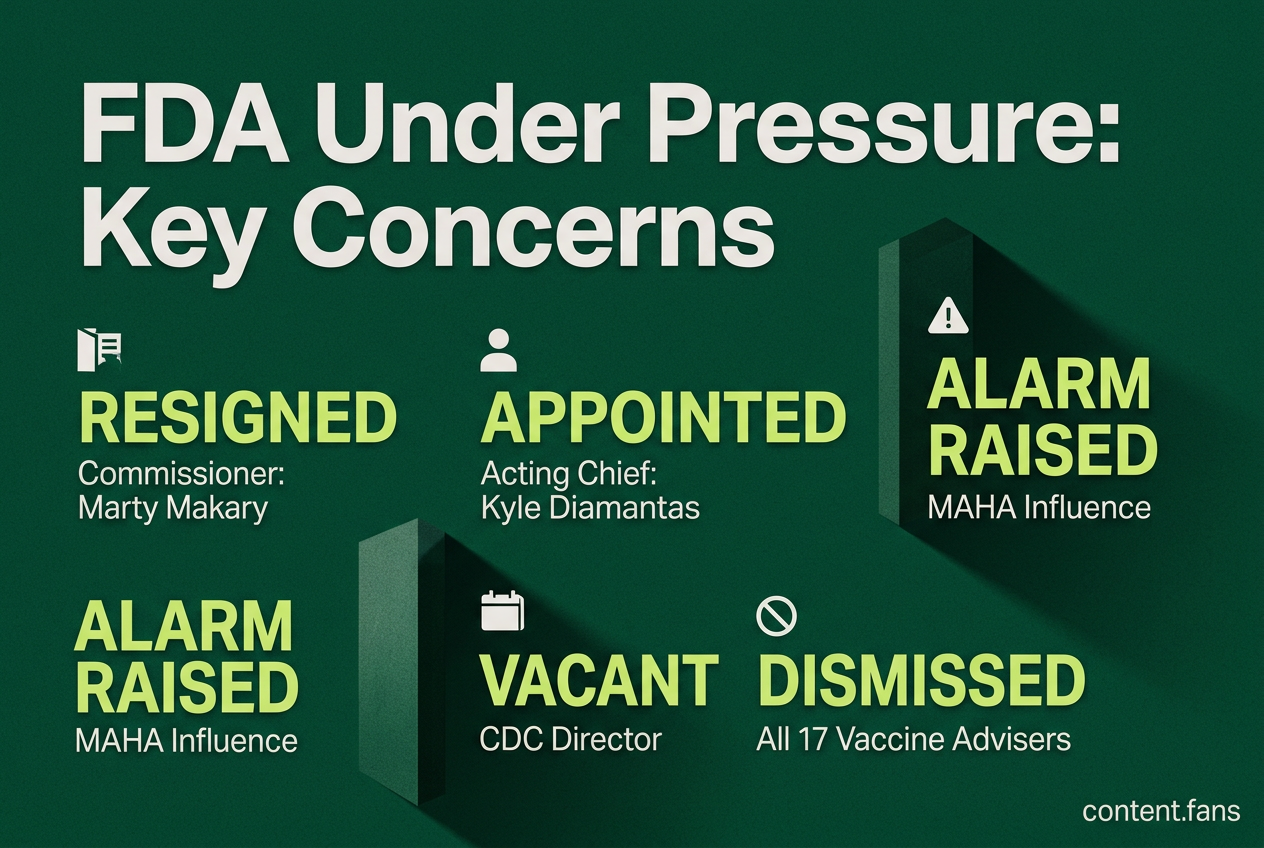
These leadership gaps extend beyond the FDA. The CDC has been without a Senate-confirmed director for a significant period, according to industry reports. The vacancy followed the dismissal of the previous director for questioning vaccine policy, which prompted multiple senior scientists to resign in protest.
Concerns Over FDA's Scientific Independence
The controversy stems from fears that the 'Make America Healthy Again' (MAHA) agenda is prioritizing political goals over scientific integrity. Recent FDA actions, such as rejecting an mRNA vaccine application and banning food dyes, alongside leadership vacancies, have led experts to question the agency's independence from HHS.
In a recent statement, Public Citizen demanded the next commissioner possess "unquestioned integrity" and be free from political influence. This sentiment was echoed by Peter Lurie, president of the Center for Science in the Public Interest, who called leading the science-based agency "a nearly impossible charge" for a non-scientist like Diamantas, whose background is in food policy, not drugs or biologics, according to industry reports.
Lurie's skepticism highlights the contentious debate surrounding the MAHA initiative itself. Launched recently, MAHA aims to address chronic disease and childhood health with numerous programs. While supporters praise its nutrition overhauls and the food dye ban, critics point to ideological interference, citing MAHA's vaccine policies, which included dismissing all 17 ACIP advisers and reducing the CDC's recommended childhood vaccine schedule.
What Experts Demand from the Next FDA Commissioner
Stakeholders and public health experts have outlined clear expectations for the next permanent commissioner:
- Proven expertise across drugs, biologics, and food safety.
- A commitment to independence from political and industry pressures.
- A strategic plan to rebuild staff morale and fill critical vacancies.
- A pledge to uphold timely, science-driven reviews free from political delays.
An industry stakeholder told FoodNavigator-USA that political resistance to platforms like mRNA could stifle innovation if the next leader doesn't "prioritize speed and efficiency." This comes as the FDA's own initiatives, such as the Commissioner's National Priority Voucher pilot designed to expedite reviews, hang in the balance, requiring stable leadership to succeed.
The White House is reportedly considering former commissioners Stephen Hahn and Brett Giroir for the role, but no nominee has been sent to the Senate. Until a permanent leader is confirmed, Diamantas must manage an agency with thousands of pending applications under an HHS secretary whose mission is to "Make America Healthy Again."
What is the MAHA agenda and how is it shaping FDA decisions?
Led by HHS Secretary Robert F. Kennedy Jr., the "Make America Healthy Again" (MAHA) initiative seeks to combat chronic disease through major policy reforms. Under MAHA, the FDA has taken significant actions, including phasing out petroleum-based food dyes and declining to process an mRNA flu vaccine application. Critics contend these decisions prioritize politics over evidence-based science, raising concerns that future product approvals may face ideological, not scientific, scrutiny.
Why are experts alarmed about political influence at the FDA?
Public health organizations warn that the FDA's scientific independence is eroding. According to industry reports, the agency's independent evidence-based scientific process has been compromised by political interference. Alarming signs include mass dismissals of scientific advisers, significant leadership churn including Commissioner Makary's resignation, and abrupt policy reversals on vaccine recommendations.
What qualities do stakeholders want in the next FDA commissioner?
A consensus has formed among consumer advocates and industry leaders on the essential qualities for the next commissioner:
1. Proven scientific credentials in key regulatory areas.
2. Unyielding integrity to resist political and industry pressure.
3. Strong leadership skills to restore morale and operational efficiency.
4. A commitment to balancing innovation with safety.
Stakeholders widely view the appointment of a Senate-confirmed scientist as critical to restoring stability.
How could continued vacancies at FDA, CDC, and Surgeon General posts harm public health?
The leadership crisis extends beyond the FDA, creating a fractured public health infrastructure. With the CDC lacking a confirmed director for a significant period and the Surgeon General nomination stalled, the consequences are already emerging: key scientists have resigned, vaccine policies are being set by temporary appointees, and public trust is declining. Health security experts warn these overlapping vacancies severely weaken the nation's ability to coordinate responses to future health crises.
Will the FDA still speed up reviews under new leadership?
While stakeholders desire efficient review processes, they insist that scientific rigor must not be sacrificed. An industry source told FoodNavigator-USA that the next leader must "resist blocking or slowing down certain technologies, such as mRNA vaccines, due to political pressures." However, consumer groups note that previous accelerated approvals coincided with abrupt changes to evidence standards. The consensus is clear: efficiency is welcome, but only if supported by transparent data and robust post-market surveillance.