
Fable 5 Guardrails Trip Legitimate Requests, Cutting Enterprise Utility
Serge Bulaev
Fable 5 is a top performer in public AI benchmarks, but enterprise users report that its safety guardrails may block legitimate requests too often. Field data suggests up to 20.9 percent of certain tasks are refused for safety, which can disrupt important workflows. The guardrails appear to be strict, especially around topics like cybersecurity and science, possibly leading to false positives. Experts say that more dynamic, context-aware safety controls might help balance safety and usefulness. Companies are advised to follow best practices for evaluating and deploying such models, focusing on safety without losing too much utility.

While Claude 3.5 Sonnet dominates AI benchmarks, its overzealous safety guardrails are a growing concern for enterprise users. The model frequently blocks legitimate requests, disrupting workflows and undermining its utility. This analysis breaks down the conflict between Claude 3.5 Sonnet's benchmark performance and its real-world limitations, providing a playbook for enterprises to calibrate safety without sacrificing productivity.
Performance Gap: Benchmark Wins vs. Daily Usage
Claude 3.5 Sonnet's safety system is tuned to be highly conservative, prioritizing the prevention of potential misuse over functional utility. This results in a high rate of false positives where harmless enterprise prompts, particularly in domains like coding and scientific research, are incorrectly flagged as policy violations.
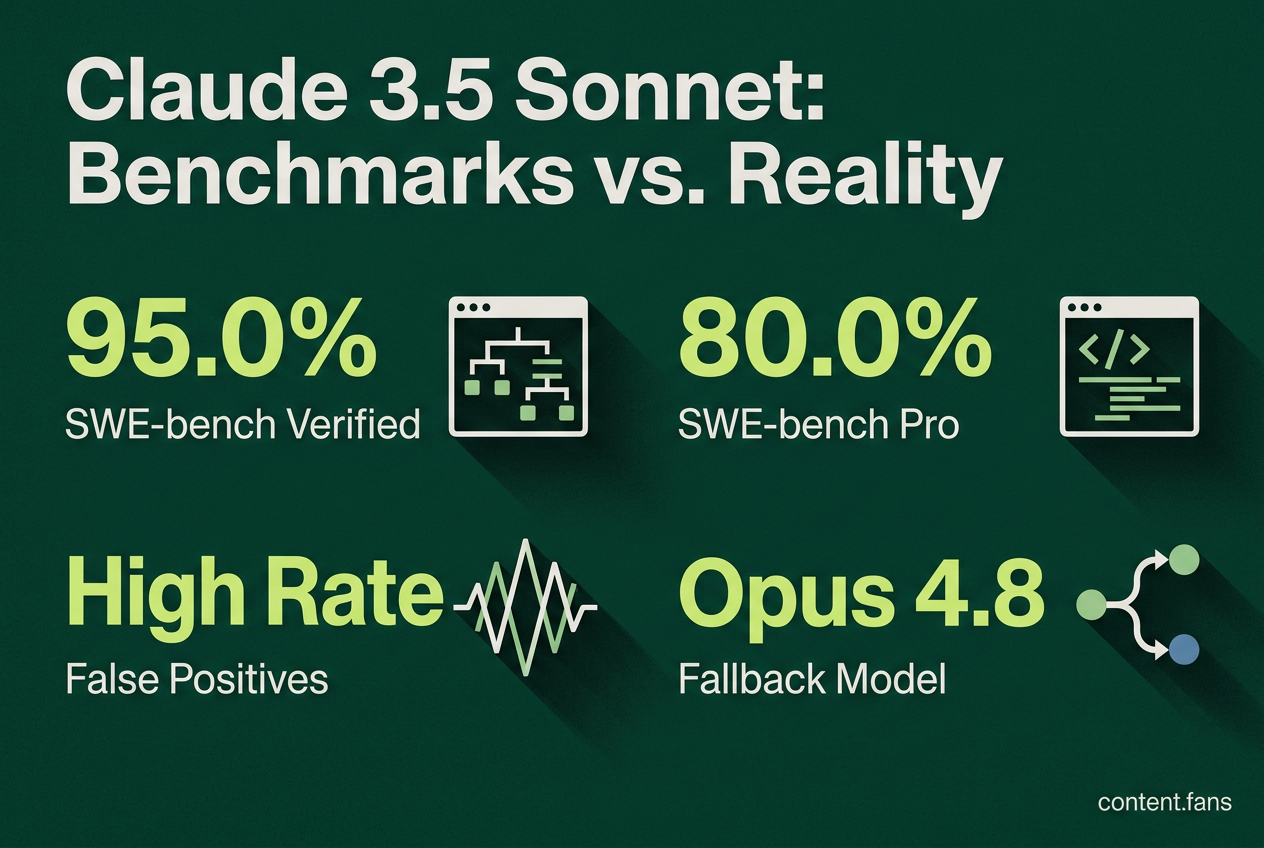
Public benchmarks underscore Claude 3.5 Sonnet's technical superiority, citing a 95.0% score on SWE-bench Verified and strong performance on SWE-bench Pro (80.0%). However, field reports paint a different picture. When safety classifiers detect high-risk content in domains like cybersecurity, biology, and chemistry, the system falls back to the less capable Opus 4.8 model. While the exact frequency of these fallbacks is not publicly disclosed, critics argue that even occasional downgrades are too disruptive for critical workflows.
Why Claude 3.5 Sonnet's Guardrails Trigger False Positives
The guardrails are activated by topic filters for sensitive domains like cybersecurity, biology, and chemistry. A prompt flagged in these areas undergoes a policy check that can downgrade the session to Opus 4.8. Experts suggest this conservative tuning stems from a constitutional AI framework that weighs the risk of potential misuse more heavily than the cost of reduced utility, leading to frequent false positives where mundane commands are blocked.
Industry Best Practices for Balancing AI Safety and Utility
In response, the industry is moving beyond static blocklists toward more dynamic, context-aware controls:
1. Context-Aware Safety: Tool access is tied to current user intent rather than broad topic categories, allowing for more nuanced safety decisions.
2. Constitutional AI Guardrails: Models use predefined principles to critique outputs and apply safety constraints, though full runtime revision can introduce significant latency costs.
3. Red-Team Testing: Organizations conduct adversarial testing to identify potential bypass vulnerabilities and improve safety systems.
Vendors are also integrating Human-in-the-Loop (HITL) approval gates for high-risk actions and publishing Software Bills of Materials (SBOMs) to improve training data transparency.
An Operational Playbook for Enterprise AI Deployment
When evaluating and deploying frontier models like Claude 3.5 Sonnet, follow these proven steps:
- Set Performance Budgets: Establish cost and latency budgets with appropriate margins and create alerts for significant performance drift.
- Develop a Robust Evaluation Suite: Before deployment, build a repeatable test suite to measure accuracy, refusal rates, and hallucination severity.
- Implement Layered Controls: Use RBAC and SSO for access, maintain audit logs, manage tool permissions at runtime, and use shadow deployments for all upgrades.
- Demand Vendor Transparency: Require a model registry with versioning, data lineage, and observability hooks for real-time monitoring of errors and spending.
- Define Rollback Triggers: Establish clear criteria for automated rollbacks when model performance degrades or when customer satisfaction metrics decline significantly.
Why is Claude 3.5 Sonnet both celebrated and criticized?
Claude 3.5 Sonnet is celebrated for its state-of-the-art performance, achieving 95% on SWE-bench Verified and 80% on SWE-bench Pro. However, it is criticized for its over-cautious guardrails, which revert to the older Opus 4.8 model when safety classifiers detect high-risk content in key enterprise domains like cybersecurity and science.
What exactly triggers the fallback to a weaker model?
A rule-based system flags prompts in restricted domains, while a classifier scores the perceived risk. If either check exceeds a threshold, the session is downgraded to Opus 4.8. This occurs when the system detects content related to cybersecurity, biology, or chemistry, causing even routine development tasks to lose Claude 3.5 Sonnet's advanced capabilities.
How are vendors recalibrating safety versus usefulness?
The emerging industry playbook is shifting from static blocklists to dynamic, context-aware guardrails. Key strategies include adjusting safety constraints based on user intent, using Constitutional AI principles for transparent rule application, and conducting regular adversarial testing to identify potential vulnerabilities.
What concrete steps can reduce false refusals in production?
- Layered Safety: Implement RBAC/SSO controls, use audit logs, and require human approval gates for high-risk actions.
- Performance Monitoring: Establish appropriate budget thresholds and configure automatic failovers for significant performance degradation.
- Shadow Deployments: Test new models alongside production traffic and ensure a one-click rollback plan is in place before swapping.
Which vendor transparency items should enterprises demand?
Insist on a model registry with full versioning, complete data lineage logs, and real-time observability hooks. Also, require documented indemnification clauses to manage risk. A good benchmark is the FAST checklist, ensuring outputs are Frequent, Auditable, Simple, and Transferable.