
Export Controls Push Developers to Local AI Stacks
Serge Bulaev
Export controls on advanced chips have made many engineering teams change how they use AI. Studies suggest that Chinese developers increased their use of local AI models much more than U.S. teams after new rules were introduced. This may mean that using open and local AI models is helping teams keep working when they can't get new technology. Teams are moving to local setups because export rules mostly block training, not deployment, and running models on their own hardware seems to keep services running. However, running models locally might make them less accurate or harder to update, and teams need to keep checking for legal and performance issues.

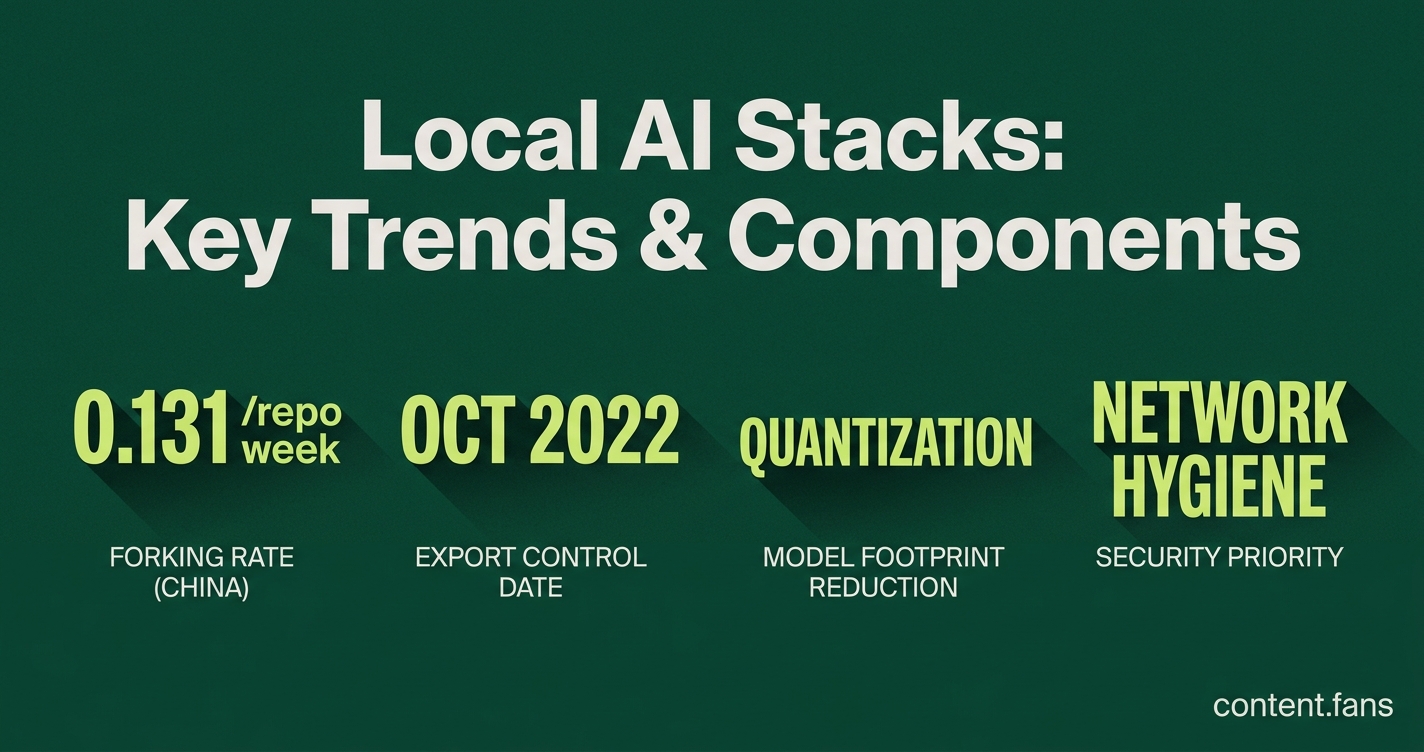
Recent export controls on advanced chips are a primary driver pushing developers to adopt local AI stacks for greater resilience. Faced with supply chain uncertainty, engineering teams are shifting toward on-premise solutions. A recent study highlights this trend, finding that forking spiked dramatically following the October 2022 BIS export control announcement, with a measured rate of 0.131 forks per repository week for Chinese developers, which was higher than the US response U.S. Policies Unintentionally Accelerated China's Open AI Ecosystems, signaling a move toward open-weights models as a durable infrastructure.
Why are teams pivoting to local AI stacks?
Engineering teams pivot to local AI stacks to ensure service continuity when cloud access is restricted by export controls or other supply uncertainties. By running quantized models on in-house hardware, they can bypass upstream blockages, maintain operational independence, and avoid the scaling limitations of gated cloud APIs.
Current export rules primarily target advanced semiconductors and technological chokepoints used in AI training China's use of open-source AI threatens the US lead in AI development. This distinction allows teams to maintain service continuity by running quantized models on their own GPUs or CPUs when cloud APIs become unavailable. This on-premise approach also helps teams avoid the inference scaling ceilings imposed by providers, such as when DeepSeek reportedly throttled its API due to compute shortages.
What are the core building blocks of a local AI stack?
A production-ready local AI stack is built on several key components designed for efficiency and security:
- Containerized Runtime: Use a single-node server like vLLM as a starting point, but plan clear upgrade paths for multi-GPU setups. Follow established best practices for building out your infrastructure vdf.ai guidance.
- Model Quantization: Employ formats like GGUF or 4-bit Q4_K_M to reduce the model's memory footprint. Crucially, always benchmark quantized performance against an FP16 baseline to validate accuracy.
- Portable Model Formats: Maintain model versions in ONNX or TorchScript to ensure compatibility across diverse hardware. Pin all artifacts to guarantee reproducibility.
- Fast Local Storage: Utilize NVMe storage to minimize model loading times. Pre-stage model weights to prevent cold-start delays during high-demand periods.
- Network Security: Implement strict network hygiene by binding inference ports to localhost, using default-deny outbound firewalls, and regularly scanning all container images for vulnerabilities.
How should teams govern and measure local AI deployments?
Effective governance ensures AI operates reliably within its defined "competency zone," a principle highlighted by research from the Partnership on AI. In critical sectors like healthcare and finance, this involves implementing human validation loops and setting clear context-window budgets (e.g., up to 32K tokens) for complex tasks. Measurement must extend beyond simple latency to include a broader set of Key Performance Indicators (KPIs):
| Metric | Reason |
|---|---|
| Tokens per second | Gauges sustained throughput during peak demand |
| Time to first token | Reflects user-perceived responsiveness |
| GPU memory headroom | Flags overload before out-of-memory errors |
| p95 latency | Captures tail risk for critical workflows |
| Queue time | Measures scheduling stress under burst traffic |
What change management patterns support local AI adoption?
Successful adoption in regulated industries often follows a phased playbook. This structured approach minimizes risk and builds institutional confidence:
- Phase 1: Audit. Identify all data classes that are required to remain on-premise for security or compliance reasons.
- Phase 2: Pilot. Deploy a single, well-defined service (such as document analysis) with a clear rollback strategy.
- Phase 3: Scale. Expand to multi-tenant clusters only after monitoring and observability tools confirm system stability.
According to industry reports, workforce training is a key element. Staff must develop both "use fluency" (operating the AI) and "choose fluency" (knowing when to escalate edge cases to more powerful cloud models).
What are the trade-offs of using local AI stacks?
While local AI stacks offer resilience, teams must actively manage several trade-offs:
- Model Freshness: Self-hosted models may lag behind the latest state-of-the-art research checkpoints available via cloud APIs.
- Accuracy: Quantization, while necessary for performance on local hardware, can sometimes reduce model accuracy on highly specialized tasks.
- Compliance: License compliance requires constant vigilance, especially when working with forked open-source models and their derivatives.
However, these constraints can also drive innovation. The need to operate with limited hardware can inspire more efficient model designs. For example, some labs are reportedly achieving near-equivalent performance to frontier models despite relying on less advanced, but more scaled-out, compute.