
EY: Only 1 in 10 Clients See AI Pay Off on Income Statements
Serge Bulaev
Only about one in ten of EY's clients can clearly show that AI helps their income statements. While many senior leaders say AI brings positive returns, few can connect these gains directly to financial reporting. Rising costs and hard-to-measure benefits make it hard for companies to prove real financial impact. EY suggests that many AI projects look successful in smaller reports but are not yet visible in overall company financials. Companies may need to set clearer targets and link payments to real business results to better measure AI's value.

Despite widespread corporate investment in artificial intelligence, a stark report from consulting firm EY reveals that very few companies can prove a clear AI pay off on their income statements. At The Information's AI Agenda Live Summit, EY executive Dan Diaso stated that only about 1 in 10 of the firm's clients can pinpoint where AI delivers a direct financial benefit.
Why AI ROI Remains Elusive for Most Businesses
The challenge in proving AI's value stems from the difficulty of translating operational wins into measurable financial outcomes. While AI projects often succeed in internal dashboards, these efficiency gains frequently fail to surface as clear revenue growth or cost savings in consolidated company financials, making the true impact invisible to shareholders.
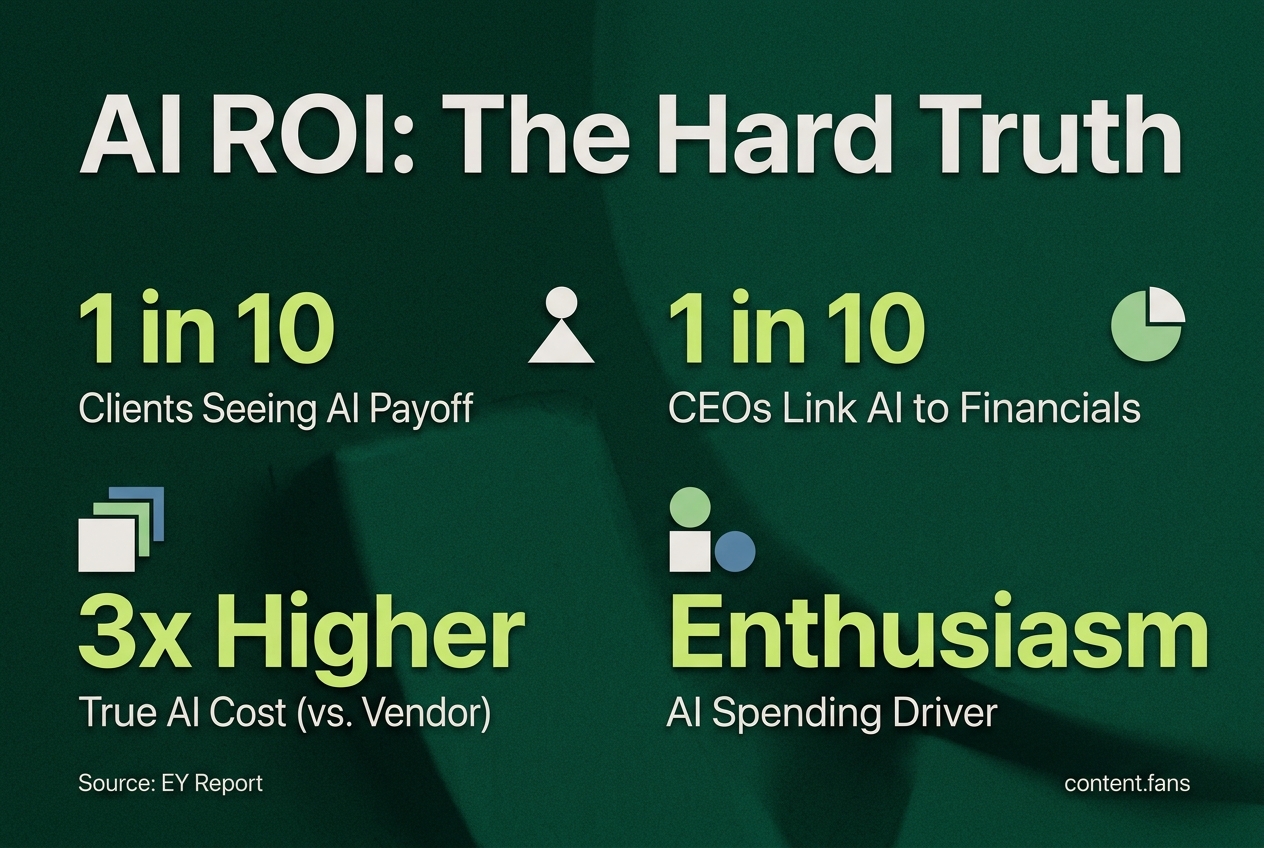
This gap between optimistic productivity anecdotes and hard-currency gains is shaping the next phase of enterprise AI. According to Diaso, current spending feels "driven more by enthusiasm than by demonstrable results." This aligns with EY research showing that while many senior leaders investing in AI claim positive returns, only around one in ten CEOs link that impact directly to financial reporting and senior-management review.
Hidden Costs and Pricing Pressures Raise the Bar
The financial picture is further complicated by escalating and often unpredictable costs. EY analysts warn that the full enterprise cost of AI can be three times higher than the vendor's token invoice once infrastructure, governance, and change management are included. This can quickly erode any thin productivity gains.
As noted in recent EY research, rising token costs are forcing boards to demand measurable value, with many respondents who see positive ROI reporting challenges in achieving material improvement in overall financial performance.
3 Strategies to Close the AI ROI Gap
To bridge this divide, finance chiefs are pressing for greater discipline. Based on interviews with stakeholders at EY, Deloitte, and Gartner, leading enterprises are adopting three key practices:
1. Start with a Baseline: Document performance metrics like error rates, cycle times, or revenue per customer before automation to accurately measure impact.
2. Assign Ownership: Make a specific line-of-business leader responsible for tracking the full economics of an AI initiative, including all retraining and governance costs.
3. Tie Payment to Outcomes: Negotiate vendor contracts that link at least part of the fee to quantified, proven business results.
As the era of experimentation gives way to fiscal scrutiny, EY's findings suggest that a focus on board-level financial targets is the new standard for AI success.
What did EY's Dan Diaso actually say about AI ROI on income statements?
At The Information's AI Agenda Live Summit, EY executive Dan Diaso delivered a sobering assessment: only 1 in 10 of EY's clients can actually demonstrate where AI-driven returns appear on their income statements. Diaso characterized current AI spending as driven more by enthusiasm than by evidence of clear revenue gains or cost reductions. This estimate aligns with broader EY research showing that only around one in ten CEOs globally link AI impact directly to financial reporting and senior-management review.
Why is there a gap between AI productivity gains and P&L impact?
Many businesses report increased productivity from AI but struggle to translate those improvements into measurable financial outcomes. According to recent research, while many senior leaders investing in AI say they have seen positive ROI, a significant portion of those respondents report challenges in translating it into measurable improvements in overall financial performance. The challenge lies in connecting operational efficiency - faster document processing, quicker code generation, automated customer interactions - to actual revenue growth or cost reductions that show up in financial statements.
How are CFOs responding to uncertain AI returns?
CFO-level scrutiny of AI investments has intensified significantly. Finance leaders are shifting from pilot-heavy experimentation to disciplined portfolio management, demanding proof of ROI, measurable value, and time-to-value before scaling spend. Recent research indicates that a minority of respondents actively using AI believed those investments had already delivered clear, measurable value. CFOs increasingly want AI to improve specific outcomes like cycle time, forecasting accuracy, cash flow, and working capital - not merely reduce manual effort. Industry reports suggest that when CFOs describe their biggest AI win, speed and cycle-time reduction often leads ahead of headcount or cost savings.
How has usage-based pricing affected AI adoption and vendor strategies?
Usage-based pricing has become the dominant model for AI services, charging customers for actual consumption such as tokens processed, API calls, or minutes used rather than fixed per-user fees. While this lowers adoption friction by removing large upfront commitments, it has also created budget volatility that exposes the lack of clear ROI. Rising bills have prompted enterprises to introduce guardrails and in some cases hire additional staff to manage AI consumption. Vendors are now responding with discounts and freebies to help buyers experiment without committing to high usage-based costs, and many are shifting toward hybrid or capacity-based models to provide more predictable budgeting.
What should enterprises consider when evaluating AI investments?
EY's research suggests organizations should track AI ROI against full enterprise cost - which may be roughly three times the token invoice once infrastructure, software, governance, organizational change, and regulatory costs are included. Finance teams need metering, caps, and monitoring to avoid bill shock. The most effective approach involves starting with clear business outcomes rather than technology adoption, establishing baselines before major spend, and backing only a select number of high-impact initiatives that can demonstrate measurable value beyond incremental efficiency.