
Every Unveils 33 AI Questions for Executives, Publicly
Serge Bulaev
Every has released a public document answering 33 common questions executives have about AI, which was previously only for a small group. The guide may help organizations by sharing lessons on strategy, governance, talent, and tool choices, suggesting that success comes from linking AI to clear business goals and changing workflows before adopting new technology widely. The advice in the document appears to match what large consulting firms suggest, such as focusing on a few valuable projects first and tracking real business results, not just experiments. The release might help close gaps in how companies govern and measure their AI efforts, and gives leaders tools to check and improve their own progress.

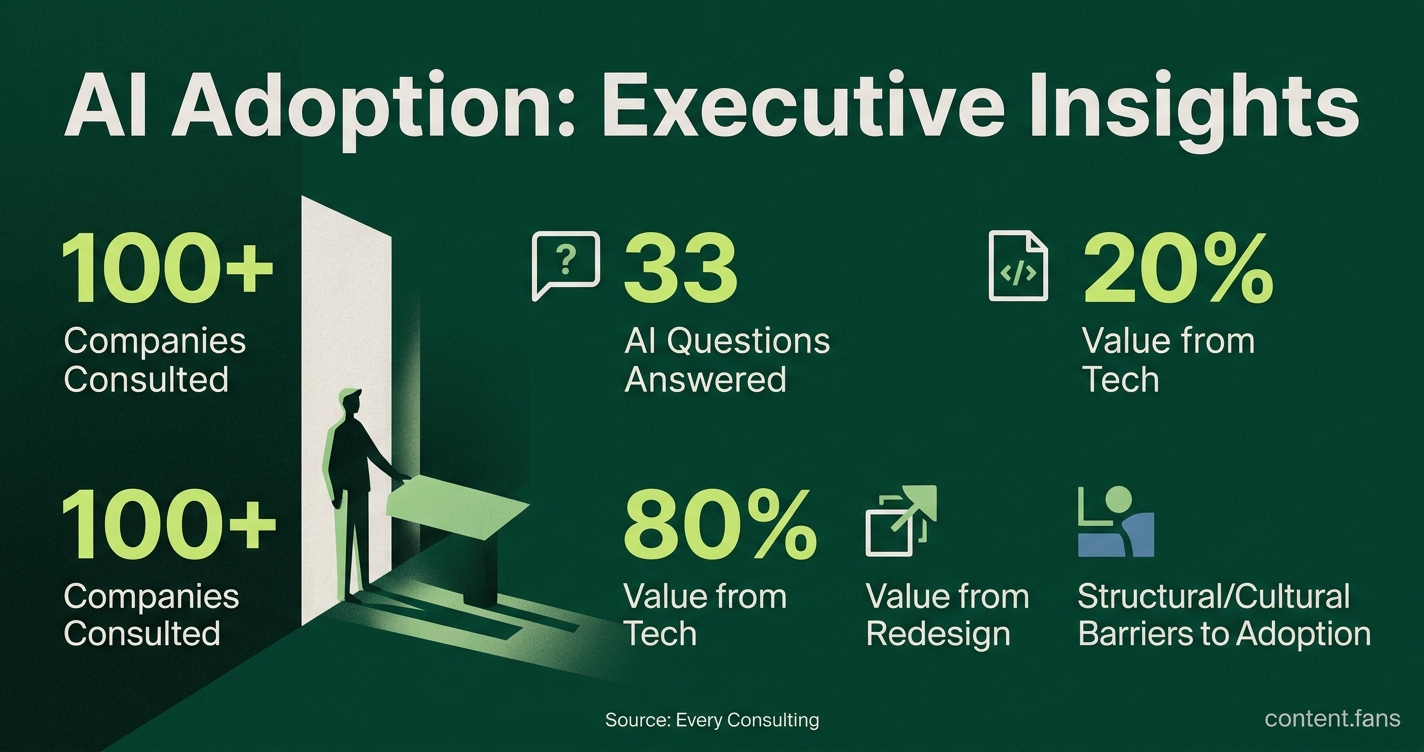
Every's consulting practice, led by Natalia Quintero and Mike Taylor, has released a comprehensive document answering 33 executive questions on AI adoption - now available to the public after initially being shared with executives at a June webinar. Drawing from consulting engagements with over 100 companies, including major media and finance clients, the resource covers strategy, governance, tool selection, and organizational restructuring for AI-native operations.
Here are five key questions from the document that address what leaders need to know right now.
What are the most common barriers to AI adoption in organizations?
The most common barriers to organizational AI adoption are structural and cultural, not technological. Success is often hindered by executives underestimating organizational change requirements and a lack of sustained leadership commitment, which can cause initiatives to stall before they can demonstrate value across the business.
According to Quintero and Taylor, AI adoption isn't being held back by the models - it's the organization. Through their work with companies, they've found that executives often overestimate technology limitations while underestimating structural and cultural blockers. Leadership commitment separates successful adopters from those who stall - the biggest gains come where leadership is "all in" rather than delegating AI exploration to IT teams or innovation labs.
The document emphasizes that one AI-fluent person can create many reusable skills across an organization, but only if given space to experiment and share. Companies that support side projects and protected experimentation time see faster learning curves than those requiring immediate ROI proof.
How should executives approach AI strategy development?
Every's framework recommends starting with business outcomes, not model selection. The document synthesizes industry patterns showing that technology delivers only about 20% of the value, while 80% comes from redesigning work.
According to the document, successful AI strategy development involves:
1. Setting a clear vision for key business outcomes AI must improve
2. Designating AI champions with explicit authority and resources
3. Proving high-value skills in controlled pilots with measurable KPIs
4. Scaling only after value is demonstrated
This aligns with broader consulting research. PwC's AI predictions similarly advise going "narrow and deep" - transforming whole workflows rather than making incremental changes. Deloitte's research confirms organizations are heavily adjusting talent strategy through workforce AI fluency, upskilling, and career redesign.
What does restructuring for AI-native operations actually involve?
Becoming AI-native requires reorganizing structure, governance, and work allocation around AI as a core operating layer - not simply adding tools to existing processes. The document outlines several restructuring priorities:
Key organizational shifts:
- Redesign workflows before org charts - map where AI executes, where humans review, and where escalation occurs
- Move from job titles to role architecture - break jobs into execution, verification, judgment, and escalation components
- Create cross-functional AI pods - small teams combining domain, product, data, and risk expertise
- Build centralized governance with decentralized delivery - maintain standards while enabling business-unit ownership
McKinsey's operating truths reinforce this, recommending that organizations "design for the swap, not the stack" - building modular, replaceable systems rather than brittle monoliths. The World Economic Forum's AI-first blueprint similarly emphasizes resequencing tasks, redefining handoffs, and embedding verification into redesigned workflows.
How should companies select and govern AI tools?
The document advocates for platform thinking over point solutions. With many organizations lacking comprehensive AI strategies according to CGI's research, tool selection often outpaces governance.
Every's recommended approach includes:
- Centralizing identity, permissions, data classification, and logging before scaling
- Treating AI as a new kind of employee - not conventional software evaluated on specs, but a capability that needs onboarding, supervision, and performance review
- Auditing regularly for swapability and vendor risk
- Assigning platform owners with explicit authority over architecture and guardrails
This addresses a critical gap: CGI found only 51% of organizations quantify AI results, meaning many lack the measurement foundation for informed tool decisions.
What practical steps can executives take in the next 60 days?
Quintero and Taylor provide a concrete 60-day plan for leaders:
Immediate actions:
1. Suspend skepticism and get hands-on - executives should personally use AI tools for real work, not delegate exploration
2. Walk through workflows like a new hire - map steps, exceptions, and approval points where AI could participate
3. Identify one high-value workflow with feasible data access and clear business impact
4. Assign executive owners from business lines, not just IT
5. Establish measurable criteria before piloting - cycle time, throughput, quality, or cost outcomes
The document stresses that PowerPoint and executive workflow realities still matter - even powerful AI work must survive presentation expectations and organizational habits. Industry analysis notes consulting firms are shifting from generic adoption advice to measuring actual value created through productivity, quality, and labor redeployment metrics.
The public release of "33 Questions Executives Ask About AI - Answered" signals broader knowledge-sharing from Every's consulting practice. For organizations at any stage of AI adoption, the document offers an actionable reference grounded in company engagements and the practical realities of implementation.