
Stack Overflow updates Stack Internal to feed enterprise AI assistants
Serge Bulaev
Stack Overflow has updated Stack Internal so companies can give their AI assistants specific, trusted answers from inside the company, instead of searching the public web. This system may help reduce AI mistakes, called hallucinations, by making answers come from verified company data. Stack Internal lets teams and AI connect to knowledge through tools like APIs, chats, and workplace apps, and tags answers with where they came from and how trustworthy they are. Experts believe some human review is still needed, since even with these changes, some mistakes might remain. The product appears to be gaining some interest, but Stack Overflow has not shared how many customers are using it yet.

Stack Overflow has updated its Stack Internal platform, a private knowledge layer designed to feed enterprise AI assistants with curated, company-specific answers. This move aims to significantly reduce AI hallucinations by grounding responses in verified internal data instead of the public web. The system functions as a "living memory" that teams and AI agents can access via API, chat interfaces, and connectors for tools like Slack and Google Docs. Every answer is tagged with trust signals, including its source and author, according to the Stack Internal platform documentation. Grounding AI in this way can substantially lower hallucination rates, offering a clear benefit for enterprises.
What is live today
Stack Internal is a private knowledge platform that helps enterprises reduce AI hallucinations. It ingests company documents and transforms them into a verified Q&A format accessible via an API. This allows AI assistants to retrieve trusted, curated answers instead of inventing facts from unverified data.
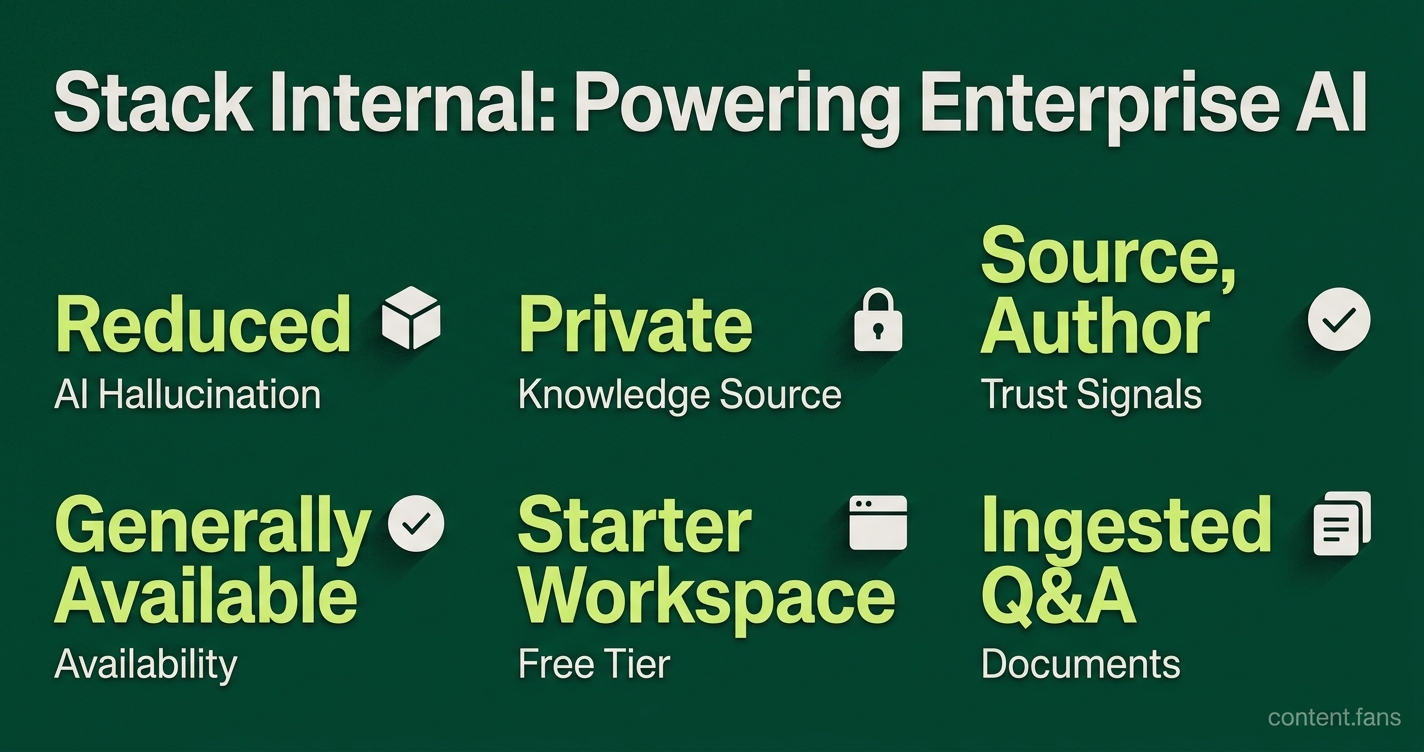
The platform's Ingestion feature is now generally available, allowing organizations to convert existing documents into structured Q&A formats with full version history. Key enterprise governance features, including role-based permissions, identity-aware data boundaries, and comprehensive audit logs, were added in a subsequent update, as detailed in the latest product releases. To encourage adoption, a free Starter workspace is available, letting teams pilot the system with up to three knowledge sources.
Signals of market take-up
Early signs suggest growing market adoption. Stack Internal is now officially labeled "generally available," and its free tier provides access to the same enterprise-grade MCP server and REST API used in production environments. Furthermore, third-party reports indicate integrations with developer coding assistants, suggesting its use is expanding beyond simple search into complex developer workflows. However, Stack Overflow has not yet released official customer counts.
How the trust layer works
The platform's trust layer automatically attaches metadata to every AI-generated response, including the source document, the author, and a calculated trust score. To address knowledge gaps, planned validation workflows will route unanswered or low-confidence questions to internal subject matter experts for review. This human-in-the-loop process is considered essential, as even a significant reduction in AI hallucinations leaves residual risk that is unacceptable for many compliance-sensitive organizations.
Competitive context
Stack Internal competes in a crowded market with alternatives like Bloomfire, Guru, Confluence, and Notion, which typically focus on wiki or card-based formats. Its key differentiator is the native Q&A schema specifically tuned for technical and developer questions. While broader enterprise search tools like Glean and Microsoft 365 Copilot operate across more applications, they lack the familiar Stack Overflow format. This distinction may help secure adoption among engineering teams, though organizations seeking a single, all-encompassing search solution may prefer the larger platforms.
What to watch next
Future updates are expected to include automatic knowledge gap detection, expanded analytics, and platform-wide accessibility improvements. The timely delivery of these features could solidify Stack Internal's position as a central knowledge spine for retrieval-augmented generation (RAG) pipelines. In the meantime, prospective users can leverage the Starter workspace to evaluate the platform's ingestion quality, governance capabilities, and API performance within their own AI workflows.