
Every Consulting Unveils 60-Day AI Implementation Playbook for Executives
Serge Bulaev
Every Consulting has introduced a 60-day, five-step playbook to help executives put AI into use at their companies. The guide, created by Natalia Quintero, may help firms that have bought AI tools but are not yet seeing results, by focusing on people, processes, and governance. The plan suggests mapping workflows, choosing a project, setting goals, creating feedback loops, training staff, and reviewing progress over two months. Early reports suggest the approach has helped some companies cut down on work time and move from testing AI to using it daily. However, results may vary, and missing key steps could lead firms to fall back into unproductive experiments.

Every Consulting's 60-Day AI Implementation Playbook provides a direct framework for executives to translate AI investments into tangible business results. Created by partner Natalia Quintero, the guide helps companies struggling with AI returns by focusing on people, processes, and governance instead of technology debates. This method addresses the execution hurdles that cause many CEOs to see no measurable AI return, according to industry reports.
What the 60 day plan asks leaders to do
The 60-day playbook is a structured framework designed to move companies from experimental AI use toward more systematic implementation. It drives organizational change through a compressed timeline, compelling teams to select a high-impact pilot, define clear success metrics, build feedback loops, and establish governance within two months.
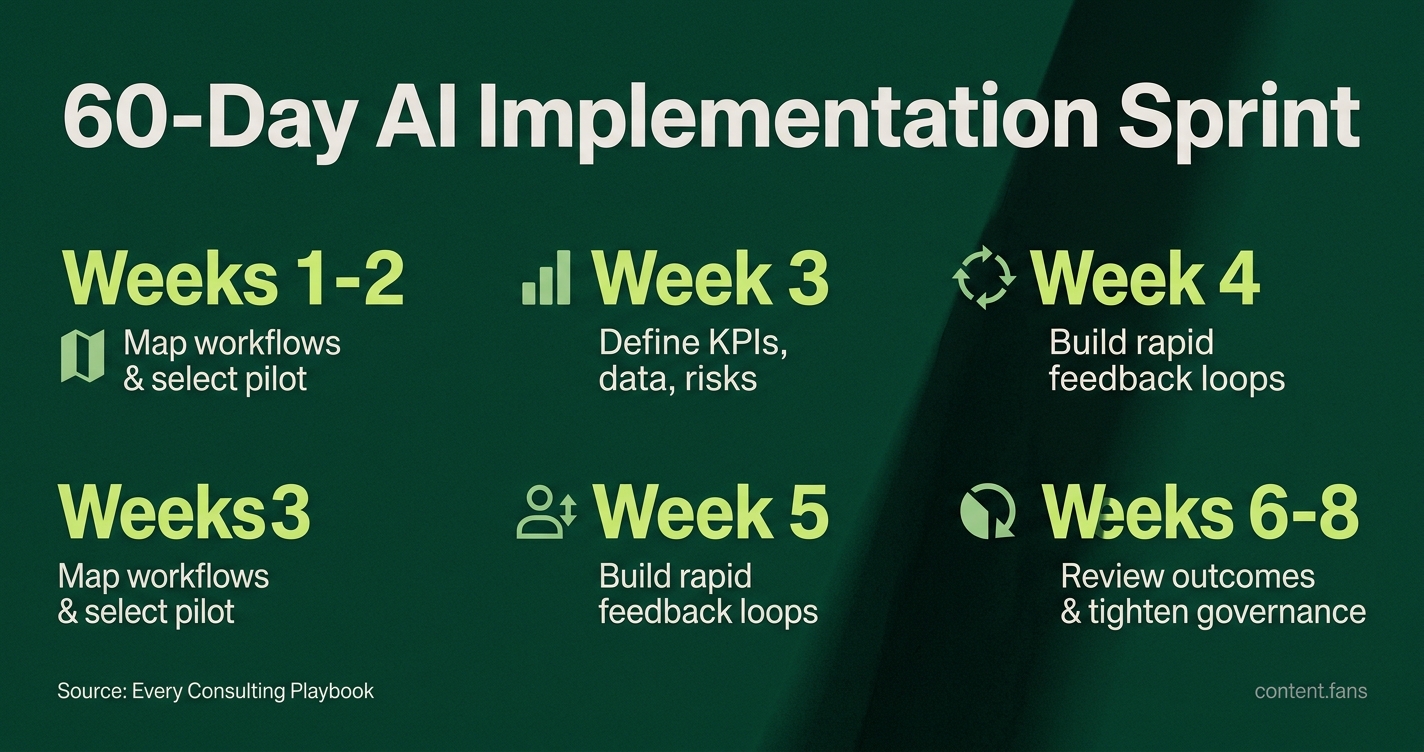
The playbook condenses this organizational change into a two-month sprint with five key checkpoints designed to move teams from discovery to scale:
- Weeks 1-2: Map key workflows and select one high-impact pilot project.
- Week 3: Define KPIs, data requirements, and risk classifications for the pilot.
- Week 4: Build rapid feedback loops with real-time telemetry.
- Week 5: Train end-users and name an internal AI champion to spearhead adoption.
- Weeks 6-8: Review outcomes, tighten governance, and decide on a wider rollout.
According to Quintero's team, the aggressive timeline accelerates learning cycles and prevents political inertia from stalling momentum.
Evidence from early adopters
Every reports that multiple organizations, including The New York Times and Walleye Capital, have implemented the method. In a notable case, a private-equity firm applying the playbook to its research workflow reportedly achieved significant time reductions in drafting investment memos (link). Another engineering client reportedly cleared a substantial backlog of work in a single afternoon.
Why executives turn to an organisational lens
Failed AI deployments frequently encounter recurring obstacles such as pilot project sprawl, unclear ROI, and weak data infrastructure. The playbook preempts these issues by emphasizing workflow discovery and governance, aligning with emerging best practices that include:
- A complete AI inventory.
- Risk-based controls linked to NIST or ISO frameworks.
- Continuous monitoring with drift alerts.
- Quarterly policy reviews.
- Clear executive ownership.
Real-time feedback loops are critical, keeping governance from becoming a bottleneck by allowing teams to adjust prompts or permissions moments after a policy breach is detected.
Implementation signals to watch
Leaders who successfully follow the guide consistently see three key operational markers emerge:
- At least one empowered AI champion embedded within the business unit.
- A dashboard that directly ties model output to key metrics like margin, cycle time, or cost.
- A governance committee that meets before day 60 to authorize scaling the pilot or shutting it down.
Firms that miss these markers often revert to scattered, low-value experiments. This outcome aligns with PwC's observation that most AI budgets flow to customer-facing work, while higher-payback back-office automations remain unfunded.
By framing AI adoption as an organizational redesign with strict milestones, the 60-day playbook offers executives a measurable way to convert enthusiasm into operational change without waiting for the perfect model.