
European Banks to Cut 212,000 Jobs by 2030 as AI Expands
Serge Bulaev
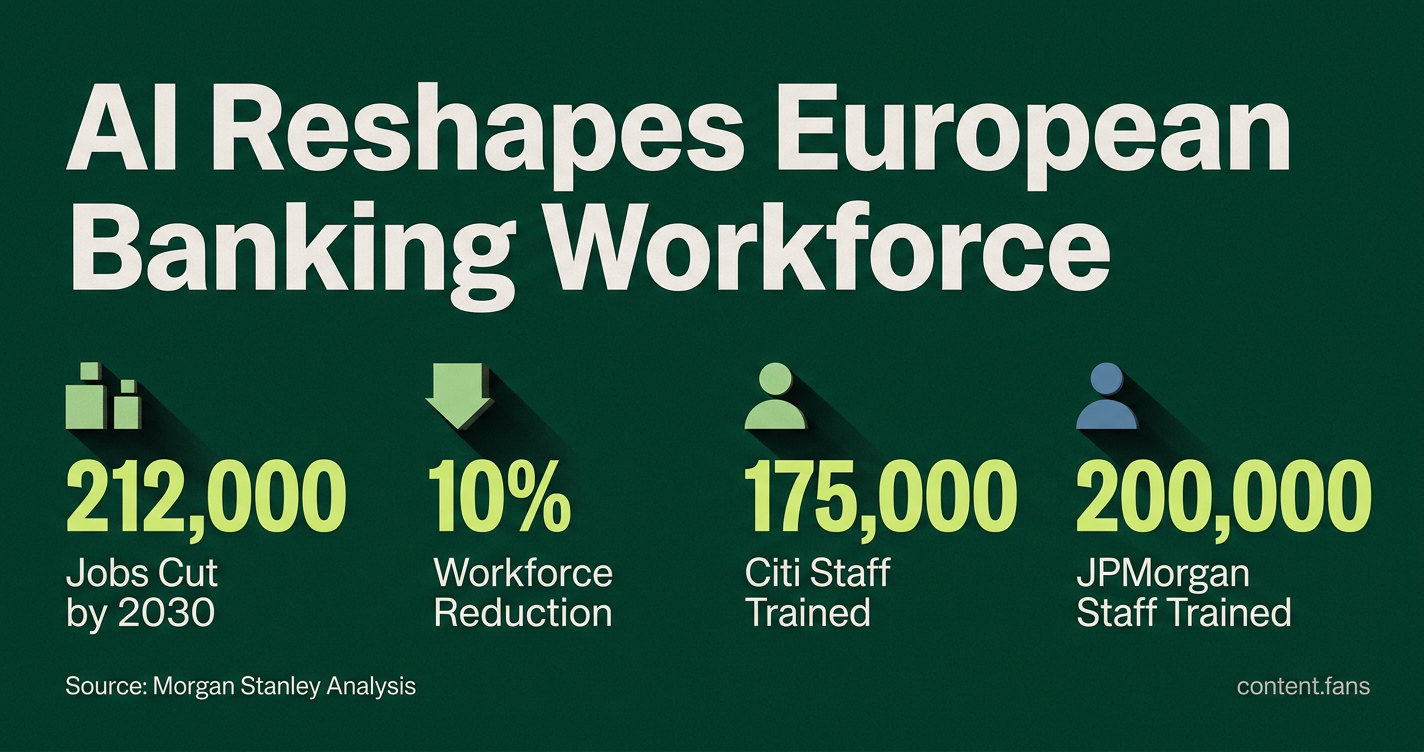
Analysts estimate that European banks may cut about 212,000 jobs, or 10 percent of their workforce, by 2030 due to the rise of AI. Most of the job losses are expected in office support and customer-service roles, while new jobs may emerge in areas like data and AI oversight. Studies suggest up to 600,000 people in the sector might need to move into different jobs. Some banks are training staff to work with AI, which suggests future jobs could focus more on managing and supervising AI tools. Overall, the numbers indicate fewer jobs in total but a shift toward new kinds of roles within banks.

Morgan Stanley's analysis, as reported by secondary coverage, projected about 200,000 job cuts in European banking by 2030, roughly 10% of the workforce; some later coverage rounded this to about 212,000 across 35 banks. This trend extends globally, with industry reports suggesting substantial additional job cuts within five years as AI automates rules-based operational and compliance tasks.
These projections signal a fundamental workforce pivot. While headcount in back-office and operational roles is expected to shrink, demand is simultaneously growing for specialists in data science, model risk management, and AI governance.
How many jobs are at risk?
Analyst projections indicate European financial services employment may decline by a significant portion by 2030. The most significant reductions are anticipated in office support, customer service, and other back-office functions, while new roles centered on technology and oversight are expected to emerge.
Supporting these trends, industry reports suggest a substantial net employment drop in Europe's financial sector by 2030. The analysis highlights that a significant number of employees may need to transition into entirely new roles within banking. These predictions align with recent layoff trends, where automation initiatives have been linked to substantial job cuts across major banks in recent years.
The roles most exposed to automation include:
- KYC verification and other compliance checks
- Loan processing and routine reporting
- Contact-center scripting
- Data entry for trade settlement
- Middle-office reconciliations
Conversely, roles requiring high-level judgment, regulatory accountability, and direct client interaction face the lowest risk of being eliminated, though they are still being reshaped by the integration of AI tools.
What regulators expect from firms
Global financial regulators are responding not by creating new AI-specific labor laws, but by applying existing frameworks for governance and accountability to AI systems. For instance, the UK is examining senior manager responsibility for AI-driven decisions, the US Treasury is pushing for clearer standards on model risk and data quality, and Singapore is developing mandatory AI risk-management guidelines. This regulatory focus inherently increases demand for human oversight, creating new roles in AI governance, model validation, and compliance.
Early signals inside large banks
Leading financial institutions are already implementing a dual strategy of targeted role reduction paired with broad workforce upskilling. Citigroup, for example, mandated AI training for 175,000 staff, while JPMorgan provided its proprietary LLM Suite and reskilling courses to nearly 200,000 employees. Similarly, Wells Fargo is training thousands of workers as it deploys generative AI pilots. These massive internal training programs signal a strategic investment in AI literacy, preparing the remaining workforce to supervise and leverage the new technology effectively.
What the numbers may indicate
Ultimately, the data points not to a simple story of job loss, but to a profound restructuring of the banking workforce. While headline job cuts in Europe and worldwide may reach substantial numbers, a parallel effort is underway to retrain a comparable number of employees. The future of bank staffing appears to be less about wholesale downsizing and more about a strategic reallocation of human expertise toward governance, ethics, and complex, high-judgment work that AI cannot replicate.