
EU bans duty-free imports under €150, adds €3 flat fee in 2026
Serge Bulaev
Starting July 1, 2026, the EU will remove the duty-free rule for imports under €150, and charge a flat €3 customs fee for each item up to that value. This may increase costs for sellers and force them to change how they price and deliver goods to EU customers. An extra €2 processing fee may be added later in 2026, raising the total charge to about €5 per item. Some experts suggest the new fees could make low-cost goods more expensive and might lead businesses to use EU warehouses instead of shipping each item separately. The €3 flat duty is set to last until July 2028, after which normal customs rates will return.

The EU's ban on duty-free imports under €150, effective 1 July 2026, introduces a mandatory €3 flat customs duty for every low-value item. This sweeping reform ends a decades-old exemption, forcing cross-border retailers to navigate increased landed costs and fundamentally rethink their pricing, fulfillment, and customs declaration strategies for the EU market.
What exactly changes in 2026
From July 1, 2026, the EU will eliminate the €150 duty-free threshold for imports, applying a new, temporary €3 flat customs duty per item. The €3 customs duty is a flat fee until July 2028. A separate €2 handling fee is expected to be introduced in autumn 2026, but this is an additional administrative cost, not a 'rise' in the customs duty rate.
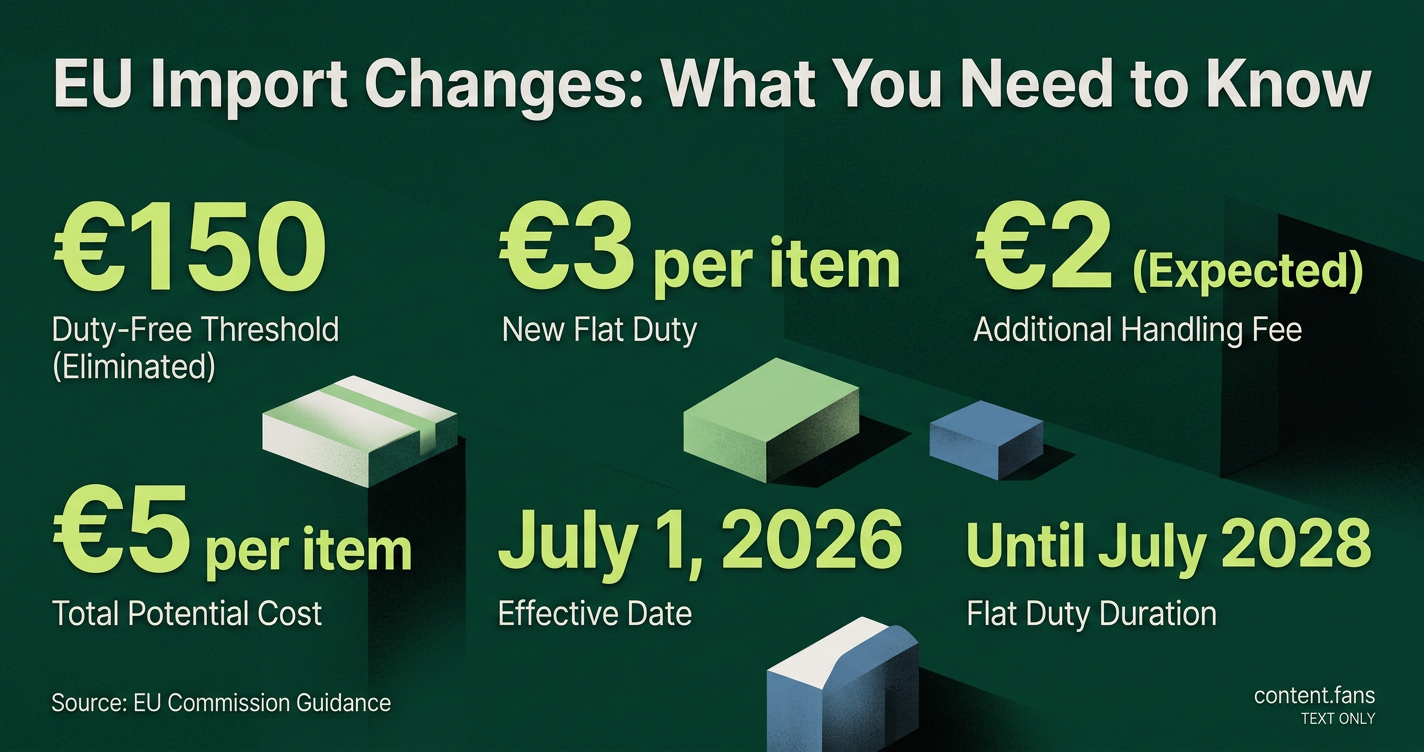
According to official European Commission guidance on the "temporary €3 customs duty" taxation-customs.ec.europa.eu, the €3 flat charge is a transitional measure. It will apply to all consignments valued under €150 until July 2028, at which point standard HS code-based duty rates will be reinstated. A separate €2 handling fee is expected to be introduced in autumn 2026, but the exact date is not definitively fixed. The total cost would be €5 (€3 duty + €2 fee) if applicable. VAT treatment remains separate; all imports have been subject to VAT since 2021, and sellers using the Import One-Stop Shop (IOSS) must account for the new duty separately from the VAT calculation.
Pricing pressure on low-ticket goods
The new duty disproportionately affects low-cost items. For low-value accessories or gadgets, the €3 fee can significantly inflate the landed cost, based on analysis of the new rules portless.com. Merchants with thin margins must now consider three core strategies:
- Absorb the duty, compressing profitability.
- Pass the cost to consumers through transparent, duty-inclusive pricing.
- Bundle multiple items to spread the fixed fee across a higher-value order.
Experts warn that failing to disclose duties at checkout will likely lead to increased cart abandonment and customer dissatisfaction when carriers demand payment upon delivery.
Logistics shift toward EU fulfilment centres
Applying a duty to every individual item makes direct-to-consumer shipping from outside the EU significantly more expensive and complex. With delays possible during customs clearance, the traditional express shipping model is under threat. This logistical friction is expected to accelerate a shift toward EU-based fulfillment centers. By shipping inventory in bulk to a European warehouse, brands pay standard duties once on a consolidated freight shipment, bypassing the per-item €3 fee on individual customer orders. While this model requires greater upfront investment and forecasting, it ensures a faster, more predictable delivery experience for the end consumer and simplifies returns.
Compliance considerations before July 2026
To mitigate disruption and ensure compliance, retailers shipping to the EU should consider the following actions:
- HS Code and Origin Accuracy: Map every SKU to its correct HS code and country of origin to ensure accurate declarations.
- IOSS Registration and DDP Shipping: Register for the Import One-Stop Shop (IOSS) and adopt a Delivery Duty Paid (DDP) model to settle all taxes and duties upfront.
- Landed Cost Recalculation: Analyze your product catalog to identify which SKUs become unprofitable after the €3 duty is applied.
- Logistics and Routing Review: Evaluate your shipping strategy and explore parcel consolidation or EU-based 3PL partners to minimize per-item fees.
- Checkout Transparency: Update your e-commerce checkout to display the duty as a clear, separate line item, preventing surprise costs for customers.
The merchant, not the consumer, is the legal debtor for this new customs duty. Incomplete or inaccurate declarations can result in fines, shipment holds, and carrier rejection. Marketplaces and logistics partners will mandate precise item-level data, including merchant identification, before accepting parcels for shipment to the EU.
Looking ahead to 2028
The €3 flat duty is reportedly a temporary measure designed to bridge the gap until further customs system developments. Industry reports suggest that by July 2028, this system may be replaced with automated calculations of commodity-specific duty rates. Retailers should use this transitional period to treat the €3 fee as a fixed operational cost while aligning their systems, pricing, and logistics to prepare for the evolving customs environment beyond 2028.