
EU AI Act Updates 2026 Compliance for Financial Firms
Serge Bulaev
The EU AI Act is setting new rules for banks and insurance companies, with strict requirements for high-risk AI models starting in August 2026. Use of AI in marketing and payments is increasing, especially for creating content and stopping fraud, but these tools need to follow new and old rules at the same time. Asset managers are using AI for portfolio and client analysis, and risk teams are testing new ways to monitor finances. There may be uncertainty about how the new rules fit with existing regulations, so companies are making detailed plans to manage this. Overall, these changes suggest that using AI in finance is becoming more about following rules than just experimenting.

The EU AI Act is already in force, with phased application: prohibited practices from 2 February 2025, most remaining obligations from 2 August 2026, and some high-risk systems embedded in regulated products from 2 August 2028. This landmark regulation is reshaping how banks, insurers, and asset managers govern artificial intelligence. This analysis highlights five key developments demonstrating where regulatory focus and industry investment are converging as the financial sector moves from AI experimentation to policy-driven implementation.
1. Europe Finalises Phased AI Act Compliance Timeline
As of the cited EU source, the Act becomes fully applicable on 2 August 2026 in general, but high-risk AI systems have phased deadlines, including 2 December 2027 for certain high-risk areas and 2 August 2028 for systems embedded into regulated products. Financial institutions using AI for credit scoring or insurance must complete conformity assessments, embed robust data governance and risk management controls, and ensure human oversight according to these phased timelines to avoid significant penalties.
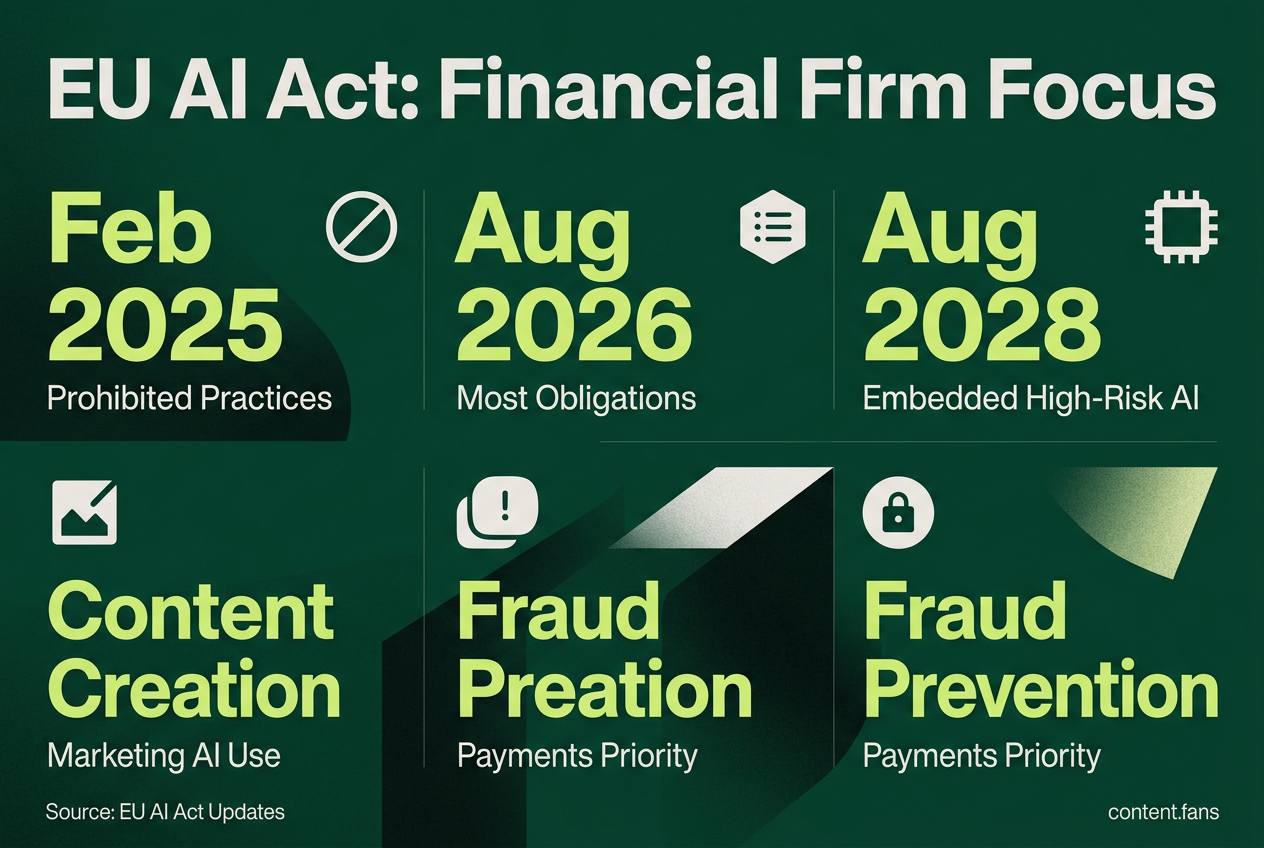
Credit scoring and insurance-related AI can fall under high-risk obligations, but the EU AI Act timeline is nuanced: most remaining obligations apply from 2 August 2026, while some high-risk AI systems embedded in regulated products are not fully applicable until 2 August 2028. According to the EU AI Act compliance brief, high-risk AI obligations include risk management, data governance, and human oversight requirements for providers and deployers, but the exact compliance deadline depends on the system category and the current phased EU AI Act timeline. Analysts note this creates a layered regime, requiring firms to integrate these new rules with existing standards like DORA and prudential guidelines.
2. Marketing Adopts Generative AI for Content Creation
According to industry reports, a significant portion of bank marketing teams are now using generative AI for content creation. An ABA Banking Journal survey identifies 'content creation' as the top use case. Insurers are following suit, using AI for text and image generation on web and social media, indicating that compliance-integrated content creation is becoming standard practice.
3. Payments Sector Prioritizes Real-Time Fraud Prevention
Payment providers are concentrating investments in two key areas: real-time fraud detection and automated accounts payable/receivable. Research from Citizens Bank highlights payment automation as a top productivity driver. Industry reports identify fraud prevention and transaction analysis as immediate opportunities, driven by the need to combat rising authorized push payment scams with more advanced risk models.
4. Asset Managers Leverage AI for Advanced Analytics
Asset managers are increasingly embedding AI into core operations, including portfolio construction, real-time risk monitoring, and client reporting, as noted in an EY paper on generative AI. Firms are using AI summarization to analyze earnings calls for timely insights, while risk teams are piloting continuous stress-testing dashboards aligned with regulatory liquidity requirements.
5. Compliance Develops Layered Governance Frameworks
Anticipating potential overlap between the AI Act and existing financial regulations, compliance teams are proactively developing unified governance playbooks. These frameworks aim to connect AI model lifecycle controls - from data lineage to human sign-off - with mandates like DORA. To prevent a last-minute scramble, institutions are prioritizing conformity assessments throughout 2025 ahead of the phased compliance deadlines.
Actionable Insights for Financial Practitioners:
* Prioritize Risk Assessment: Map all current and planned AI use cases against the AI Act's risk tiers immediately to identify compliance gaps and future bottlenecks.
* Integrate Compliance: Align AI models used in marketing and fraud detection with existing disclosure and accuracy rules to minimize future remediation costs.
* Monitor Regulatory Guidance: Stay informed on sector-specific guidance, as financial supervisors may issue new model-risk bulletins before the phased deadlines.
These developments confirm a significant shift in financial services: AI adoption is maturing from experimental pilots to strategic, policy-driven deployment. For firms, compliance with the EU AI Act is no longer an afterthought but the central factor shaping the future of artificial intelligence in finance.
What is the exact deadline for EU financial firms to be fully compliant with the AI Act's high-risk rules, and what happens on that date?
The EU AI Act has phased deadlines with most remaining obligations becoming enforceable from 2 August 2026, while some high-risk AI systems embedded in regulated products are not fully applicable until 2 August 2028. From these dates, every model classified as high-risk must have
- completed conformity assessments,
- embedded risk-management and data-governance controls,
- demonstrable human oversight, and
- documented accuracy and robustness tests.
Supervisors can begin on-site audits and penalty proceedings according to the phased timeline, so fines or business restrictions are possible immediately after the relevant deadline.
How does the AI Act interact with existing financial-sector regulation such as DORA or MiFID?
Rather than replacing sector rules, the AI Act adds a horizontal layer on top of them. A credit-decision engine, for example, must still meet prudential model-risk standards and DORA operational-resilience tests, but it must also satisfy the AI Act's data quality, transparency, and human-oversight obligations. Compliance teams are therefore building single governance frameworks where a single evidence package can serve both the AI Act and sector regulators, reducing regulatory fragmentation.
Which AI applications in finance are formally classed as "high-risk" under the Act?
The text explicitly lists creditworthiness assessment and life & health insurance pricing / underwriting as high-risk. If an AI system makes or materially influences decisions in these areas, it is captured even if it is only a component in a larger analytics stack. Marketing chatbots or internal document summarisation tools are generally not high-risk, but fraud detection models in payments can fall into the category if they directly trigger block-lists or payment refusals.
What concrete operational controls must be in place according to the phased timeline?
Firms need at least six core controls:
1. Conformity assessment (internal or via third-party)
2. Risk-management system covering the whole lifecycle
3. Data-governance ensuring training data is accurate, complete and bias-monitored
4. Technical documentation that regulators can audit
5. Human oversight with clear escalation paths
6. Robustness & accuracy testing under foreseeable stresses.
Many institutions are pre-certifying models in 2025 to leave room for remediation before the phased deadlines.
Can individual EU Member States create extra AI rules that override or duplicate the Act?
No. The AI Act is directly applicable EU law; national authorities cannot introduce conflicting requirements. What they can do is assign dedicated supervisory roles (for example, BaFin in Germany will act as competent authority for AI in credit institutions), and can issue administrative guidance on how inspections will be carried out. Financial firms therefore design one compliance program and apply it EU-wide, avoiding the regulatory patchwork that still characterises data-protection enforcement today.
Key links
- what financial firms must do now