
Equinix Unveils Distributed AI Strategy for 2026 Inference Demands
Serge Bulaev
Equinix has announced a new distributed AI strategy for 2026 that aims to move AI inference closer to where data is created, rather than focusing only on adding more computing power. The company suggests that reducing latency, handling data laws, and lowering bandwidth costs may now be more important than just scaling up hardware. Their plan includes new software for better network control and a physical expansion so customers can run AI models near users while still training in larger data centers. Equinix's tests show this approach may give faster responses and help companies manage data rules and costs. Experts say these steps could make Equinix a key place for companies to run AI close to their users while still using big cloud providers for training.

Equinix's Distributed AI strategy for 2026 prioritizes moving AI inference workloads closer to data sources, challenging the industry's focus on raw compute power. The colocation leader argues that as AI matures, factors like low latency, data sovereignty, and bandwidth efficiency become paramount for production-scale deployments. This strategic shift combines advanced software control planes with a significant physical footprint expansion, enabling customers to run inference at the edge while centralizing model training in power-dense regions.
The Shift to Distributed Inference
Equinix projects that by 2026, AI inference traffic will surpass training traffic, a critical inflection point for infrastructure strategy. The company asserts that scaling out - distributing infrastructure across multiple locations - is now as vital as scaling up compute power. This outlook is supported by industry analysis predicting inference will constitute a significant majority of AI workloads in the coming years. To address this, Equinix's "Build Bolder" initiative is funding construction projects across multiple markets, intending to substantially expand its capacity.
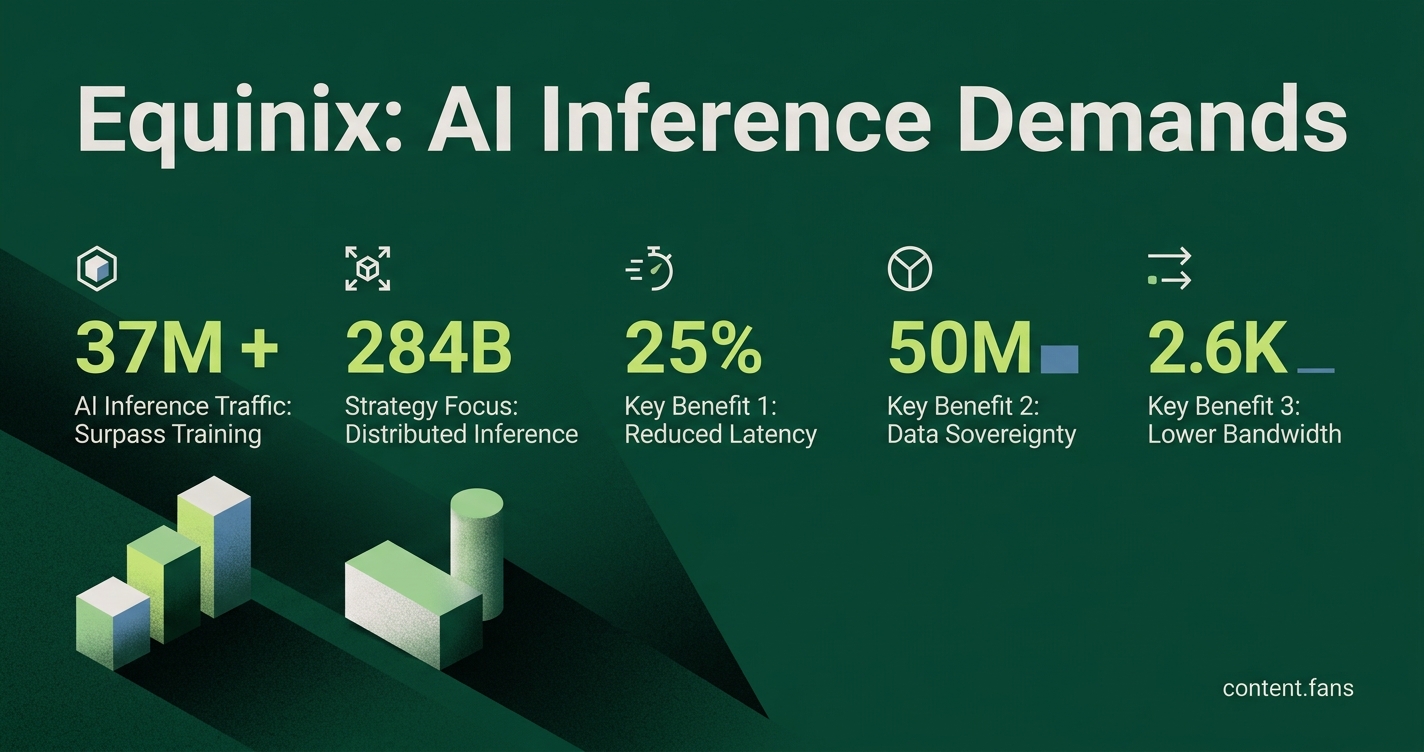
Equinix's distributed AI strategy focuses on decentralizing AI inference to edge locations. This approach is designed to reduce latency, comply with data sovereignty laws, and lower bandwidth costs by processing data closer to where it is generated, rather than sending it to centralized cloud data centers.
Core Elements of the Distributed AI Framework
- Fabric Intelligence Control Plane: An AI-driven software layer that enhances Equinix Fabric with real-time telemetry and automated routing. It optimizes multicloud and inference traffic, capable of maintaining low latency for synchronous inference tasks.
- Distributed AI Hub: A centralized platform connecting enterprises with hyperscalers and specialized GPU providers like CoreWeave and Crusoe. The Hub acts as a rendezvous point for compute, data, and partners, enforcing data governance policies across all tiers.
- Global Location Strategy: Equinix is leveraging its global presence, with top model providers already operating many network nodes within its facilities. CEO Adaire Fox-Martin attributes this growth to enterprises moving from pilots to full production, especially with agentic AI driving consistent, high-volume traffic.
Practical Implications for Enterprises
- Reduced Latency: By processing models locally instead of transmitting data, enterprises can achieve significantly improved response times for users in key regional metros, according to Equinix's internal benchmarks.
- Data Sovereignty and Compliance: The platform's integrated policy layer allows businesses to restrict regulated data within specific geographical boundaries, simplifying compliance with regulations like GDPR.
- Lower Operating Costs: Minimizing data egress across regions significantly reduces bandwidth expenses. Field reports suggest customers can achieve substantial cost reductions on traffic related to retrieval-augmented generation (RAG).
Near-Term Milestones
- Q1 2026: Launch of Fabric Intelligence and the first production-ready Distributed AI Hubs.
- Full-Year 2026 Financials: A revenue target of $10.144-$10.244 billion, supported by substantial capital expenditure for capacity expansion.
- Strategic Partnership Growth: Salesforce is expanding its private networking capabilities across multiple countries using Fabric Cloud Router, highlighting the growing demand for secure, low-latency multicloud AI solutions.
Industry experts view this strategy as positioning Equinix as the essential neutral ground for hybrid AI. It allows enterprises to leverage hyperscalers for large-scale training while deploying inference workloads proximate to users for optimal performance. By integrating network automation, robust governance, and high-density power, Equinix is defining the future role of colocation providers in an AI-driven world where inference is the dominant workload.
What is driving Equinix to move AI inference workloads to the edge?
Latency, sovereignty, and global scale.
By 2026, a significant portion of enterprise AI traffic will be inference, not training, and every millisecond matters for fraud-detection, robotics, or live recommendation engines. Placing GPU micro-pods inside Equinix metros dramatically cuts round-trip time and keeps regulated data inside the same country. The result is substantial latency improvements and lower cloud egress bills for customers.
How does the new Distributed AI Hub work?
It is a single software-defined room that bundles five things: compute islands, private high-speed links, native cloud on-ramps, data-sovereignty controls, and an open-card slot for any GPU cloud.
Customers pick a city, walk a cable to the Hub, and quickly have private Layer-3 reach to numerous clouds, including CoreWeave, Lambda, Crusoe, AWS, Azure, and GCP without back-hauling traffic to another continent.
Where are the first hubs live, and who is using them?
Multiple major markets are planned for Q1 2026. Many of the top foundation-model vendors and leading neoclouds are already engaged, while Fortune-500 manufacturers and banks are exploring inference islands for low-latency factory-floor or trading-desk applications.
Is this only for hyperscalers, or can a "normal" enterprise buy space?
Any Equinix IBX can be configured for distributed AI workloads. GPU islands can be paid monthly like cloud credits; no power feeds or chillers are shared with neighbours, so enterprises with different requirements can coexist in the same facility. Salesforce is already using Fabric Cloud Router to link AWS and Azure privately across multiple countries.
What happens after 2026 - will capacity keep up?
Equinix has multiple builds active across numerous markets and substantial capex planned for 2026, part of a "Build Bolder" target to significantly expand capacity.
Analysts model strong growth in AI colocation revenue through 2028, driven by inference, not training.