
Enterprises Target AI Spending, Route Tasks to Cheaper Models
Serge Bulaev
Enterprises are working to control AI costs by using cheaper models for simple tasks and adding rules to prevent overspending. Finance and engineering teams may disagree over expensive AI usage, but shared oversight and cost checks are becoming more common. Studies suggest that using mid-weight or local AI models can lower costs, and having clear cost dashboards may help teams stay productive. Research appears to show that careful cost monitoring does not always slow down developers, even if it sometimes feels that way. Overall, a balance between managing expenses and maintaining productivity seems to be emerging.

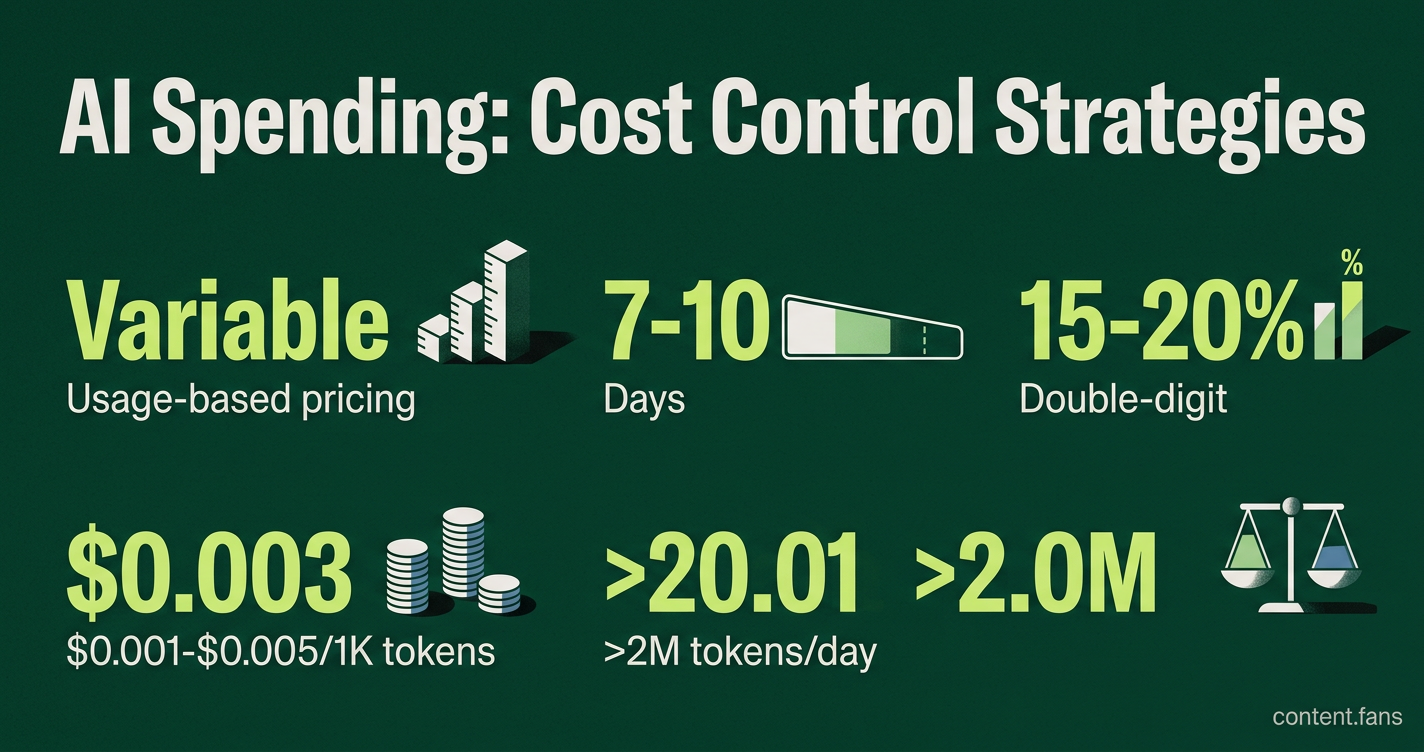
As enterprises target AI spending, a new tension is emerging between engineering teams eager to innovate and finance leaders watching token invoices climb. The conflict stems from usage-based pricing, where industry reports reveal significant cost spreads between cheap production models and premium reasoning models. This volatility, which can burn a monthly budget in days, has prompted firms like Uber and Meta to add guardrails and cap access to expensive tools.
The emerging solution is not to halt innovation but to instill discipline. By shifting to portfolio-level governance, implementing smart model-routing, and providing transparent cost dashboards, organizations are finding a balance. They are proving that cost control and developer productivity are not mutually exclusive goals.
Why Budgets Tighten After Successful AI Pilots
After initial successes, finance and technology groups are implementing shared governance to manage the unpredictable costs of production AI. Industry analyses highlight three pillars for this new approach: tying spend to measurable outcomes, enforcing continuous monitoring, and funding the entire project lifecycle, including maintenance and retraining. This shifts budgeting from one-off projects to holistic portfolio oversight.
The primary driver for tightening AI budgets is the shift from fixed-cost pilots to variable, usage-based production models. A single unchecked service can exhaust a monthly budget in days due to massive price differences between models, forcing finance teams to implement stricter, portfolio-level governance for predictability.
Implementing Controls Without Stifling Developer Velocity
Effective cost programs embed checkpoints directly into MLOps pipelines, exposing cost-per-model and cost-per-request alongside performance metrics like accuracy and latency. According to Mavvrik, this transparency helps curb "token maxing" - the tendency for teams to default to the newest, most expensive model when a lighter one would suffice.
Common controls that maintain developer speed include:
- Routing simple tasks to cheaper, mid-weight models
- Enabling caching layers to reduce redundant prompts
- Ring-fencing an "innovation budget" for pure experimentation
- Automating alerts when token consumption exceeds forecasts
Taming Variable Spend with Mid-Weight and Local Models
Vendors now offer a range of mid-weight and open-weight models that deliver strong performance for common tasks like summarization and retrieval-augmented generation. For lower-volume workloads, mid-weight API models often provide the best time-to-value. A cited 2026-style guide says the break-even point is typically above 2 million tokens per day, with self-hosted costs of about $0.001-$0.005 per 1K tokens at scale.
Data from Menlo Ventures confirms that open-weight models retain double-digit enterprise share, showing cost is already a key factor in model selection. Furthermore, many organizations report efficiency gains from AI, implying that disciplined governance can coexist with productivity.
Viewing Governance as a Productivity Feature
While developers often worry that cost checkpoints will slow them down, early evidence suggests a perception gap. Industry research indicates that engineers may feel faster using top-tier models but can actually be slower on certain tasks. This highlights an opportunity for improvement. By using transparent dashboards and automated routing, enterprises can enhance both budget adherence and genuine developer throughput, creating a system where governance actively boosts productivity.
A Practical First Step to Avoid AI Budget Overruns
To gain control this quarter, create an AI cost taxonomy and apply it to every active project. Break spending into key categories such as training, inference, data platform, networking, and change-management - commonly recommended buckets in AI FinOps approaches. Once engineers can see cost-per-prompt in the same dashboard where they monitor latency and accuracy, the organization empowers engineering-led cost control before the CFO has to impose top-down limits.