
Enterprises Face 5 Big Roadblocks Adopting Agentic AI Workflows
Serge Bulaev
Enterprises may face big challenges when trying to use agentic AI for automating workflows instead of using many single-user apps. Experts suggest that the main difficulties are not the AI models themselves, but issues with integration, control, and changing how people work. Many pilot projects stall because of problems with connecting to old systems, missing audit trails, unclear controls, and vendor lock-in. Successful adoption seems to need careful planning for both technology and organization, such as clear rules, secure integrations, and staff training. If these steps are followed, enterprises might be able to move to more efficient, automated workflows with less risk.

Enterprises are increasingly exploring the shift from seat-based SaaS to automated workflow-execution platforms. However, successfully adopting agentic AI workflows involves a complex blend of technology, governance, and organizational change. This transition promises to reduce licensing costs and boost efficiency by having AI systems execute entire processes. Yet experts warn that while AI model capability is advancing rapidly, the primary roadblocks are integration, governance, and company culture.
Parallel readiness tracks: architecture and organization
Industry analysis suggests that operational readiness, not raw AI power, is the key to success. Before pilots begin, teams must address fragmented workflows and establish real-time integration. This requires a two-track approach: preparing the technical architecture with API gateways and zero-trust security, and readying the organization with clear approval chains, policy ownership, and training for human oversight.
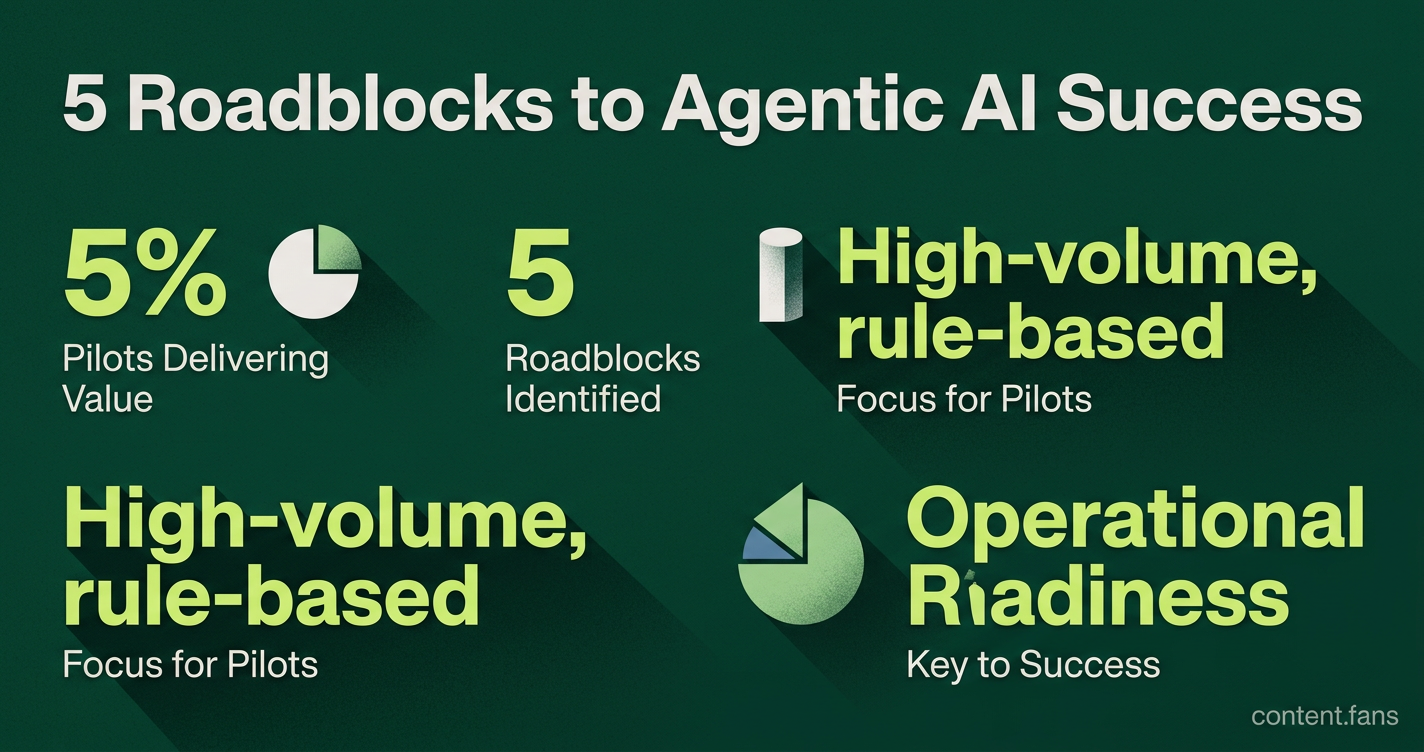
Enterprises adopting agentic AI face significant hurdles beyond the models themselves. Key challenges include integrating with legacy systems, ensuring robust governance and audit trails, managing organizational change, and avoiding vendor lock-in. Successful adoption requires a strategic plan that addresses both technical architecture and operational readiness from the outset.
Pilot selection templates
Ideal starting points for agentic AI pilots include high-volume, rule-based processes like customer support, contract review, or supply-chain dispatch. According to industry reports, companies have achieved significant automation gains in support operations and substantial cost savings in logistics operations. Focusing pilots on narrow processes with clear metrics like time or cost savings provides executives with the concrete evidence needed for broader investment.
Governance checkpoints to exit "pilot purgatory"
UiPath cites MIT's 2025 GenAI Divide report saying only 5% of integrated AI pilots are delivering millions in value. Analysts identify five common roadblocks that prevent projects from reaching production:
1. Legacy System Integration: Gaps in connectivity with existing enterprise systems.
2. Compliance and Audit: Lack of detailed audit logs for regulatory review.
3. Observability: Poor visibility into how AI agents make decisions.
4. Failure Handling: No clear process for when autonomous systems fail.
5. Vendor Lock-In: Platform choices that limit future flexibility with AI models.
Addressing these five blockers with clear policies during the pilot stage is critical for moving to production.
Vendor evaluation scorecard (sample criteria)
| Category | Key questions |
|---|---|
| Security & compliance | SOC 2? Encryption at rest/in flight? Granular RBAC? |
| Integration depth | Pre-built connectors for ERP, CRM, ITSM? Webhook support? |
| Orchestration | Multi-agent coordination, dependency handling, rollback safety? |
| Observability | Action logs, cost metrics, root-cause debugging tools? |
| Model flexibility | Multi-LLM support, BYO weights, swap without refactor? |
| Commercial fit | Transparent usage pricing, cost-per-task projection, SLA commitments? |
When evaluating vendors, procurement teams should prioritize security and deep integration over slick user interfaces. To cut through marketing hype, experts recommend using a standardized scorecard. Asking all vendors the same questions and demanding detailed reference architectures ensures a fact-based comparison.
Sequencing integration
A phased approach is crucial for secure integration. Best practices, outlined by firms like Nuvento and Virtido, recommend starting with read-only access for AI agents. Write privileges should only be granted incrementally, always gated by human approval. This sequenced rollout, combined with zero-trust security for agent actions and regular reviews, can significantly reduce security incidents compared to 'big bang' launches.
Change-management playbook
Successful organizational adoption depends on managing the human element of automation. While Gartner estimates 40% of enterprise apps will have embedded agents by 2026, many pilots still fail to scale. To bridge this gap, leading firms define clear roles by publishing RACI charts for automated decisions, training staff on how to audit agent performance, and aligning AI metrics with established business KPIs.
By aligning technical readiness, governance frameworks, and clear workforce communication from day one, enterprises can confidently transition from isolated seat-based software to coordinated workflow execution, capturing efficiency gains without increasing operational risk.
Q1: Why do most agentic AI pilots stall before reaching enterprise-wide production?
Because integration is significantly harder than the demo.
Recent deployments show that a significant number of enterprise AI pilots fail to scale according to industry research. The primary blocker is operational fit: legacy ERPs, fractured approval chains, and siloed data force teams into months of custom connector work and workflow redesign. Pilot success therefore depends on choosing a use-case with repeatable, rule-based steps and clear system touch-points - such as accounts-payable three-way match or customer-service ticket triage - where the integration surface is narrow and the ROI equation is simple.
Q2: What governance controls must be in place before an agent can act on live data?
Auditability, role-based access, and human-in-the-loop checkpoints are non-negotiable.
FloTorch, UiPath, and Nuvento all flag the same four pillars: end-to-end audit trails, RBAC, policy enforcement gates, and real-time monitoring dashboards. Enterprises that skip these discover too late that regulators and internal risk teams will not sign off on opaque autonomous execution. A practical starting point is to map each workflow step to a governance checklist: who can approve, what data the agent may read, which systems it can write to, and how every action is logged for post-mortem review.
Q3: How can procurement teams avoid vendor lock-in when evaluating agentic platforms?
Require LLM-agnostic orchestration and open APIs from day one.
Industry analysis warns that lock-in compounds at multiple layers - model, framework, runtime, and developer patterns. The safest way to future-proof is to:
- insist on multi-LLM support and the ability to bring your own model
- verify that all connectors and workflow definitions are exportable in standard formats
- demand a staged off-boarding test written into the contract
These checkpoints are now listed as must-haves in leading RFP templates for agentic AI procurement.
Q4: Which pilot use-cases are delivering measurable ROI?
Look at back-office processes with high volume and low variability.
According to industry reports, enterprises are capturing significant value in areas such as:
- Customer service: AI agents handling substantial volumes of customer conversations with significant efficiency gains
- Logistics: AI-powered shipment routing delivering substantial cost savings
- Document processing: AI agents reclaiming hundreds of hours monthly and reducing processing time significantly
Each of these pilots shared three traits: standardized data inputs, clear success metrics, and simple integration surfaces, proving that repeatability is the fastest path to provable ROI.
Q5: What does a practical 90-day migration plan look like?
Weeks 1-2: pick one repeatable workflow with an owner willing to co-sponsor and run a compliance pre-check.
Weeks 3-6: deploy a contained pilot in a non-production sandbox with full audit logging; measure baseline KPIs (cost per case, cycle time, error rate).
Weeks 7-10: expand to a limited production ring including human-in-the-loop approval gates; validate security and observability dashboards.
Weeks 11-12: draft the scale-out playbook - integration sequencing, change-management comms, and vendor contract renegotiation tied to throughput-based pricing rather than seat licenses.
Following this cadence lets teams prove value fast while keeping risk bounded, a pattern already used by major enterprises in their production deployments.