
Enterprises can cut LLM overruns with new procurement checklist
Serge Bulaev
The article suggests that using a careful checklist may help procurement teams check if LLM vendors are the right fit, safe and fairly priced before they sign contracts.

Early enterprise LLM agreements have led to significant cost overruns, with many invoices reportedly exceeding forecasts substantially. Procurement checklists help sourcing managers avoid these pitfalls by providing a disciplined framework to vet LLM vendors. This guide provides a comprehensive checklist for evaluating vendors on capability, security, and price before signing a contract.
Validate capability on your own data
Public LLM leaderboards are poor predictors of real-world enterprise performance. Testing vendors on redacted data samples from your specific workflow is supported by analysts at firms like Benchmarkit or Mavvrik. Implement blind scoring to prevent rater bias and demand full disclosure of the model's architecture (e.g., Transformer, Mixture of Experts), as different architectures excel at different tasks like code generation or summarization.
A robust evaluation process for LLM vendors moves beyond public benchmarks. It requires testing models against your specific workflows using redacted company data. This private evaluation, combined with blind scoring by internal raters, provides a clear view of a model's true performance and suitability for your enterprise.
Lock down data residency and usage
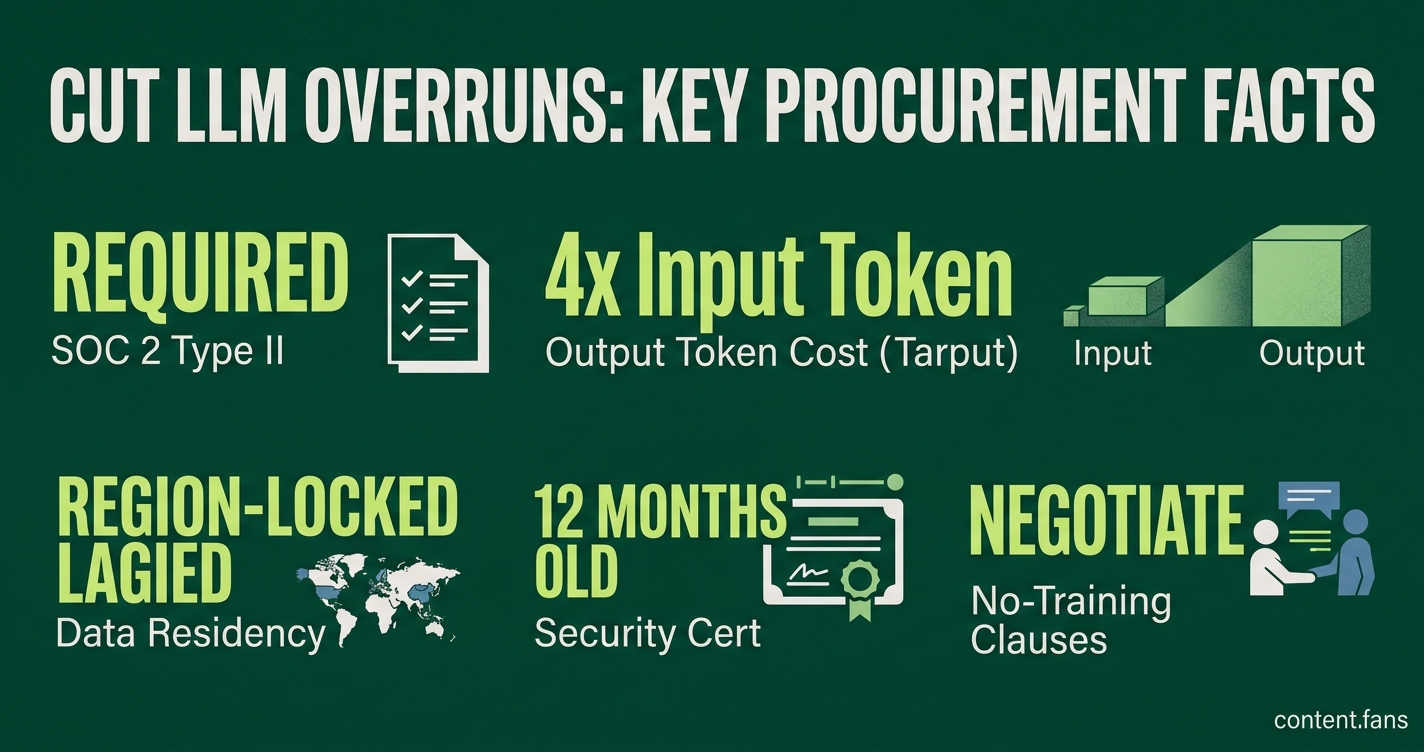
Data handling is a critical point of failure in production LLM rollouts. While most enterprise tiers offer zero-retention settings, these must be explicitly enabled. Contractually require vendors to provide region-locked data processing and prohibit the co-mingling of your data with other customers. Major providers including Azure OpenAI, Google Vertex AI, Anthropic, and OpenAI offer EU data residency options through specific regions or partnerships. Also, negotiate strict no-training clauses and a clear data deletion timeline upon contract termination, as missing data export paths can delay migrations for weeks.
Demand verifiable security and governance
A current SOC 2 Type II certificate, issued within the last 12 months, is the minimum security requirement. Beyond certifications, your contract must require version pinning to prevent automatic model updates from breaking production workflows. Define a clear escalation path for harmful outputs. The Cloud Security Alliance also advises annual third-party penetration tests by specialists in LLM jailbreaking. For regulated industries like healthcare or finance, map all sub-processors and secure appropriate data-processing addenda, such as Business Associate Agreements (BAAs).
Stress-test commercial terms at scale
While token-based pricing reflects compute usage, it can conceal significant hidden costs. Output tokens on flagship models can be four times more expensive than input tokens. Request a sample billing run using your projected token mix to forecast costs accurately. Scrutinize data egress fees, which can sometimes exceed the base service cost. Protect your budget by contractually capping mid-term price increases and securing early-exit clauses tied to service-level agreements (SLAs). For mission-critical systems, prioritize vendors with Series C funding or later.
Institute a quarterly review and escape hatch
The LLM landscape changes rapidly, so ongoing governance is crucial. Procurement teams should re-run private evaluations and update cost models quarterly. Implement a technical abstraction layer to enable seamless switching between LLM providers if performance or governance standards decline. To satisfy auditors, capture proofs of data deletion and maintain tamper-evident logs in your SIEM without storing raw user prompts.
Key Procurement Red Flags
Be vigilant for these immediate red flags during vendor evaluation:
- No written commitment to zero-retention or no-training data policies.
- SOC 2 Type II certification is more than 12 months old.
- Pricing that does not separately disclose input and output token costs.
- Undefined or unclear data egress fee schedules.
- Refusal to include a quarterly performance evaluation clause in the contract.
By systematically applying this procurement checklist, enterprises can confidently adopt high-value LLM technologies. This structured approach mitigates financial risk, closes compliance gaps, and prevents unexpected downtime, ensuring AI initiatives deliver on their promise without costly surprises.
How does the procurement checklist prevent cost surprises with LLMs?
The checklist ensures financial diligence by forcing a comprehensive audit of all pricing levers before deployment. Key contractual terms to secure include transparency on token rates versus subscription costs, including all hidden fees; a "billing dry run" using a sample workload to generate a forecast invoice; and a price-lock clause capping annual increases. As analysis shows token pricing can vary significantly based on traffic, a dry run is critical for preventing overruns.
Which data-handling items must appear in every LLM contract?
To mitigate data risk, every LLM contract should confirm "yes" to these six questions:
- Does the model operate in a dedicated, specified region (e.g., EU-only)?
- Is zero-retention for prompts and completions an available and enabled setting?
- Are all sub-processors named and bound to the same jurisdiction?
- Is a "no-training" clause included, preventing the vendor from using your data?
- Will the vendor provide tamper-evident audit logs upon request?
- Is there a defined data-deletion timeline (e.g., ≤ 30 days) after termination?
A "no" on any point warrants an immediate red-flag review. Exact contract wording for the EU AI Act can be found in guides from RMOK Legal or ZiaSign.
What certifications should procurement teams demand currently?
The minimum set of verifiable certifications and SLAs to demand from an LLM vendor includes:
- SOC 2 Type II issued within the past 12 months
- GDPR/HIPAA addendum for processing personal or health data
- ISO 27001 or FedRAMP Moderate for government and public-sector use
- Version-pinning SLA to lock a specific model revision for at least 180 days
The EU AI Act emphasizes risk classification, technical documentation, and audit rights as key compliance requirements for AI vendors.
How can the checklist shorten vendor selection timelines?
This checklist accelerates vendor selection by converting requirements into reusable artifacts. Create a two-page PDF for RFPs, an interactive spreadsheet for auto-scoring vendors, and a workshop deck to align stakeholders. Teams using a workshop format report faster short-listing cycles because it surfaces legal and security objections before, not after, extensive pilot programs.
Does the checklist cover post-deployment governance?
Yes, the checklist establishes an ongoing quarterly review process for post-deployment governance. This loop includes re-running your private evaluation with fresh real-world examples, refreshing your cost model against actual invoices, and confirming you receive model update notifications at least 14 days before any breaking changes are deployed. This process can prevent major budget issues and significant annual overruns.