
Enterprises adopt new models to govern always-on AI agents
Serge Bulaev
Enterprises are increasingly using always-on AI agents for tasks like emails and finance, which may raise new security and control questions. Treating each agent like an employee - with unique credentials and clear ownership - appears to be a key step for safety and traceability. Organizations might set rules so that low-risk tasks happen automatically, but actions with more risk require human approval. Reports suggest that strong logging, runtime checks, and clear data rules are needed to meet legal and compliance demands. By 2026, about 40% of enterprise apps may use these agents, so companies seem to be moving toward structured, layered oversight instead of ad hoc solutions.

As enterprises increasingly govern always-on AI agents by granting them persistent access to sensitive systems like email and finance APIs, the need for robust security frameworks has moved from theory to practice. This shift raises critical questions about identity management, runtime policy enforcement, and ultimate accountability when autonomous actions occur.
A leading strategy involves a risk-based operating model where each AI agent is treated as a distinct entity with its own credentials, activity logs, and designated owner, establishing clear lines of responsibility.
Why enterprises register agents like employees
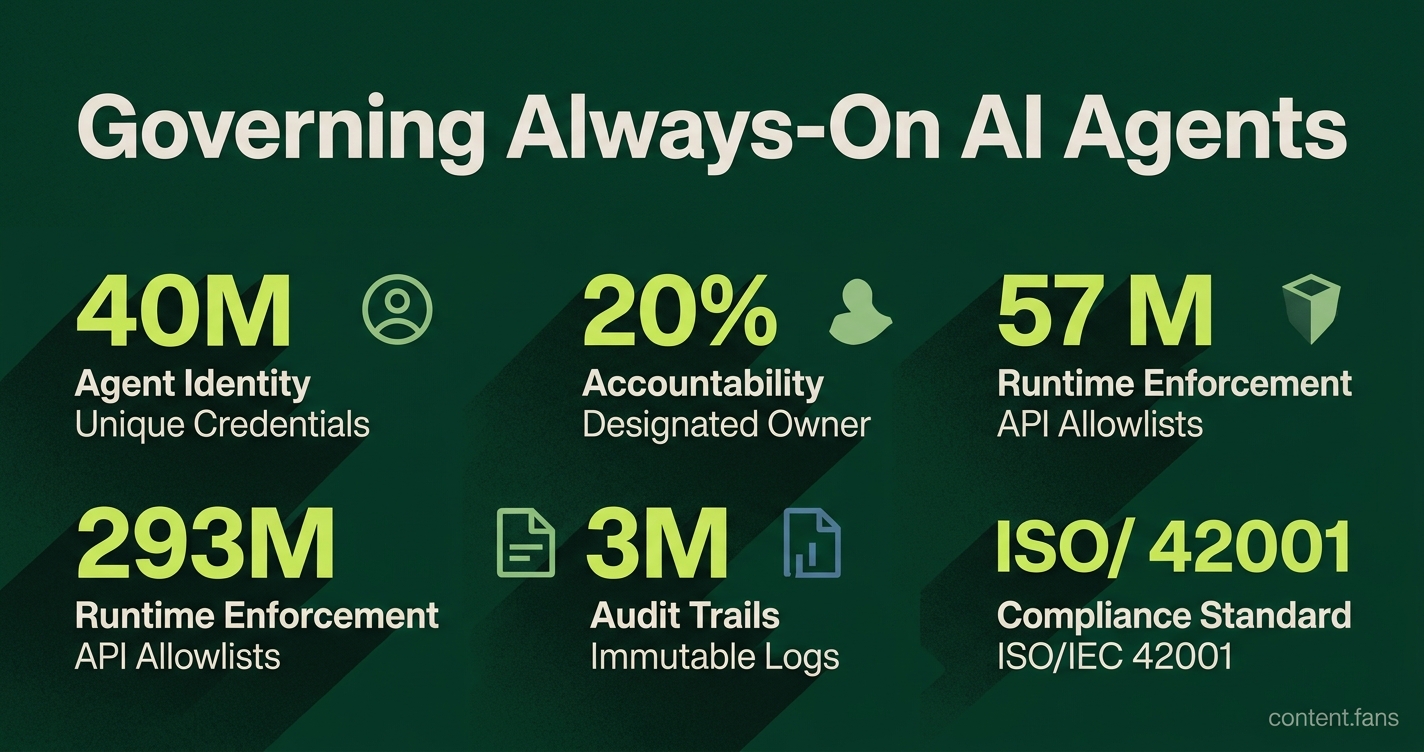
Establishing an agent as an independent digital identity is the foundational line of defense. For example, the Agentic Operating Model from the Berkeley Center for Management Review assigns accountability through a dedicated Governance layer. Leading governance frameworks mandate that each agent has unique credentials, defined permissions, and a listing in a central registry. This approach prevents the use of shared access keys, which can obscure traceability and hinder incident response.
Enterprises govern AI agents by assigning each one a unique identity, credentials, and owner, similar to a human employee. This model requires defining strict operational boundaries, enforcing policies at runtime, maintaining immutable audit logs, and clarifying liability through specific contract clauses to ensure safety and compliance.
Defining autonomy boundaries
Effective governance requires defining clear autonomy boundaries through tiered decision-making. While low-risk tasks like internal calendar updates can be automated, high-risk actions such as sending external emails or authorizing payments above a set threshold demand human approval. All actions must be logged with the agent ID, policy decision, and tool used, with any deviation from established patterns triggering an immediate escalation.
Runtime controls and audit trails
Policy enforcement must occur at runtime through technical controls like API allowlists and the rejection of unsanctioned tool usage. Creating immutable logs that include the agent's reasoning traces is also critical. By mapping these controls to frameworks like the NIST AI Risk Management Framework, organizations can streamline compliance with regulations such as the EU AI Act, demonstrating robust governance without overhauling existing policies.
Data residency and retention settings
Since persistent AI agents operate continuously on server-side infrastructure, data residency and retention rules are paramount. Standards like ISO/IEC 42001 classify data residency, retention, and deletion as formal management obligations. This means any configuration drift from these settings constitutes a potential compliance breach, not just a deviation from best practices.
Contract clauses shaping liability
Legal experts emphasize that the deploying organization typically retains liability for an agent's actions. To manage this risk, master service agreements should include specific clauses defining the agent's authority, establishing audit rights, and setting indemnities for errors like unauthorized payments or privacy breaches. Relying on "model updates" as a defense is unlikely to protect an enterprise from claims of negligence.
Quick reference checklist
- Register each agent with a designated owner, scope, and version.
- Assign unique credentials and prohibit the reuse of API keys.
- Establish clear autonomy tiers and approval thresholds for all actions.
- Implement runtime policy enforcement with allowlists and structured logs.
- Align controls with NIST AI RMF, ISO/IEC 42001, and the EU AI Act for audit readiness.
An enterprise transformation report suggests that a significant portion of enterprise applications will embed task-specific agents by late 2026. This rapid integration highlights the urgency for organizations to adopt structured, layered governance models over reactive, ad hoc solutions.