
Enterprises Adopt AI Governance Playbooks to Manage LLM Risks
Serge Bulaev
Enterprises are increasingly adopting AI governance playbooks to manage risks from large language models (LLMs), as they try to balance productivity and compliance. Only about 21 percent of firms reportedly had formal generative-AI policies by mid-2025, which suggests that many organizations may still need structured guidance. Best practices appear to include combining general standards like the NIST AI Risk Management Framework with specific controls for LLMs, such as prompt-injection defenses and artifact tracking. Playbooks often recommend careful review of generated code, control gates at each workflow step, and strong artifact management. Automation and visible governance may help organizations both improve compliance and make work easier for teams.

As enterprises weigh productivity gains against compliance risks, AI governance playbooks for LLM-driven workflows are becoming a boardroom priority. Best practices point to a layered model that merges foundational standards like the NIST AI RMF with LLM-specific controls such as prompt-injection defense and lineage tracking. Industry reports indicate that many surveyed firms still lack formal generative-AI policies, underscoring the urgent need for structured guidance.
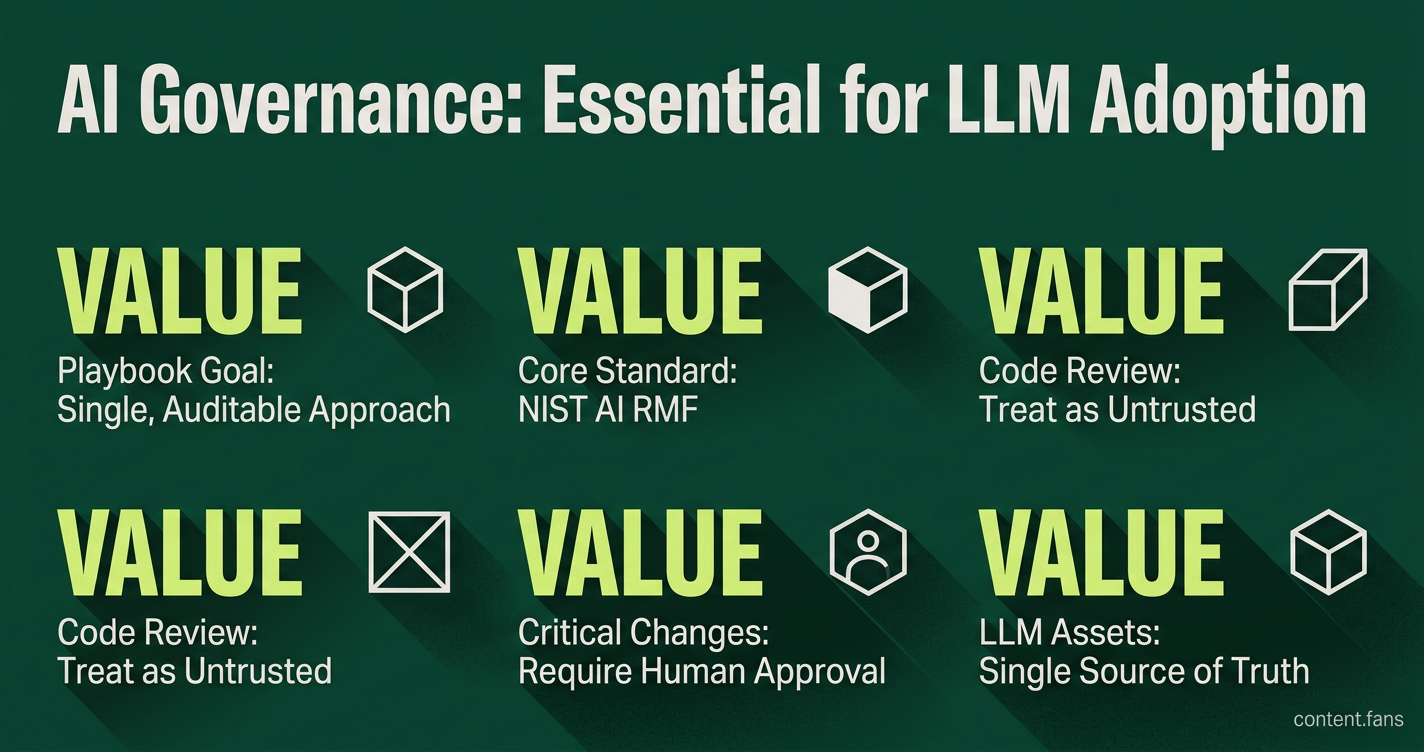
A practical playbook provides a single, auditable approach for security, legal, and engineering teams to share.
Core governance scaffolding
An AI governance playbook is a centralized document that establishes clear policies, roles, and controls for using large language models. It provides auditable procedures for risk assessment, security reviews, and operational monitoring, ensuring that teams can innovate with AI safely and in compliance with internal and external standards.
The core scaffolding should include:
- Policy and accountability - An AI governance council with delegated decision rights across legal, security, and engineering, as advised by EWSolutions.
- Risk assessment - A process mapped to the NIST AI RMF stages (Govern, Map, Measure, Manage).
- Technical controls - Safeguards covering code and IP, access management, bias testing, and adversarial red-teaming.
- Operational monitoring - Includes continuous drift detection, usage logging, and incident response runbooks.
Establishing a single source of truth for all LLM assets - including model versions, prompts, and applications - is crucial for simplifying this framework and automating evidence collection for audits.
Review checklists for code-generation outputs
Frameworks consistently emphasize the need for secure output review. Experts at Atlan recommend treating all AI-generated code as untrusted until it has been reviewed and scanned by a human. A practical review checklist should include:
- Confirming model version, prompt template, and context files in a header comment.
- Running static analysis and vulnerability scanning before any merge.
- Requiring human approval for changes touching authentication, payments, secrets, or production deployment.
- Logging all approvals and test results in an immutable system.
Integrating these checks into pull-request templates is an effective way to reduce friction for development teams while maintaining strict accountability.
Playbook gates across the Codex lifecycle
A robust playbook integrates control gates at each phase of the LLM lifecycle. These gates define clear checkpoints where teams must pause to test, validate, or escalate, ensuring no step is overlooked.
| Phase | Sample gate | Evidence captured |
|---|---|---|
| Context creation | Data classification review | Owner, data source, sensitivity tag |
| Prompt templating | Prompt-injection threat model | Template ID, reviewer sign-off |
| Generation | Automated bias and security tests | Test suite version, pass-fail log |
| Human review | Secure code review checklist | Approver ID, diff hash |
| Deployment | Risk tier approval | Environment, rollback plan |
| Drift monitoring | Performance and safety thresholds | Alert history, incident tickets |
This structured, gated workflow directly supports ISO/IEC 42001 certification goals by ensuring all artifacts, decisions, and incidents remain fully traceable.
Codex-native artifact management
Code, test cases, and documentation produced by LLMs like Codex must be treated as governed artifacts. Best practices emphasize immutable storage, signed provenance, SBOM generation, and automated retention policies. A minimal viable policy should mandate:
- All generated artifacts must be published to a central repository with cryptographic signatures.
- High-risk artifacts (e.g., those affecting regulated workloads) must trigger mandatory vulnerability scanning and be quarantined on CVE failure.
- Retention must follow class-based rules, such as eight years for production artifacts and six months for experimental ones.
This approach secures the supply chain provenance of every asset and prevents repository sprawl from ungoverned artifacts.
Continuous evidence and reporting
For governance to succeed, it must be visible and non-blocking. Executive dashboards that display metrics like policy coverage, incident closure times, and unauthorized usage rates allow leaders to monitor risk without impeding development velocity. Automating this metrics collection and reporting has been shown to increase internal satisfaction, as it frees teams from manual evidence gathering. This governance-as-code approach simultaneously improves compliance and the developer experience.
What exactly is inside an AI Governance Playbook for Codex adoption?
An enterprise-grade playbook bundles policies, roles, and operational checklists so that any team can adopt Codex or similar LLMs without reinventing controls.
Typical contents include:
- Named owners for model inventory, data context, and output review
- Approval gates before context files are exposed to the model
- Review checklists for generated code, covering IP, security, and correctness
- Step-by-step incident-response runbooks for hallucinations or leakage
- Detailed audit trails that capture prompts, outputs, and human overrides
How does the playbook move an organization up the AI maturity curve?
The playbook acts as a pre-condition for levels 3-5 of most maturity models: once repeatable governance is in place, the organization can confidently automate deployments, expand to multi-model pipelines, and enable self-service experimentation under policy guardrails.
Industry reports suggest that firms with formal LLM policies move significantly faster from pilot to scaled production because uncertainty and ad-hoc risk reviews are removed from every sprint cycle.
Which external standards should the playbook map to?
To stay future-proof, map each control to three anchor frameworks:
1. NIST AI RMF 1.0 - core risk process (Govern → Map → Measure → Manage)
2. NIST Generative AI Profile (AI 600-1) - LLM-specific threat modeling
3. ISO/IEC 42001:2023 - auditable management system for procurement and compliance
These references give auditors an immediate "why" for every policy and make third-party due-diligence questionnaires more streamlined.
How do regulated industries measure success of the playbook in practice?
Success is measured by faster, safer scaling rather than raw usage growth.
Key indicators include:
- Unauthorized usage rates typically drop substantially once policy and monitoring are automated
- Average time-to-approve a new LLM use case often falls from weeks to days after initial risk-tiering is complete
- Audit findings related to AI frequently decrease significantly within governance cycles
Banks, insurers, and healthcare providers cite audit-trail completeness and model drift detection as key metrics regulators now scrutinize.
What technical artifacts must be governed throughout the Codex-native lifecycle?
Treat every Codex-native artifact (prompt templates, context files, generated code snippets, fine-tuned weights) as a versioned, immutable asset:
- Register each artifact in a central catalog with SBOM and provenance metadata before promotion
- Enforce cryptographic signing so trust is computed at retrieval time, not assumed
- Apply retention and cleanup rules automatically: active, archived, deleted, or legal-hold
- Log every access, promotion, or rollback action to maintain a single source of truth for auditors
This single pattern, adopted from supply-chain security, reduces storage bloat and eliminates orphaned code that could later become a compliance risk.