
LLM, RAG, AI Agents: What Each Means for Your AI Architecture
Serge Bulaev
LLM, RAG, AI agent, and Agentic AI are different ways to build AI systems, and picking the right one depends on the needs of the job. An LLM is best for simple tasks where no outside information or citations are needed. RAG may work better when answers need to include current or special documents, but its accuracy depends on what is found during retrieval. AI agents can handle tasks that require using tools or doing several steps, and Agentic AI may help when many agents need to work together on complex tasks. There may not be one best choice, so teams might start simple and add more features as their needs grow.
Understanding the core differences between an LLM, RAG, AI Agents, and Agentic AI is critical for modern system design. While these concepts frequently appear in architecture discussions, teams often confuse a simple retrieval augmentation with a complex multi-agent framework. These distinctions are not merely academic; they directly impact performance targets, compliance strategies, and project budgets. This guide provides a practical framework for architects to determine whether a base model, a retrieval layer, an autonomous agent, or a network of agents is the right choice for their specific use case.
Four Abstractions, One Toolbox
- LLM (Large Language Model): A pretrained model that generates text based solely on its internal training data. It has no access to external tools or live information.
- RAG (Retrieval-Augmented Generation): An architecture that enhances an LLM by adding a retrieval pipeline. This allows the model to consult fresh, external documents at inference time to ground its answers in specific data.
- AI Agent: A system that uses an LLM as a reasoning engine to achieve a goal. It can plan steps, use tools (like APIs or functions), observe the outcomes, and iterate until the task is complete.
- Agentic AI: A more advanced system that orchestrates multiple, specialized AI agents. These agents collaborate, sharing state through a central coordinator to solve complex, multi-faceted problems.
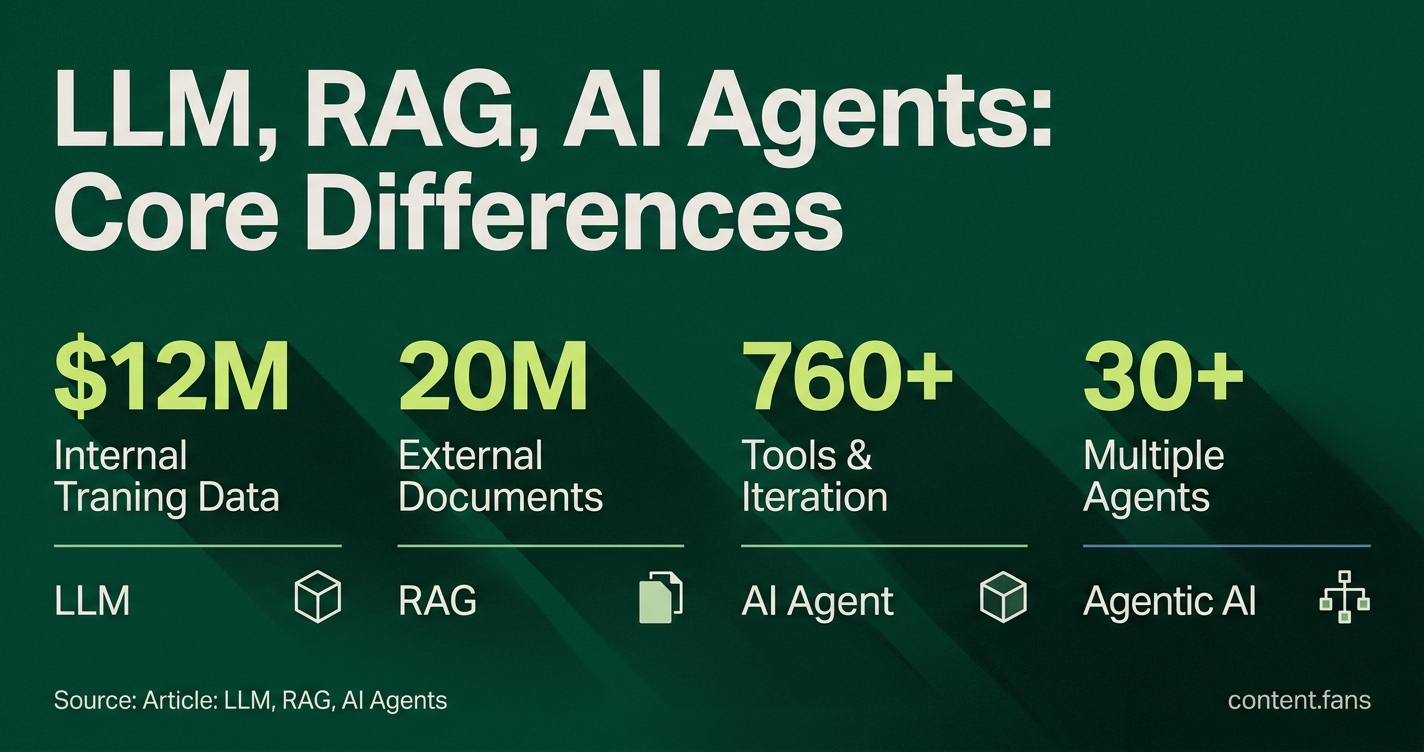
Each AI architecture offers a different level of capability. A standalone LLM provides general text generation, while RAG grounds responses in specific, up-to-date documents. An AI agent introduces autonomous task execution with tools, and Agentic AI orchestrates multiple agents for complex, collaborative workflows.
Choosing the Right Abstraction Level
- Start with an LLM for tasks involving stable domains where external citations are unnecessary.
- Implement RAG when responses must incorporate current or proprietary information. As noted in a Databricks enterprise guide, this approach achieves higher factual accuracy for dynamic knowledge by citing retrieved context in real time (Databricks).
- Upgrade to an AI Agent for tasks requiring multi-step reasoning, tool integration, or error handling. A common example is extracting data via a database function and then formatting the output.
- Adopt Agentic AI for complex workflows that mirror organizational roles, such as a planner agent collaborating with coder and tester agents within a single computational graph. Many frameworks are emerging for stateful, checkpointed agent graphs, with LangGraph being a popular choice.
The 2025-2026 Orchestration Market
The orchestration market is seeing consolidation around several primary code-first frameworks: LangGraph, CrewAI, the OpenAI Agents SDK, Microsoft's Agent Framework, and Google's ADK. This trend indicates a shift in enterprise priorities from flashy demos to production-ready features like durable state, robust observability, and strong governance. CrewAI is favored for its lightweight, role-based agent "crews," while LangChain is evolving into a broader LLM application toolkit rather than a specialized orchestration engine.
Tool Calling: Local Functions vs. MCP
Choosing how an agent calls tools involves a trade-off between performance and flexibility. Native function calling offers low latency and tight security by executing code within the application's boundaries. In contrast, MCP (Model Context Protocol), which can run over HTTP, sacrifices some speed for improved tool discovery and vendor neutrality. In a notable case, Anthropic demonstrated an MCP workflow for code execution that significantly reduced prompt tokens, showcasing cost savings for systems with large tool catalogs (code execution MCP workflow). Teams with a small, static toolset often prefer native calls, while those managing numerous, evolving tools should consider piloting MCP.
Quick Reference: Choosing Your Architecture
| Capability Required | Best Fit: LLM | Best Fit: RAG | Best Fit: Agent | Best Fit: Agentic AI |
|---|---|---|---|---|
| Citable, verifiable sources? | No | Yes | Yes | Yes |
| External tool integration? | No | Limited | Yes | Yes |
| Autonomous multi-step tasks? | No | No | Sometimes | Yes |
| Robust audit trail needs? | Basic logs | Source documents | Tool execution traces | Stateful graph checkpoints |
As this guidance shows, there is no single "best" architecture. The optimal approach is evolutionary. Teams can begin with a simple LLM implementation and strategically layer on retrieval, tool-calling, and multi-agent orchestration as system complexity and business requirements increase.
What is the difference between an LLM and a RAG system?
A Large Language Model (LLM) generates text from its internal parameters, which are fixed after training; it cannot access new information. In contrast, Retrieval-Augmented Generation (RAG) enhances an LLM by first retrieving relevant information from an external knowledge base (like a set of documents or a database). This retrieved context is then provided to the LLM to generate a response that is grounded in current, citable sources.
Crucially, while RAG improves factual grounding, it does not guarantee correctness. The final accuracy is highly dependent on the quality of the retrieval system - if it fetches irrelevant or incorrect information, the LLM's output will reflect that.
When should I use RAG vs. Fine-Tuning?
The choice between RAG and fine-tuning depends on your primary goal:
- Use RAG when your priority is factual accuracy with dynamic or proprietary data. It allows the model to provide current, citable answers that are easy to update.
- Use Fine-Tuning when you need to change the model's behavior, such as its tone, style, or ability to produce structured output. It is best for teaching skills, not facts.
For many enterprise applications, a hybrid approach is superior. As noted by sources like Databricks, combining both methods allows teams to achieve high factual accuracy via RAG while using fine-tuning to ensure behavioral consistency and proper formatting.
What distinguishes an AI Agent from an LLM with tool-calling?
While a simple tool-using LLM executes a function and returns a result in a single turn, an AI Agent operates within a persistent loop. An agent can maintain a goal, create a multi-step plan, execute tools, observe the outcomes, and adapt its plan until the objective is met.
This iterative cycle (plan → act → observe → replan) is the key differentiator. The LLM acts as the "brain" or reasoning engine, while the agent framework provides the memory and control flow for autonomous problem-solving. Agentic AI extends this concept by orchestrating multiple specialized agents to collaborate on a shared, complex goal.
How should I implement tool calling: Local Functions or MCP?
The primary distinction is location: local function calling executes code within your application, while MCP (Model Context Protocol) invokes tools remotely via a standardized protocol.
| Use Case | Recommended Approach | Rationale |
|---|---|---|
| Latency-critical, simple toolset | Local Function Calling | Offers the lowest overhead and a tighter security boundary. |
| Evolving, large tool ecosystem | MCP | Provides superior modularity, tool discovery, and vendor neutrality. |
| Multi-tenant SaaS with data isolation | Local Function Calling | Ensures greater control over security, authentication, and data access. |
While MCP introduces network overhead, it can dramatically reduce costs by keeping large tool definitions out of the prompt. As Anthropic reported, an MCP workflow significantly reduced prompt tokens in a code execution task. However, this comes at the cost of an expanded security surface.
What are the leading agent orchestration frameworks for 2025-2026?
For production-grade agentic systems, the market is converging on a few key frameworks. The focus has shifted from demos to enterprise-ready features like durable state, observability, and governance.
Leading Code-First Frameworks:
- LangGraph: Widely seen as a top choice for building stateful, auditable, and production-ready agentic workflows.
- CrewAI: Popular for its intuitive, role-based approach to creating multi-agent "crews."
- OpenAI Agents SDK: A managed framework for building agents within the OpenAI ecosystem, with strong native tool routing.
- Microsoft Agent Framework: The successor to AutoGen, this is Microsoft's unified path for agent development, especially within Azure.
- Google ADK: A strong contender for building agentic systems on the Google Cloud Platform.
Stateful orchestration is now a baseline requirement for production systems, enabling workflows to be checkpointed, resumed, and audited. This is why graph-based frameworks like LangGraph are frequently recommended. For teams seeking low-code solutions, platforms like n8n, Salesforce Agentforce, and Microsoft Copilot Studio offer viable alternatives to building from scratch.