
Eight Levels of AI Adoption Maps Current Generative AI Progress
Serge Bulaev
The Eight Levels of AI Adoption is a framework that helps teams see how advanced their use of generative AI might be, from simple chatbots to complex systems that manage other AI agents. The levels show how much freedom the AI has and how risky mistakes may be. Experts suggest that moving up the levels depends on trust, the cost of errors, and how well teams can watch what the AI does. There may not be strong proof of the value at each level, and some say the model mainly focuses on daily work rather than compliance. Reaching the highest level appears possible, but real-world use is still rare and may involve extra risks.

The Eight Levels of AI Adoption provides a crucial framework for teams to benchmark their generative AI implementation progress. This practical model outlines a progression from Level 1 (No AI) to Level 8 (Orchestration Mastery). The framework is descriptive, not prescriptive, grouping AI usage patterns by the level of autonomy granted and the potential cost of mistakes.
What each level tries to capture
The sequence of adoption, detailed in Every's article Where Do You Fall on the Eight Levels of AI Adoption?, includes No AI, Ask & Review, YOLO Mode, Squeezing the Code, Agent-First, Multiplexing, Orchestration Chaos, and Orchestration Mastery. This progression focuses on behavioral changes in daily work, not just tool selection, moving from "No AI" to full "Orchestration Mastery" as discussed in The Pragmatic Engineer episode.
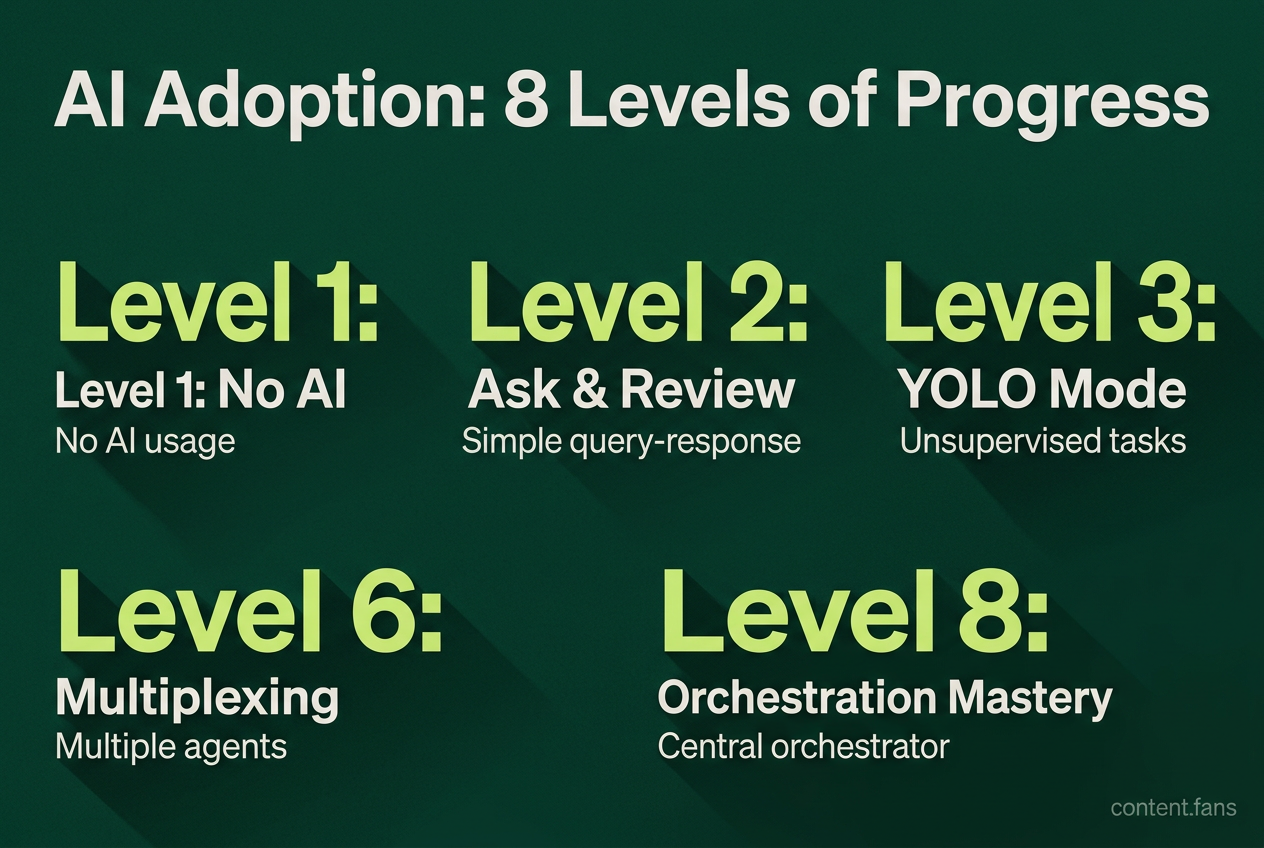
The eight levels represent an escalating scale of AI autonomy in workflows. They begin with no AI usage and simple query-response interactions, move through task-completing agents and autopilots, and culminate in complex systems where multi-agent teams are managed by a central orchestrator for continuous, proactive operations.
Why higher is not automatically better
Advancing through the levels is not always the best course of action. The model identifies three key factors to guide progression: trust, error cost, and observability. If the potential cost of an AI error is high or proper monitoring is absent, remaining at a lower, more supervised level is safer than advancing to higher autonomy levels.
- Trust: The AI must demonstrate consistent and accurate performance over time.
- Error Cost: The potential impact of a failure must be low, avoiding effects on customers or compliance.
- Observability: Tools must be in place to log, audit, and replay agent actions for clear oversight.
Only when teams can confidently affirm all three conditions should they experiment with the next level. This pragmatic, step-by-step approach contrasts with more governance-focused enterprise frameworks, like the Adobe inflection point guide, which prioritize extensive readiness audits and continuous monitoring.
How experts read the model
Industry experts find the framework valuable for its reflection of a key trend in software engineering: the shift from single-turn prompts toward multi-agent orchestration. Commentary emphasizes that the levels define how teams work and integrate AI into daily behaviors, rather than merely which tools they use.
Currently, the model's validation is largely informal, lacking peer-reviewed studies that quantify the value delivered at each level. Critics also note its workflow-centric focus, which differs from governance-oriented models like Sema4.ai's five-stage curve that prioritize policy, compliance, and enterprise-wide optimization over agent autonomy.
Where the ladder fits today
Real-world examples of the highest levels are still emerging across various industries. While vendor case studies describe applications in customer support triage and IT operations, they often include important caveats about security and the need for human oversight. This indicates that while the top levels are technically achievable, widespread and robust adoption continues to evolve.
Ultimately, the Eight Levels of AI Adoption framework provides an accessible and powerful language for teams to map their current capabilities and understand the risks associated with advancing. Organizations should use this model in conjunction with domain-specific governance checks before ceding greater control to AI agents.
What exactly are the eight levels of AI adoption?
The framework published by Every's consulting team spells out a simple 8-rung ladder:
- No AI - Traditional workflows without AI assistance
- Ask & Review - AI provides answers that you carefully review
- YOLO Mode - AI suggests and you often accept with minimal review
- Squeezing the Code - AI handles routine tasks while you focus on complex work
- Agent-First - AI agents complete full workflows with your oversight
- Multiplexing - Multiple AI agents work in parallel on different tasks
- Orchestration Chaos - Complex multi-agent systems with some coordination challenges
- Orchestration Mastery - Seamless meta-agent coordination of specialized agents 24/7
Every step increases autonomy and lowers human keystrokes, but also raises error cost and oversight needs.
How do I know when it is safe to move up a level?
The guide offers three green lights:
- Trust in the AI output is high - measured by spot-checks, user surveys and rollback rate.
- Cost of a mistake is low - if a wrong invoice or code commit would lose less than 30 min to fix, you can probably go one rung higher.
- Observability tools are in place - logs, version control and human-in-the-loop hooks so you can see the agent's chain of thought.
If any of the three is red, stay where you are. Higher is not automatically better - the framework treats Level 3 or 4 as the sweet spot for most finance and legal teams, while software teams often feel comfortable at Level 6.
What sample prompts help test the next level?
Every's article gives a ready-made prompt for each transition. Two favourites:
-
Testing Level 2 → 3
"Take the attached design spec and create a working React component that passes the Jest tests listed. Commit the code to the repo and open a pull request."
If you feel comfortable clicking "Merge" without line-by-line review, you have reached Level 3 behaviour. -
Testing Level 5 → 6
"Monitor my calendar and inbox, find external webinars that match our OKRs, register me, block travel time and add the event to Confluence afterwards."
The moment the assistant does all four steps before you notice, you are living at Level 6.
Full prompt deck is inside the framework page.
Are other companies already running Level 8 orchestrators?
According to industry reports, organizations are beginning to explore advanced orchestration capabilities in specific domains. Some case studies describe:
- Insurance companies testing central orchestrator systems that route photos to damage-assessment agents, text to fraud-scoring agents and repair quotes to pricing agents, with human review triggered when confidence scores fall below certain thresholds.
- E-commerce platforms piloting nightly supply-chain orchestration that pulls weather, customs and shipping data, re-routes containers and notifies customers, while incorporating compliance agents for regulatory changes.
Many enterprise applications are beginning to incorporate task-specific agents, though most deployments remain at intermediate levels due to high error costs in sectors like finance and healthcare.
How does the framework compare with other maturity models?
| Framework | Focus | Typical user | Top strength |
|---|---|---|---|
| Every 8-Level | Individual / team workflow | Product & engineering teams | Fast self-assessment and prompt recipes |
| Sema4.ai 5-Level | Enterprise governance | CIO & risk office | Board-level KPIs and policy gates |
| Adobe RAI | Responsible AI readiness | Compliance & HR | Ethics checklist baked into rollout |
Teams often layer models: use Every for sprint planning, Sema4.ai for enterprise sign-off and Adobe for regulatory audit.